
When one of our e-commerce clients discovered they owed €42,000 in unexpected VAT payments after their first major EU shipment, I realized how many businesses underestimate European VAT complexity. As founder of GeeseCargo with extensive EU import experience, I’ve learned that understanding VAT isn’t just about compliance—it’s crucial for accurate pricing, cash flow management, and competitive positioning in European markets.
VAT (Value Added Tax) applies to most goods imported into the EU at rates ranging from 17-27% depending on the member state. The tax is calculated on the CIF value (cost, insurance, and freight) plus any import duties. Businesses can typically recover VAT through various mechanisms, but proper registration, documentation, and timing are essential for compliance and cash flow optimization.
The EU’s VAT system creates both challenges and opportunities for importers. While it adds complexity and upfront costs, understanding the mechanisms enables strategic planning that can minimize financial impact and even create competitive advantages through proper VAT management.
What Are the Fundamental VAT Concepts for Importers?
Understanding basic VAT principles is essential before navigating the specific procedures and requirements for European imports.
How Is Import VAT Calculated?
VAT calculation follows a standardized formula across the EU: (Customs Value + Import Duties + Other Taxes) × VAT Rate. The customs value typically includes the product cost, transportation to the EU border, and insurance.
VAT rates vary significantly between member states. While the EU mandates a minimum standard rate of 15%, actual rates range from 17% in Luxembourg to 27% in Hungary, with reduced rates for specific products in most countries.
Customs value determination follows WTO valuation rules. The transaction value method is primary, using the price actually paid or payable for the goods with specific adjustments for certain costs and assists.
What’s the Difference Between Import VAT and Domestic VAT?
Import VAT applies when goods enter EU territory from outside. This tax is levied at the border and is generally recoverable for businesses registered for VAT in an EU member state.
Domestic VAT applies to sales within the EU. When businesses sell goods already within the EU, they charge VAT to their customers and remit it to tax authorities, minus any input VAT they’ve paid.
The VAT chain continues after importation. Once goods clear customs, subsequent sales within the EU trigger domestic VAT obligations, with each business in the chain collecting and remitting VAT.
What Are the VAT Payment and Reporting Procedures?
The mechanics of VAT payment, reporting, and recovery vary based on your business structure, volume, and chosen simplification schemes.
How Does Standard VAT Payment Work?
Immediate payment requirement applies at customs clearance. Under standard procedures, import VAT must be paid before goods are released from customs control, creating significant cash flow impacts.
Customs declaration submission triggers VAT assessment. The Single Administrative Document (SAD) used for customs declarations includes VAT calculation, with payment required upon submission or shortly after.
VAT recovery occurs through subsequent VAT returns. Businesses registered for VAT can reclaim paid import VAT in their periodic VAT returns, typically creating a cash flow timing difference rather than permanent cost.
What Simplified Procedures Reduce Cash Flow Impact?
Postponed VAT accounting (PVA) eliminates upfront cash outflow. Available in most EU countries, PVA allows businesses to account for import VAT on their VAT return rather than paying at border clearance.
Import One-Stop Shop (IOSS) simplifies e-commerce VAT. For distance sales under €150, IOSS allows suppliers to collect and remit VAT at point of sale rather than upon importation.
Fiscal representation requirements vary by member state. Non-EU businesses may need to appoint a fiscal representative to handle VAT compliance, though requirements are relaxing in many countries.
How Can Businesses Recover Import VAT?
VAT recovery mechanisms transform import VAT from a cost to a cash flow consideration, but proper procedures and documentation are essential.
What Are the Standard VAT Recovery Procedures?
VAT return submission is the primary recovery method. Businesses include import VAT paid in the input VAT section of their periodic VAT returns, offsetting it against output VAT collected on sales.
Documentation requirements include customs declarations and import VAT statements. The customs declaration (SAD) serves as the primary evidence for import VAT recovery, supplemented by import VAT payment confirmations.
Time limits for recovery claims vary by country. Most EU members allow VAT recovery for 3-5 years from the transaction date, though procedural requirements differ significantly between states.
What Special Recovery Schemes Exist?
Thirteenth Directive refunds allow non-EU business recovery. Businesses without EU establishment can reclaim VAT through special refund procedures, though documentation requirements are stringent and processing times lengthy.
Electronic refund systems streamline cross-border recovery. The EU-wide electronic refund system allows businesses to claim VAT refunds from other member states through their home country’s tax portal.
Quarterly versus monthly reporting affects recovery timing. Businesses with higher VAT volumes often qualify for monthly reporting, accelerating VAT recovery compared to standard quarterly reporting.
How Does E-Commerce VAT Special Regime Work?
The 2021 VAT e-commerce package dramatically changed VAT treatment for low-value goods, creating both simplification and compliance challenges.

What Is the Import One-Stop Shop (IOSS)?
IOSS applies to distance sales of goods not exceeding €150. The scheme allows suppliers to collect VAT at point of sale and remit it through a single electronic portal, eliminating VAT at importation.
Registration can be direct or through an intermediary. Non-EU businesses can register directly in one member state or use appointed intermediaries to handle IOSS compliance.
Customer transparency requirements mandate clear VAT display. IOSS participants must clearly state VAT amount to EU customers and ensure VAT is included in the price paid.
How Does the One-Stop Shop (OSS) Differ from IOSS?
OSS handles intra-EU distance sales and certain services. While IOSS covers imports, OSS simplifies VAT for cross-border sales within the EU for both EU and non-EU businesses.
Registration thresholds vary for EU versus non-EU businesses. EU businesses have country-specific thresholds before OSS mandatory, while non-EU businesses can use OSS voluntarily regardless of sales volume.
Quarterly reporting and payment through single return. Both OSS and IOSS use quarterly reporting cycles with single electronic submission and payment in the registration member state.
What Are the Country-Specific VAT Considerations?
While the EU VAT system is harmonized, significant national variations create compliance complexity for multi-country importers.
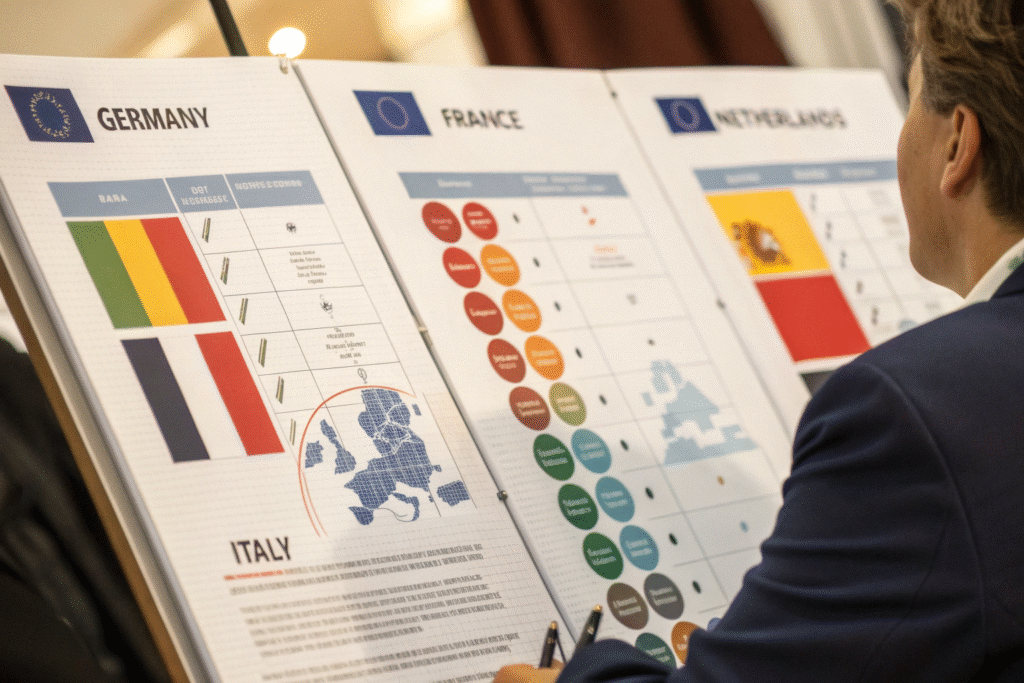
How Do VAT Rates and Structures Vary?
Standard VAT rates range from 17% to 27% across member states. Luxembourg (17%), Germany (19%), France (20%), and Hungary (27%) represent the range, with most countries clustering around 21-23%.
Reduced rates apply to specific product categories. Most countries have reduced rates for essentials like food, medicines, and books, though qualification criteria and rate levels vary significantly.
VAT exemptions and special schemes differ nationally. While the EU framework standardizes VAT principles, member states have discretion over exemptions, particularly for education, healthcare, and financial services.
What Procedural Differences Impact Importers?
Fiscal representation requirements are easing but still vary. Some countries still require formal fiscal representation for non-EU businesses, while others allow direct registration.
VAT return frequencies and deadlines differ. Some countries require monthly returns for all businesses, while others use turnover-based thresholds to determine reporting frequency.
Language requirements for documentation create compliance needs. While English is often accepted for customs, VAT authorities typically require documentation in the local language.
How Can Importers Optimize Their VAT Position?
Strategic VAT management can significantly reduce costs, improve cash flow, and create competitive advantages in European markets.
What Classification and Valuation Strategies Reduce VAT?
Correct HS code classification impacts both duty and VAT. Since VAT is calculated on customs value including duties, proper classification that minimizes duties also reduces VAT burden.
Customs valuation optimization legally reduces taxable base. Ensuring only mandatory elements are included in customs value and properly documenting deductible items can lower both duty and VAT liabilities.
Use of customs special procedures defers and potentially reduces VAT. Procedures like customs warehousing, inward processing, and temporary admission can postpone or eliminate VAT obligations.
How Can Cash Flow Be Improved Through VAT Management?
Postponed VAT accounting adoption eliminates import cash outflow. Businesses that qualify for and implement PVA avoid paying VAT months before recovering it through returns.
VAT group registration may provide cash flow benefits. In some countries, related companies can form VAT groups that enable internal transactions without VAT cash flow impact.
Return preparation efficiency accelerates recovery. Streamlining VAT return processes and documentation reduces the time between VAT payment and recovery.
Conclusion
EU VAT for imports represents a complex but manageable aspect of European market entry. The most successful importers treat VAT not as a simple tax compliance issue but as an integral component of their European business strategy, affecting pricing, cash flow, and competitive positioning.
At GeeseCargo, we’ve helped hundreds of clients navigate EU VAT complexity, with the most successful outcomes coming from businesses that integrate VAT considerations into their initial European expansion planning rather than treating it as an afterthought. The key is understanding that VAT management requires balancing compliance with financial optimization across multiple jurisdictions.
Begin your VAT planning by determining your optimal EU establishment structure, then select the appropriate VAT schemes for your business model, and finally implement processes that ensure ongoing compliance while maximizing cash flow efficiency. Remember that in EU imports, VAT isn’t just a cost—it’s a strategic business factor that, when managed properly, can contribute significantly to European success.