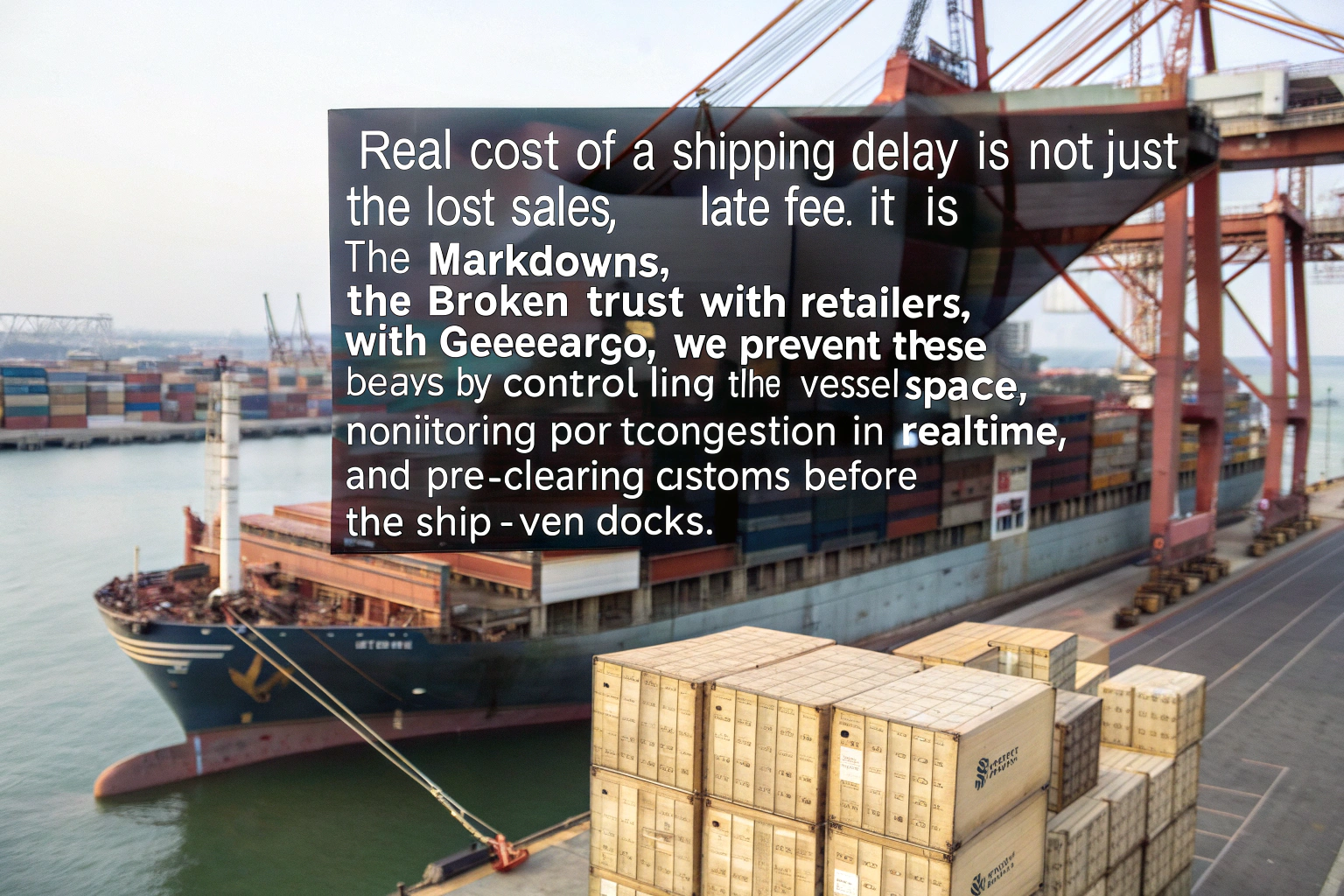
You wake up on a Monday morning. Your big retail order is supposed to arrive at your warehouse today. You check the tracking. The vessel is still sitting at anchor outside the Port of Los Angeles. The arrival date just pushed back by ten days. Your stomach drops. You have a promotional launch scheduled. You have empty shelves. You have a buyer threatening to cancel the purchase order. This is not just a delay. This is a cash flow crisis. And you are completely powerless to fix it.
The real cost of a shipping delay is not just the late fee. It is the lost sales, the markdowns, the broken trust with retailers, and the trapped working capital. At GeeseCargo, we prevent these delays by controlling the vessel space, monitoring the port congestion in real time, and pre-clearing customs before the ship even docks.
I have managed supply chains through port strikes, canal blockages, and pandemic chaos. I know which vessels run late. I know which terminals have a chassis shortage. I will break down the hidden financial damage a single delay causes. Then I will show you the systems we use to keep your container moving when everyone else’s stops. You can stop being a victim of the ocean schedule.
What Are the Hidden Financial Penalties of a Late Container?
The ocean carrier has a schedule. If the vessel is late, they do not pay you. They have force majeure clauses protecting them. You are the one who absorbs every dollar of the delay. The cost hits you from multiple directions at once. Some of these costs you see immediately. Others hide in your accounting until the end of the quarter.
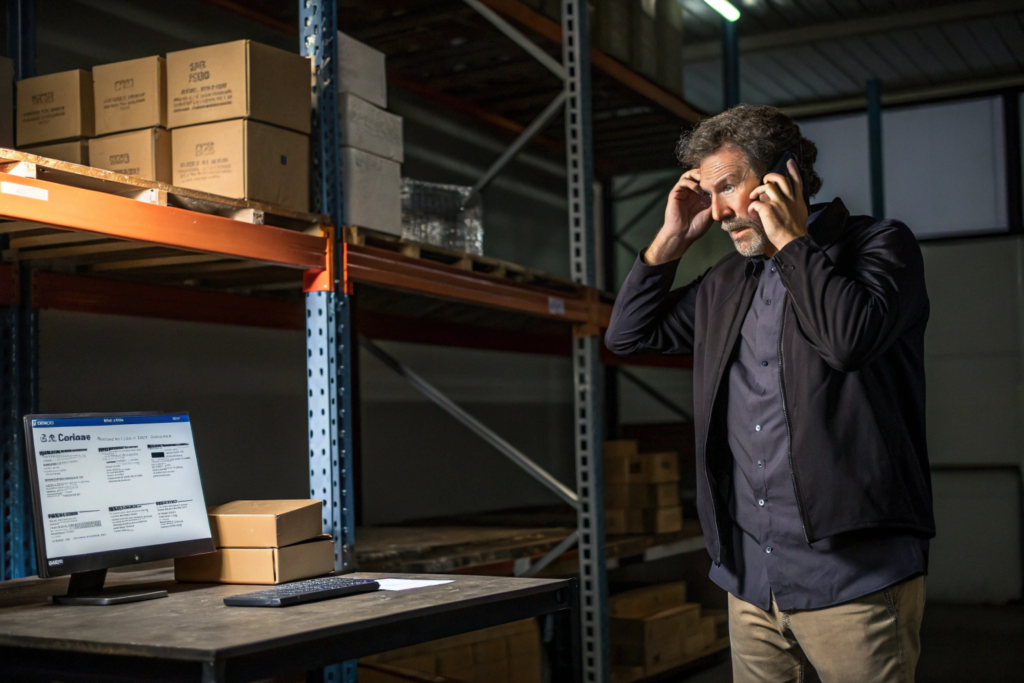
You might think the only cost is the wait. But the port charges you daily rent for your container sitting on their terminal. Your trucker charges you a dry run fee when they show up and the cargo is not ready. Your customer charges you a compliance violation for being late. These charges compound. A ten-day delay on one container can easily generate $2,000 in penalties before you even count the lost sales.
How Much Do Port Demurrage and Detention Really Cost You?
Demurrage is the rent you pay the terminal when your container sits there too long after discharge. Detention is the rent you pay the steamship line for keeping their container beyond the allowed free days. Standard free time is usually four working days for the port and seven days for the container. After that, the meter starts.
A typical demurrage charge runs $150 to $300 per day after the free period. Detention can be $100 to $175 per day. If a delay causes your container to sit for an extra week beyond the free time, you just added $1,400 to your freight bill. I have seen invoices where the demurrage and detention charges exceeded the original ocean freight. The worst part? The delay was not even the importer’s fault. The vessel was simply late. But the terminal operators do not care whose fault it is. The bill goes to the cargo owner.
Can a Shipping Delay Trigger Chargebacks from Your Retail Partners?
Absolutely. And this is the cost that truly hurts a brand. Big box retailers operate on strict delivery windows. Walmart, Target, and other major chains have compliance programs. If your container is late and you miss the delivery appointment, they fine you. The typical chargeback is 3% to 5% of the invoice value.
On a $50,000 shipment of clothing, a 3% chargeback is $1,500. You lose that money instantly. It comes right out of your profit. Even worse, if you are chronically late, the retailer reduces your shelf space. They treat you as an unreliable vendor. They buy more from your competitor. The long-term revenue loss from lost retail relationships dwarfs any single penalty fee. I work with fashion brands specifically to avoid this scenario. The delivery window is sacred.
How Does Port Congestion Turn a Small Delay into a Total Standstill?
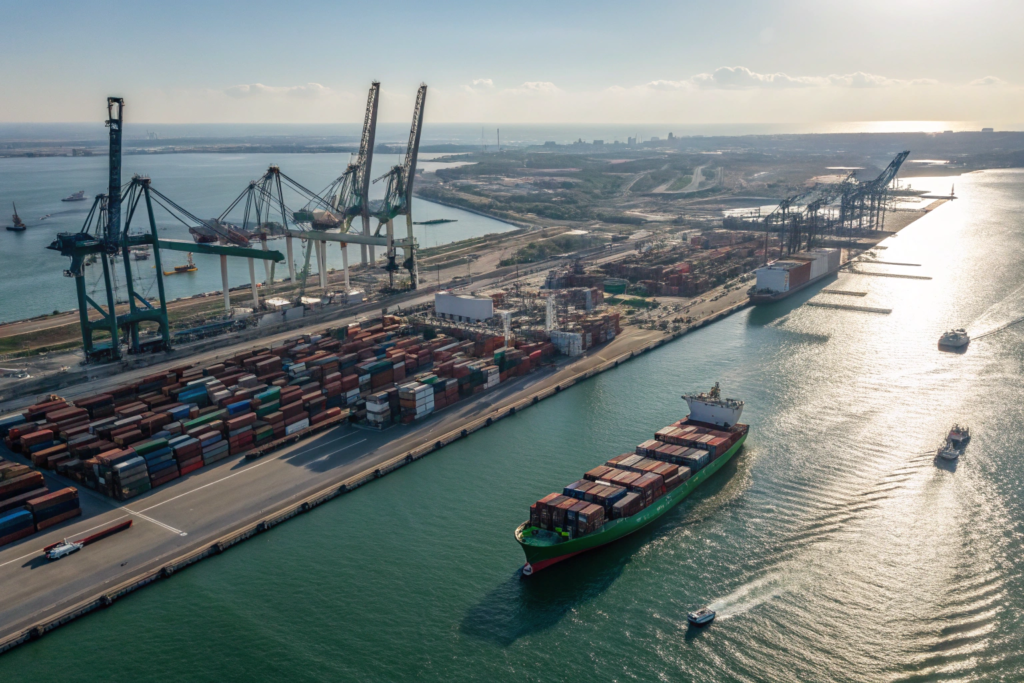
Port congestion is the monster under the bed for importers. A vessel arrives on time, but there is no berth. It anchors in the bay. It waits for five days. Then when it finally docks, there are not enough longshoremen to unload it. The container sits on the vessel for another two days. This happens regularly at major US gateways.
The standard transit time from Shanghai to Los Angeles is about 14 days on the water. But the total door-to-door time can easily double if the port is congested. You planned for 28 days total transit. It becomes 42 days. Your inventory forecast breaks. Your warehouse staff sits idle. You lose control of your business schedule. And most forwarders just shrug and say "port congestion." As if there is nothing anyone can do.
Why Does the West Coast Labor Situation Affect Your Delivery Dates?
The longshoremen union and the terminal operators negotiate contracts. When those negotiations break down, the work slows down. The cranes move slower. The shifts are shorter. The port throughput drops by 20% or more. You cannot predict the outcome of labor negotiations. But you can predict that there will be disruptions during a contract year.
We track the Pacific Maritime Association updates closely. When we see tension rising, we shift our cargo to alternative gateways. We might route your clothing shipment through the Port of Oakland or even up to Seattle-Tacoma. Yes, the inland trucking might cost a bit more. But the container will move. It will not sit on a vessel for two weeks burning your free time. We give you the option. "Do you want the standard LA route with risk, or the alternative route with certainty?" You make the call based on real information.
How Does GeeseCargo Use “Priority Discharge” to Skip the Queue?
We pay for a premium service at the terminal. It is called priority discharge or hot hatch cargo. We pay an extra fee, usually around $150 to $300 per container, to have your box discharged first. When the vessel docks, the crane pulls our containers before the general cargo. They are placed in a dedicated stack area with priority pickup.
This is not a secret. Any importer can request it. But most do not know it exists. Their forwarder never offers it. We do. For time-sensitive fashion shipments and seasonal gift orders, this service saves two to five days at the port. Those days are the difference between making the retailer delivery window and missing it. The $200 fee is cheaper than a 3% chargeback. This is the math I do for my clients every day.
Can a Delay in Customs Clearance Be Prevented Before the Ship Sails?
Customs clearance happens after the vessel docks, right? Wrong. Smart clearance happens before the vessel leaves the origin port. The US Customs and Border Protection system allows pre-filing. You can submit the entry documents five days before the vessel arrives. If there is a problem, you fix it while the ship is still on the water.
Most delays are not random. They are caused by paperwork problems. The commercial invoice has a vague description. The packing list does not match the invoice. The HTS code is flagged for anti-dumping review. These are preventable errors. But if you only submit the documents when the vessel arrives, the error causes a hold. The container sits in the exam area for a week. You pay storage. You pay exam fees. You lose your delivery window.
What Is an ISF Filing and How Does a Mistake Hold Your Cargo?
The Importer Security Filing, or "10+2" filing, must be submitted to US Customs at least 24 hours before the vessel loads in China. If the ISF is late, customs fines you $5,000. If the ISF is missing, they can refuse to unload your container. It sits on the vessel and goes back to Asia. This actually happens.
We file the ISF as soon as you give us the commercial invoice. We match the manufacturer name, the buyer name, and the origin code precisely. Our system checks for common errors, like a mismatch between the stuffing location and the port of loading. I have a dedicated team that does nothing but compliance filings. We treat the ISF filing as the critical mission it is. Not an afterthought.
How Does Pre-Clearance with CBP’s Simplified Entry Program Work?
We use the Simplified Entry program when speed is critical. We transmit the entry summary data early. CBP reviews it and sends back a "May Proceed" status before the vessel docks. The container is released instantly upon discharge. The trucker picks it up the same day.
To do this, the paperwork must be perfect. We verify every line item. We check for anti-dumping flags. We ensure the country of origin is documented. This is the value of experience. My staff knows which products trigger additional review. We preemptively include the documentation. We do not wait for customs to ask questions. We answer them before they are asked. This pre-clearance capability is why our DDP shipments consistently beat the industry average transit time.
How Does GeeseCargo’s Real-Time Monitoring Catch Problems Before You Feel Them?
You cannot fix a problem you do not know about. Most importers check their tracking link once a week. By the time they see the delay, it is too late to act. The container has already missed the transshipment connection. The free time has already expired. You need a forwarder who watches the shipment like a hawk watches the ground.
At GeeseCargo, every active shipment has an owner inside our company. That person checks the vessel’s GPS position daily. They check the terminal operating status at the destination. They check the estimated arrival time of the trucker. If a vessel falls behind schedule by more than six hours, an alert triggers. We do not wait for you to call us. We call you. "Ron, the vessel is delayed by a day. We have already pushed your truck appointment back 24 hours. Your delivery will be Wednesday instead of Tuesday. We have it under control."
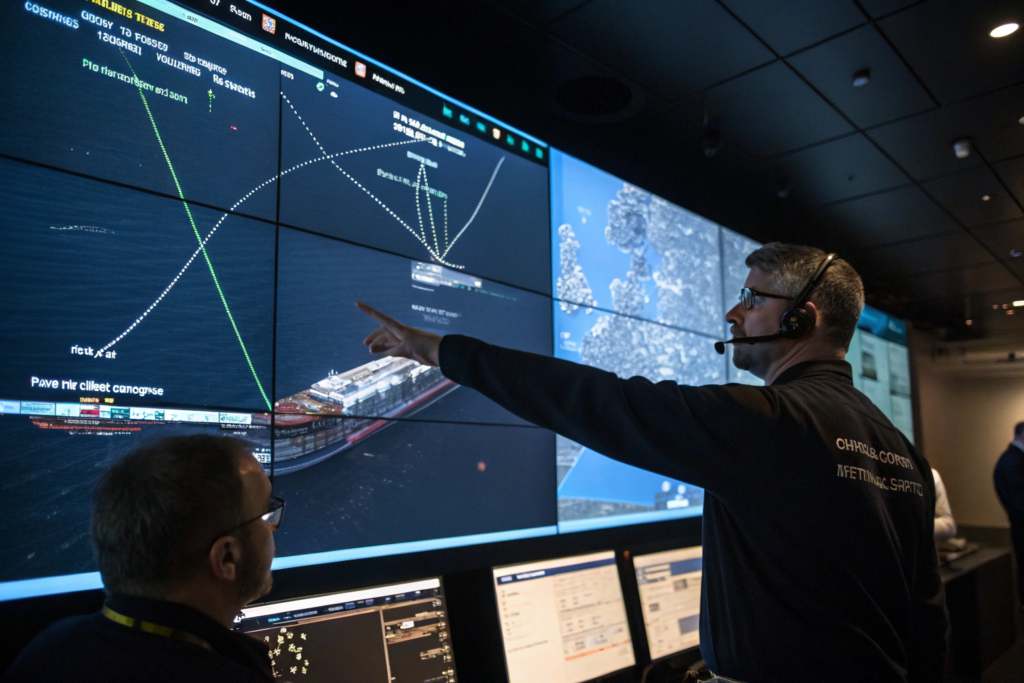
What Satellite Tracking Technology Does GeeseCargo Use?
Vessel positions are public information. But accessing it in a useful way requires technology. We use a platform that integrates AIS satellite data with terminal operating systems. I can see the vessel’s speed, its current heading, and its estimated time of berthing based on the queue at the destination port. I do not rely on the carrier’s website. Those are often delayed by 24 hours.
We combine the satellite data with trucking GPS tracking. Once the container leaves the port, we see the truck moving on the highway. We know its arrival time at your warehouse within a 30-minute window. This is not expensive technology. It is just technology that most small forwarders are too lazy to implement. We invested in it because our clients need reliability, not guesses. The marine traffic tracking data combined with our internal TMS gives us a complete picture.
How Does a Human “Account Guardian” Save Your Shipment?
Technology sends alerts. But a human makes decisions. Each client of GeeseCargo has a named account manager. This person knows your product type. They know your warehouse hours. They know your pain points from past shipments. When the system flags a delay, the account manager does not just forward you an email. They present a solution.
A shipment of gifts for a holiday season got stuck on a vessel that lost an engine near Busan. The system alerted my team at 2 AM. By 9 AM, my account manager had found an alternative feeder vessel. She arranged for the container to be transshipped in Korea and loaded onto a faster ship. The client received the goods only three days late instead of fourteen. The cost was $400 extra for the re-routing. The client saved a $10,000 holiday order. That is the power of a dedicated human watching your cargo.
Conclusion
A shipping delay is never just a shipping delay. It is a cash flow disruption. It is a retail chargeback. It is a storage bill from the port. It is a warehouse crew standing around with nothing to unload. And worst of all, it is a competitor taking your shelf space because you could not deliver. The ocean is unpredictable. Ports get congested. Paperwork gets flagged. But these events do not have to become a crisis for your business.
At GeeseCargo, we have built our entire service model around preventing the preventable. We use priority discharge to skip the port queue. We pre-clear customs to eliminate document holds. We monitor vessels by satellite so we know about a delay before the carrier announces it. We have human experts who reroute your cargo in real time when something goes wrong. You do not just buy freight space from us. You buy a guarantee that we will fight for your timeline with every tool we have.
If you are tired of explaining delays to your buyers and paying penalties you did not earn, let us change the dynamic. Contact GeeseCargo and ask about our Time-Critical DDP service. Send us your next order details. We will build you a timeline that includes buffer strategies and port alternatives. You will know exactly when your goods will arrive. And you will finally be able to make promises to your customers that you can actually keep.