You run a business in Germany, France, or the Netherlands. You found the perfect supplier in Yiwu or Guangzhou. The products are exactly what your market wants. You negotiate a good unit price. Then the shipping conversation starts. Suddenly you are facing a maze of European Union regulations. You hear terms like EORI number, VAT deferment, and Union Customs Code. Your supplier offers FOB. A local forwarder quotes EXW. You try to piece together a door-to-door chain. You end up with a Chinese trucker, a Chinese broker, an ocean carrier, a European customs agent, and a local delivery company. Five different entities. Five different invoices. Zero accountability when something goes wrong. You spend more time managing logistics than growing your brand. That frustration is spreading across Europe. And European importers are looking for a way out. They are switching to GeeseCargo because we offer a single, clean DDP door-to-door solution that bridges China and the EU without the chaos.
European importers are switching to GeeseCargo’s DDP door-to-door service because we eliminate the complexity of EU customs, VAT handling, and multi-party logistics. We act as the single point of accountability from the factory in China to the warehouse in Europe. We handle Chinese export clearance, ocean or rail freight, EU import customs under our own fiscal representation, VAT payment and deferment, and final delivery to your door. You do not need an EORI number. You do not file EU customs declarations. You do not prepay VAT and wait months for a refund. We consolidate the entire journey into one fixed price and one team. European buyers are choosing us for the same reason American buyers do. They want the goods to arrive without the headache.
I have watched the European market shift dramatically in the last three years. The old model of using separate agents in China and Europe is dying. Importers are tired of the finger-pointing. They want one throat to choke. They want landed cost certainty. They want a partner who understands both sides of the Silk Road. I want to show you exactly why our DDP model fits the European market so well and why businesses across the continent are moving their freight to us.
What Makes EU Customs Clearance So Different from the US?
Importing into the United States under DDP has one major challenge. The tariff and the CBP entry. The US system is centralized. One customs authority. One set of rules. The European Union is a different beast. It is a single market with 27 member states. But each state has its own customs office. Each has its own VAT rate. The Union Customs Code governs the rules, but the implementation is local. You need a fiscal representative in the country of import. You need to handle the Entry Summary Declaration. You need to navigate the complex VAT rules. A forwarder who only knows the US lane will crash into the EU regulatory wall. We have built specific expertise to handle this.
EU customs clearance differs from the US because it requires a fiscal representative, an EORI number registered in a member state, and compliance with the Union Customs Code. VAT is handled differently. Instead of a simple duty payment, you must account for import VAT, which can be deferred or reclaimed. GeeseCargo manages this entire process. We provide the fiscal representation. We file the electronic customs declaration through the member state’s system. We handle the VAT payment at the border using our deferment account. We then deliver the goods to your door with all duties and taxes settled. You do not register for an EORI. You do not interact with local customs authorities. We are the buffer.
I recall a German importer who had been using a US-centric forwarder for his China-EU shipments. The forwarder was excellent on the Pacific route. But when his container hit Hamburg, the problems started. The forwarder had no German fiscal representative. They asked the importer to use his own EORI and pay the VAT upfront. The importer had to wire €8,000 in import VAT to the customs office before the goods were released. He waited 4 months for the VAT refund from the tax authority. His cash flow took a hit. He was furious. He switched to us. We used our fiscal representative. We deferred the VAT. He paid us the all-in DDP price. No separate tax payment. No refund wait. That is the EU difference.
Why Do You Need a Fiscal Representative for EU DDP?
Under EU law, if you are a non-EU company acting as the Importer of Record, you must appoint a fiscal representative in the member state where the goods first enter the EU. This representative is jointly liable for the customs debt. It is a serious legal appointment. Not every forwarder has this setup. We have established fiscal representation in key EU entry points like the Netherlands, Germany, and Belgium. Our representative holds the necessary guarantees with the local customs authority. They file the import declaration in our name as the IOR. This legal structure allows us to offer true DDP to European importers. You, the buyer, are not listed as the importer. You are the consignee. The customs liability sits with GeeseCargo and our appointed fiscal representative. This is a massive protection for your EU import operations.
How Does the Union Customs Code Affect Your Shipment?
The Union Customs Code is the legal framework for all EU customs procedures. It mandates electronic data interchange. It requires the Entry Summary Declaration for security risk analysis. It sets the rules for customs valuation and origin determination. Non-compliance leads to fines and delays. We know the UCC. Our customs team files the declarations according to its specifications. We ensure the commercial invoice meets the EU’s strict data requirements. We include the correct Incoterms, the 6-digit HS code for the EU tariff schedule, and the origin statement. We do not cut corners on documentation. A shipment that is UCC-compliant sails through customs quickly. A shipment with sloppy paperwork sits in a bonded warehouse accruing storage fees. Our customs compliance process is built to prevent those delays. The goods clear fast. You get your inventory on schedule.
How Do We Handle the European VAT Maze for Importers?
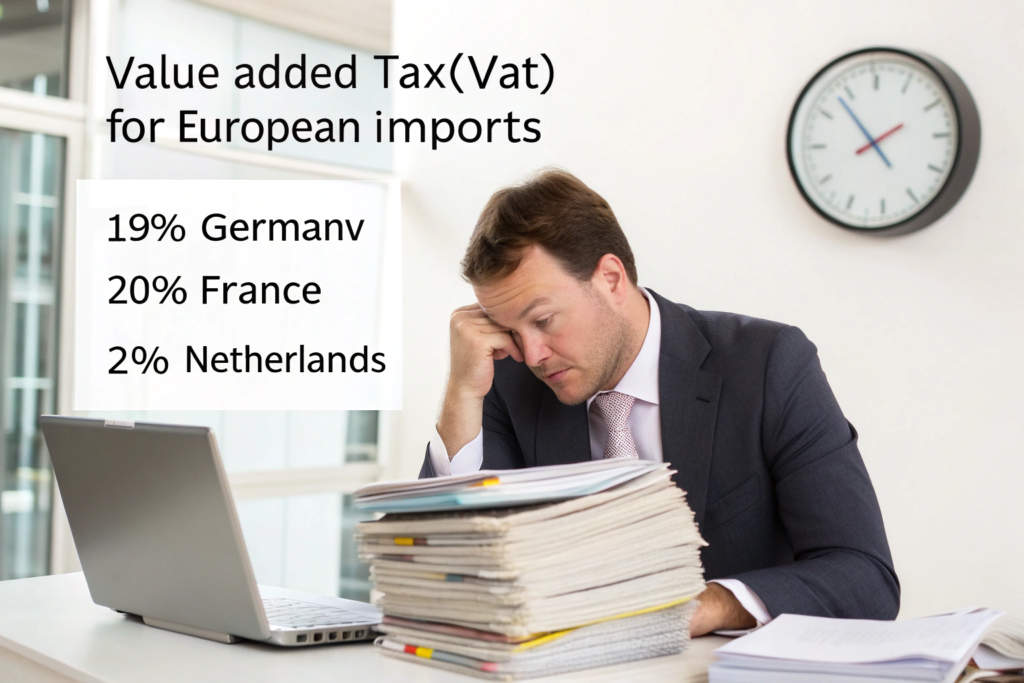
Value Added Tax is the biggest headache for European importers. When goods enter the EU, import VAT is due at the border. The rate depends on the country of entry and the product type. For clothing and accessories, the VAT can be 19% in Germany, 20% in France, or 21% in the Netherlands. That is a significant cash outlay. If you pay it yourself, you tie up working capital. You then reclaim it on your next VAT return. The gap between payment and refund can be months. A smart DDP provider handles this differently. We use a VAT deferment mechanism. We do not pay the VAT upfront in cash. We defer it through our fiscal representative’s license. Then we settle it within our overall tax accounting. You never see the VAT bill. You never lend the government your money.
We handle the EU VAT maze by using a VAT deferment account held by our fiscal representative. When your goods enter the EU, the import VAT is not paid in cash at the border. It is deferred and accounted for in our periodic tax filing. We then invoice you the all-in DDP price, which includes the duty but does not separately charge you the import VAT as a cash outlay. You do not pay the VAT upfront and wait for a refund. You pay our fixed price. The VAT becomes our internal accounting matter, not your cash flow problem. This is one of the biggest reasons European importers switch to our DDP service.
I spoke with a small brand owner in Amsterdam. She imports handbags and accessories from China. She was using FOB and managing the customs herself. Every shipment, she had to pay around €5,000 in import VAT to the Dutch customs. She had to have that cash ready at the port. Then she reclaimed it on her quarterly VAT return. The process took 2 to 3 months. She was constantly short on working capital. She asked me, "Can you just make the VAT disappear?" I laughed. I told her, "I cannot make the tax disappear. But I can make the cash flow problem disappear." We switched her to our DDP with VAT deferment. Now she pays one invoice. She never wires money to the Belastingdienst. Her cash flow stabilized. She invested the freed-up capital into new product lines. That is the power of VAT deferment on a growing business.
What Is an Article 23 VAT License and How Does It Help?
In the Netherlands and some other EU states, an Article 23 license allows a fiscal representative to defer import VAT permanently. The VAT is not just delayed. It is shifted from the import declaration to the periodic VAT return. The net result is often a zero cash payment because the import VAT and the input VAT credit cancel each other out on paper. This is the gold standard of EU import VAT handling. Our fiscal representative in the Netherlands holds an Article 23 license. When your goods enter through Rotterdam, we apply the Article 23 mechanism. The VAT line on the customs entry shows a zero cash payment. You receive the goods with no VAT bill. This is a massive competitive advantage. It is one of the reasons we route a significant volume of EU DDP shipments through the Netherlands. The Dutch customs system is efficient and friendly to importers who use proper fiscal representation.
Can We Handle VAT for B2C E-Commerce Sellers into Europe?
Yes. The rules changed in July 2021 with the introduction of the Import One-Stop Shop. For B2C shipments under €150, the IOSS allows the seller to collect VAT at the point of sale and remit it monthly. If you are an Amazon or Shopify seller shipping directly to European consumers, the IOSS simplifies the process. We can integrate with your IOSS registration. We provide the carrier with the IOSS number. The goods clear customs without the end customer paying import VAT at the door. For shipments over €150 or for B2B transactions, we use our standard DDP with fiscal representation. We adapt the customs procedure to your sales model. Whether you sell wholesale to retailers or direct to consumers, we have a compliant VAT solution. You do not need to become a tax expert. You tell us your business model. We apply the correct customs procedure.
Rail Freight vs. Ocean Freight: Which DDP Route Saves Time to Europe?
The China-Europe freight corridor is not just about ships anymore. The Belt and Road Initiative has built a massive rail network connecting Chinese cities like Xi’an and Chengdu directly to European hubs like Duisburg, Hamburg, and Małaszewicze. Rail freight is a game changer for European importers. It offers a middle ground between expensive air freight and slow ocean freight. A container ship from Shanghai to Rotterdam takes 30 to 35 days. A freight train from Xi’an to Duisburg takes 15 to 18 days. That is nearly half the transit time for a moderate premium. For fashion, seasonal gifts, and fast-moving accessories, that speed is a competitive weapon. You can react to trends faster. You can hold less inventory. We have integrated rail freight into our DDP product for Europe.
We offer both rail freight and ocean freight DDP routes to Europe. Ocean freight is the most cost-effective for high-volume, non-urgent shipments. It takes 30 to 35 days from Chinese ports to major EU ports like Rotterdam, Hamburg, and Antwerp. Rail freight takes 15 to 18 days from Chinese rail terminals to European rail hubs. It costs more than ocean but significantly less than air. GeeseCargo helps you choose the right mode based on your inventory velocity and product type. For seasonal clothing and trending gifts, we often recommend rail. For stable, year-round accessories, we recommend ocean. Both modes are fully covered under our fixed DDP price, including all customs, VAT, and final delivery from the rail terminal or port to your door.
I have a client in Paris who sells fashion accessories. He used to ship everything by ocean to Le Havre. The 35-day transit plus customs clearance meant he had to plan his orders 2 months in advance. Fashion trends change faster than that. He was constantly stuck with inventory that was out of style. We introduced him to our rail DDP solution. We ship his goods by train from Xi’an to Duisburg. From Duisburg, we truck the goods to his warehouse in Paris. Total transit: 20 days door to door. He cut his lead time in half. He now orders smaller batches more frequently. He reacts to trend data. His sell-through rate improved. The rail premium was 15% more than ocean, but his reduced markdowns more than covered it. Rail DDP is not just a transport option. It is an inventory strategy tool.

When Should You Choose Rail DDP Over Ocean DDP?
Choose rail DDP when time-to-market matters more than the absolute lowest cost. If you sell seasonal products like Christmas gifts, winter coats, or summer accessories, a 30-day ocean transit can cause you to miss the selling window. The product arrives, and half the season is gone. You mark it down. You lose margin. Rail gets the goods into your warehouse in under 3 weeks. You capture the full-price selling window. Choose rail when your product has high value density. A container of premium clothing has a high inventory carrying cost. The interest on the capital tied up for an extra 15 days of ocean transit can exceed the rail premium. Choose rail when you are testing a new product. You can ship a smaller batch quickly, test the market, and reorder based on real data. We help you run the freight mode comparison. We show you the ocean DDP price and the rail DDP price side by side. You make the decision based on your business needs, not on a generic recommendation.
How Does the Silk Road Rail Network Connect Your Goods?
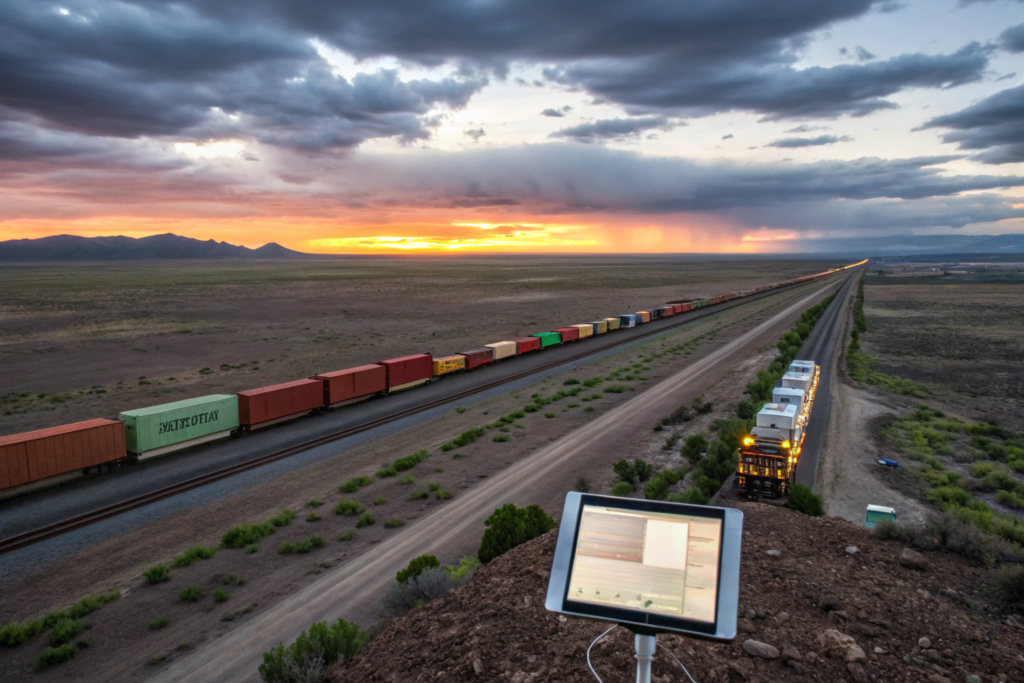
The China-Europe Railway Express runs on two main corridors. The northern route goes through Kazakhstan, Russia, and Belarus into Poland. From Poland, the cargo connects to Germany, France, and beyond. The southern route goes through Kazakhstan, the Caspian Sea, and into Turkey or the Balkans. We primarily use the northern route for its speed and reliability. Your goods are loaded into a secure container at a terminal in Xi’an or Chengdu. The container travels on a dedicated freight train. It crosses borders with pre-cleared transit documents. It arrives at a terminal in Duisburg or Hamburg. Our European team receives the container. We clear it through customs using our fiscal representative. We arrange the final truck delivery to your warehouse. The entire chain is integrated. The rail freight leg is just one part of our DDP whole. You track the container’s GPS position across the steppe. It is a beautiful thing to watch your goods travel the ancient Silk Road on a modern train, all under one fixed price.
Why Is a Single Chinese-European Logistics Partner More Reliable?
The traditional China-Europe logistics chain is fragmented. A Chinese forwarder handles the origin. A European forwarder handles the destination. They communicate through emails and forwarded documents. The left hand rarely knows what the right hand is doing. If the Chinese forwarder misdeclares the weight, the European forwarder gets the penalty notice. If the European forwarder misses the delivery window, the Chinese forwarder says, "Not our problem." You, the importer, are stuck in the middle of a transcontinental blame game. The fragmentation is the root cause of most shipping failures. We fix it by being one company that operates on both ends. Our team in China loads the container. Our team in Europe receives it. They are on the same internal system. They share the same boss. They have the same goal.
A single Chinese-European logistics partner is more reliable because there is no handoff between independent companies. GeeseCargo operates as one entity with offices and staff in both China and Europe. Our Chinese team manages the factory pickup, export clearance, and vessel loading. Our European team manages the import clearance, fiscal representation, and final delivery. They communicate on the same platform in real-time. There is no information loss. There is no dispute over responsibility. If a problem occurs, one person owns it. This unified model delivers higher on-time rates, fewer customs delays, and a single source of truth for the importer. European importers are switching to us because they are tired of being the project manager for a disconnected chain of agents.
I once audited a shipment for a new client in Milan. He had been using a Chinese agent and an Italian agent. The Chinese agent loaded the container and sent the documents. The Italian agent received them 3 days later. There was a discrepancy in the carton count. The Italian agent held the shipment. The client called the Chinese agent. The Chinese agent blamed the factory. The factory was closed for Chinese New Year. The container sat in the port of Genoa for 10 days, running up storage fees. The client paid €2,000 in demurrage. He could not hold anyone accountable. When he switched to GeeseCargo, we showed him our single system. The Chinese team inputs the data. The Italian team sees it instantly. Discrepancies are caught at the origin, not at the destination. He has had zero demurrage charges since switching. The single-partner model is not just convenient. It is cost-effective.
How Does Our China-Based Team Coordinate with Our EU Team?
We run a shared digital logistics platform. When our Guangzhou office books a container, the data flows instantly to our EU operations center. The commercial invoice, packing list, and export declaration are uploaded to the cloud. The EU team reviews the documents before the ship even leaves the Chinese port. They check for EU-specific compliance issues. They pre-file the Entry Summary Declaration. They schedule the trucking from the port. By the time the vessel docks in Rotterdam, the import clearance is pre-prepared. The goods clear within 24 hours in most cases. The truck is waiting. This seamless coordination is possible because we are one company. We do not email attachments across time zones. We work in the same system. The China team and the EU team have a joint morning video call three times a week. They discuss every active shipment. Nothing falls through a crack.
Can a Chinese Forwarder Really Understand European Delivery Standards?
Yes, if they invest in it. We have European logistics managers on our team. They are local hires who know the road networks, the pallet standards, and the delivery appointment culture. They know that a delivery in Paris requires a smaller truck than a delivery in a German industrial park. They know that Italian warehouses often close for a long lunch. They know that Scandinavian deliveries require winter tires and heated trailers. This local knowledge is built into our DDP service. Our China team knows the origin. Our EU team knows the destination. Together, we know the whole picture. A pure Chinese forwarder without a local EU presence cannot match this. They outsource to an agent who may or may not care about your brand. We care. We own the last mile delivery in Europe just as we own the first mile in China.
How Does Our DDP Service Handle EU Product Compliance?
Importing into the EU is not just about customs and VAT. Your products must comply with EU safety, health, and environmental regulations. Clothing must meet REACH chemical standards. Gifts and toys must carry the CE mark and comply with the Toy Safety Directive. Electronics must have RoHS compliance. Textiles must have fiber composition labels in the language of the destination country. If your goods fail a compliance check, customs seizes them. The container is held. The goods may be destroyed. A standard freight forwarder does not care about product compliance. They tell you it is your responsibility. They are right, legally. But we go further. We advise you on the requirements before the goods ship. We check the documentation at origin. We help you avoid the compliance trap.
GeeseCargo’s DDP service handles EU product compliance by providing pre-shipment advisory and document verification. We do not assume legal liability for your product’s conformity. That remains yours. But we actively help you meet the requirements. We check that your CE mark documentation is in order. We verify that the supplier’s test reports are valid. We ensure the packaging labels comply with EU language and recycling directives. At the customs declaration, we present the correct certificates to the authorities. If a compliance question arises during clearance, we manage the communication with the authorities and guide you through the resolution. This proactive compliance support reduces the risk of customs stops and product seizures.
A Spanish importer of plush toys came to us after a disaster. His previous shipment was seized by customs in Barcelona. The toys did not have the correct EN71 test reports. The entire container was held. He had to pay for destruction or re-export. He lost the goods and the shipping cost. It nearly bankrupted his small business. When he came to us, we asked for his product specifications before we even quoted. We identified the missing compliance steps. We connected him with a testing lab in China that could test the toys to EU standards before shipment. We waited to load the container until the test reports were in hand. The next shipment cleared customs without a hiccup. He told us we saved his business. We did not act as the compliance certifier. We acted as the compliance gatekeeper. That is the value a knowledgeable DDP partner brings.
What CE Marking Documentation Do We Check?
The CE mark is not just a sticker. It is backed by a technical file. The file includes the product description, the design drawings, the risk assessment, the test reports from an accredited lab, and the Declaration of Conformity signed by the manufacturer or importer. We ask you to provide these documents before the goods ship. Our EU customs team reviews them for completeness. We check that the test reports are current and cover the correct EN standards. We check that the Declaration of Conformity is properly signed and dated. If something is missing, we flag it. We do not file the import declaration until the compliance file is complete. This gatekeeping prevents the CE marking issues that cause customs holds. You may not know what a technical file should contain. We do.
How Do We Manage WEEE and Packaging Regulations?
For electronics and gifts with electronic components, the EU Waste Electrical and Electronic Equipment directive applies. You must register with a national WEEE authority and report your volumes. For all products, the EU Packaging and Packaging Waste Directive requires you to account for the packaging material you place on the market. Germany has the VerpackG with its dual system registration. France has a similar scheme. These are complex, country-specific requirements. We advise you on which regulations apply to your product. For smaller importers who are not ready to register individually, we can offer solutions through our network of compliance partners. We do not ignore these regulations. We bring them to your attention early. A shipment that violates WEEE or packaging law can be stopped at the border. We keep your supply chain clear of these obstacles.
Conclusion
European importers are switching to GeeseCargo’s DDP door-to-door service for a simple reason. The old way is broken. Juggling a Chinese agent, a European customs broker, a VAT accountant, and a local trucker is not sustainable. It drains your time. It drains your cash. It puts your brand at risk every time a container crosses a border. Our DDP model fixes this by consolidating the entire China-to-Europe supply chain under one roof. We handle the Chinese export. We handle the ocean or rail freight. We handle the EU customs clearance with our own fiscal representative. We handle the VAT deferment so you do not tie up capital. We handle the final delivery with local, knowledgeable carriers. We advise on product compliance to keep your goods out of customs jail.
The European market is sophisticated. It demands speed, compliance, and financial efficiency. Our service delivers all three. We have the team in China to control the origin. We have the team in Europe to master the destination. We bridge the two with a digital platform and a human relationship. If you are an importer in Germany, France, the Netherlands, or anywhere in the EU, and you are tired of the logistics jigsaw puzzle, we are ready to help. Let us give you a single, fixed DDP price for your next shipment. Visit us at geesecargo.com and let us show you why so many European businesses are making the switch. You focus on building your brand in Europe. We will focus on getting your goods there.