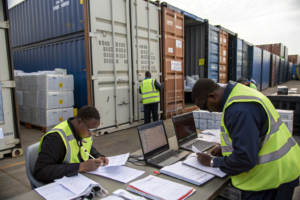
When one of our pharmaceutical clients faced a production line shutdown due to a missing $15,000 component, a $42,000 air charter saved them from $2.3 million in daily production losses. As founder of GeeseCargo with extensive air charter experience, I've learned that charter services aren't just for emergencies—they're strategic tools that solve specific supply chain challenges commercial airlines can't address.
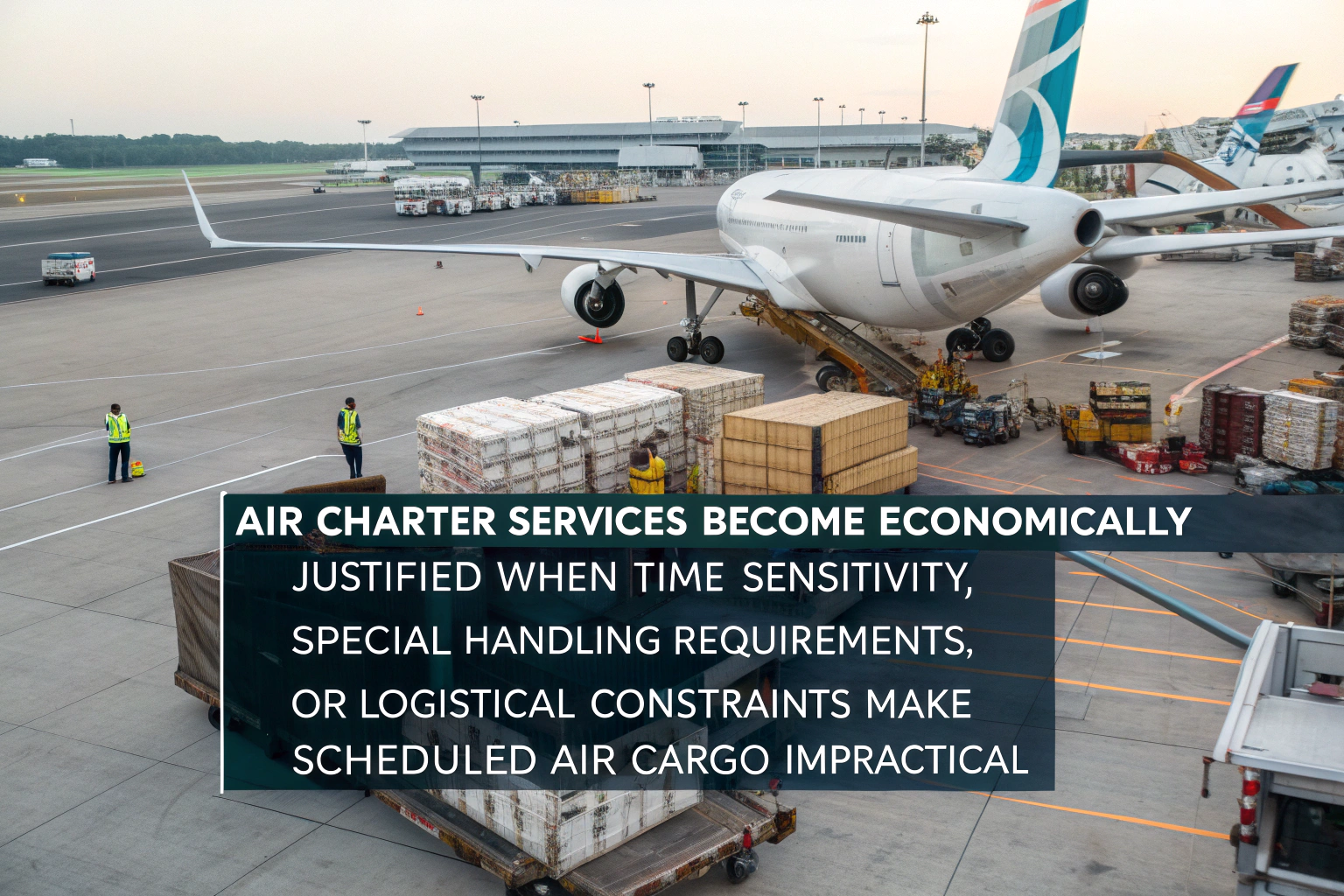
Air charter services become economically justified when time sensitivity, special handling requirements, or logistical constraints make scheduled air cargo impractical. Typical scenarios include emergency shipments, high-value goods, oversized cargo, remote locations, and time-critical production components. Charter costs of $50,000-$500,000 are typically justified when potential losses exceed charter expenses by 5-10x.
Air charter represents the premium end of air freight, offering complete control, flexibility, and speed unmatched by commercial options. Understanding when these benefits justify the substantial cost premium separates companies that use charters strategically from those that see them only as emergency measures.
What Specific Scenarios Justify Air Charter Costs?
Air charter economics work when the value of time, control, or capability exceeds the substantial cost premium over commercial air cargo.

When Do Emergency Situations Require Air Charter?
Production line shutdown prevention justifies immediate charter deployment. When manufacturing stoppages cost $50,000+ per hour, even expensive charters become economically rational within hours of disruption.
Emergency repair part delivery maintains critical operations. For power generation, telecommunications, or transportation infrastructure, charters can deliver repair components hours or days faster than alternatives.
Medical emergency and humanitarian response often need charter flexibility. Medical supplies, disaster relief equipment, and emergency personnel movement frequently require charter capabilities when commercial options are unavailable or too slow.
How Do High-Value Cargo Considerations Support Charter Use?
Security-sensitive shipments benefit from dedicated aircraft control. High-value electronics, precious metals, artwork, or sensitive documents avoid multiple handlings and security exposures of commercial cargo handling.
Temperature-sensitive pharmaceuticals require controlled environments. Charter aircraft maintain precise temperature control throughout transit, avoiding terminal exposures that can compromise pharmaceutical efficacy.
Confidential prototypes and intellectual property need secured transport. New product prototypes, military equipment, or trade show displays often warrant charter security to prevent competitive intelligence gathering.
What Operational Advantages Does Charter Service Provide?
Beyond emergency response, charters offer operational benefits that solve specific logistical challenges commercial aviation cannot address.
How Does Charter Flexibility Solve Routing Challenges?
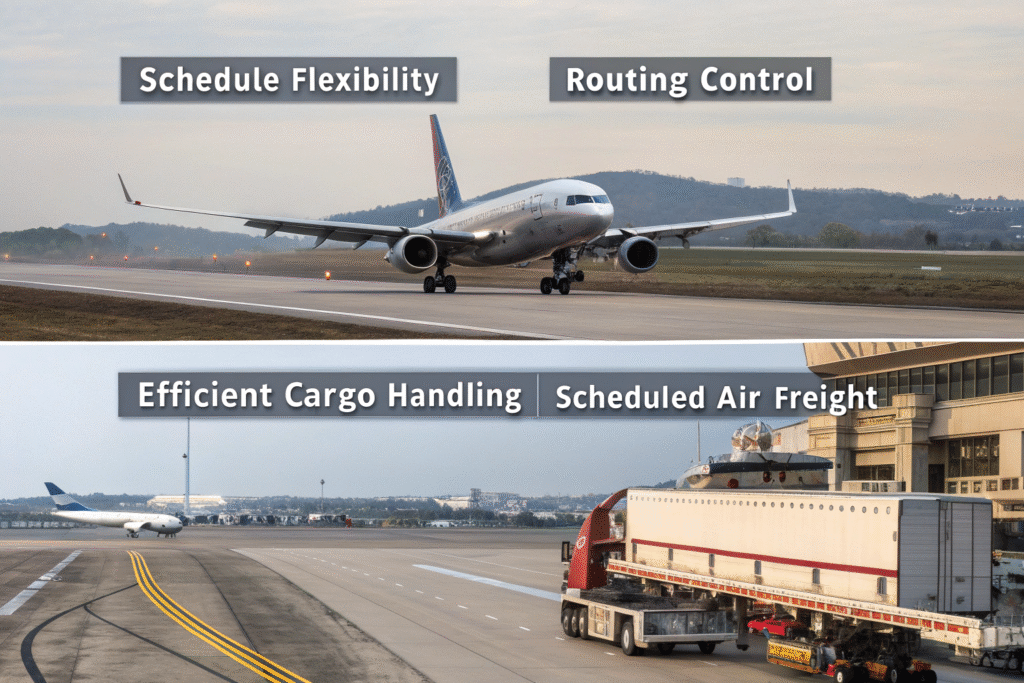
Remote location access reaches underserved airports. Charter aircraft can access thousands of airports worldwide that commercial carriers don't serve, reaching closer to final destinations.
Customized scheduling matches production or event timelines. Charters operate on your schedule, not airline timetables, enabling precise coordination with manufacturing, installations, or events.
Multiple stop itineraries optimize complex logistics. Charters can efficiently handle multi-city routes that would require days via commercial connections with multiple airline changes.
What Handling and Control Benefits Justify Premium Costs?
Eliminating terminal handling reduces damage and loss risk. Direct loading from truck to aircraft avoids multiple terminal handlings that account for most cargo damage and loss.
Supervised loading ensures proper securing and handling. Your team can directly supervise loading, ensuring specialized equipment or fragile items receive proper care and securing.
Customized security protocols provide enhanced protection. Charters allow implementation of specific security measures, escort requirements, or surveillance beyond standard airline protocols.
How Do You Calculate the True Cost-Benefit of Charter Services?
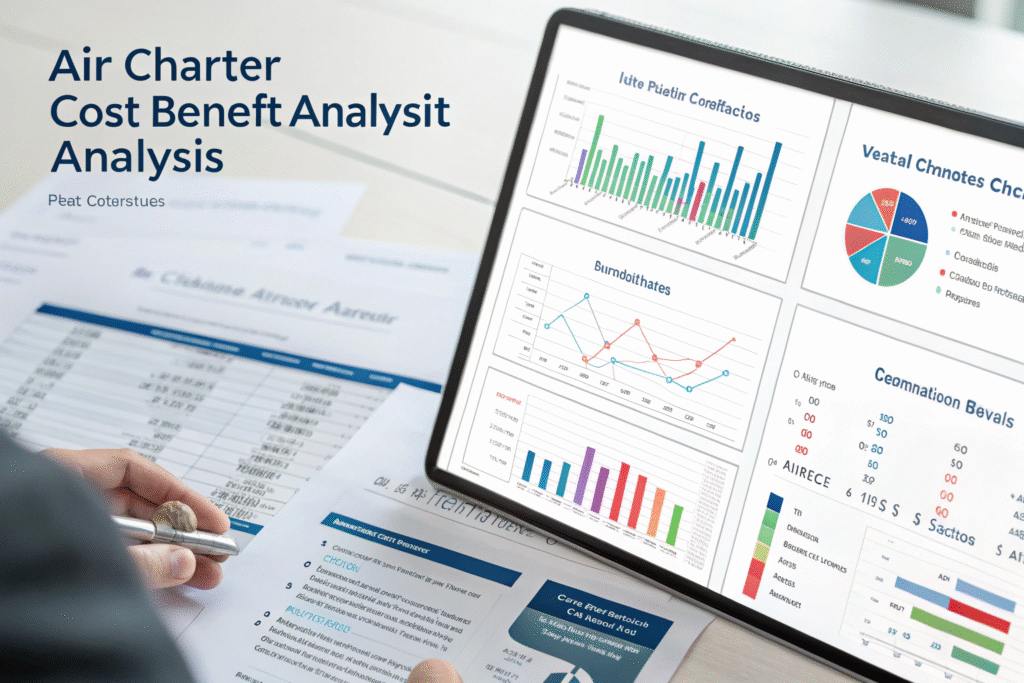
Rational charter decisions require comprehensive cost-benefit analysis that accounts for both direct expenses and avoided losses.
What Cost Factors Should Be Included in Charter Analysis?
Direct charter costs include aircraft rental, crew, and landing fees. These typically range from $3,000-$15,000 per flight hour depending on aircraft size and type.
Indirect expenses encompass ground handling and special equipment. Customs clearance, security, specialized loading equipment, and temporary storage add 15-30% to base charter costs.
Opportunity costs of alternative transportation represent savings. Comparing charter costs against commercial air freight, expedited ground, or ocean transportation highlights the premium for charter speed and control.
How Should Potential Losses Be Quantified?
Production downtime costs calculate manufacturing impact. For manufacturers, hourly production value × downtime hours avoided provides the most straightforward charter justification.
Market opportunity costs measure lost revenue potential. For seasonal products, event merchandise, or marketing campaigns, delayed arrival can mean missed revenue windows.
Contract penalty avoidance calculates default consequences. Many contracts include substantial late delivery penalties that charters can avoid through timely delivery.
Reputational impact, while harder to quantify, has long-term value. Customer relationship damage from stockouts or missed commitments can exceed immediate financial impacts.
What Aircraft Types Suit Different Charter Needs?
Matching aircraft capabilities to shipment characteristics ensures cost-effective charter solutions.
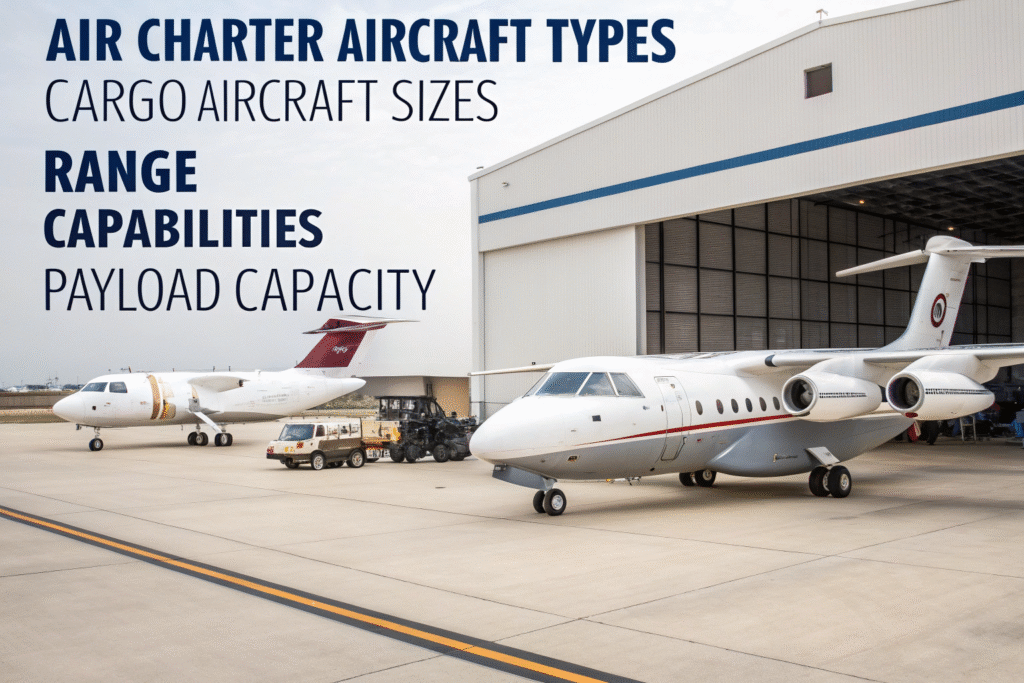
How Do You Select Appropriate Aircraft for Your Shipment?
Small turboprops (Cessna Caravan, Pilatus PC-12) serve regional short-haul needs. These aircraft typically carry 1-2 tons up to 1,000 miles, accessing small airports with minimal infrastructure.
Medium jets (Learjet, Citation) balance range and payload flexibility. Carrying 2-5 tons up to 2,500 miles, these aircraft offer good speed and airport flexibility for most domestic charters.
Large cargo aircraft (Boeing 737, Airbus A300) handle substantial volumes. For payloads of 15-25 tons, these aircraft provide intercontinental range with maindeck container capability.
Specialized freighters (Antonov, 747) accommodate outsized cargo. Unique dimensions, heavy weights, or unusual shapes may require specialized aircraft with large door openings and strong floor loading.
What Operational Factors Influence Aircraft Selection?
Airport infrastructure limitations dictate aircraft options. Runway length, handling equipment, and terminal facilities at both origin and destination determine feasible aircraft types.
Payload-range requirements balance capacity with distance. The fundamental aviation tradeoff between how much weight can be carried how far drives aircraft selection and potential technical stops.
Loading configuration needs affect aircraft suitability. Side door versus main deck loading, container compatibility, and internal cabin configuration impact loading efficiency and cost.
What Are the Practical Steps to Arrange a Charter?
Successfully executing air charters requires understanding the booking process, documentation, and operational coordination.

How Does the Charter Booking Process Work?
Requirement definition specifies needs and constraints. Clearly documenting shipment details, timing requirements, origin/destination pairs, and special handling needs enables accurate charter quotations.
Operator selection balances capability, availability, and cost. Charter brokers or direct operator contact identifies available aircraft matching your requirements, with safety records and insurance verification.
Contract negotiation establishes terms and responsibilities. Charter agreements specify aircraft type, schedule, pricing, cancellation terms, and liability allocations.
What Operational Coordination Ensures Success?
Ground handling arrangements prevent airport delays. Coordinating loading equipment, fuel, crew transportation, and customs clearance in advance ensures smooth operations.
Documentation preparation meets regulatory requirements. Air waybills, customs declarations, security forms, and special permits must be prepared according to origin, destination, and transit country requirements.
Contingency planning addresses potential disruptions. Weather alternatives, technical failure responses, and schedule changes require advance planning to minimize impacts.
What Common Mistakes Should You Avoid with Air Charter?
Understanding frequent errors helps prevent costly problems and ensures successful charter outcomes.
What Planning Errors Undermine Charter Effectiveness?
Inadequate lead time reduces options and increases costs. Last-minute charters face limited aircraft availability and premium pricing, while 48-72 hour planning typically provides better options and pricing.
Poor requirement definition leads to aircraft mismatch. Underestimating weight, dimensions, or special handling needs can require expensive last-minute aircraft changes or even shipment rejection.
Underestimating ground time requirements causes schedule disruptions. Loading, customs, and handling often take longer than flight time, particularly for complex shipments.
What Operational Mistakes Create Problems?
Inadequate documentation preparation causes customs delays. Missing or incorrect documentation at either origin or destination can ground aircraft for hours or days while issues are resolved.
Poor communication with operators creates misunderstandings. Clearly communicating all requirements, constraints, and special handling needs prevents operational surprises.
Insufficient contingency planning magnifies disruptions. Weather, technical issues, or operational problems require prepared alternatives to minimize schedule impacts.
Conclusion
Air charter services represent a specialized logistics solution that delivers unparalleled speed, control, and flexibility for specific situations where these attributes create sufficient value to justify substantial cost premiums. The most sophisticated users treat charters as strategic capabilities rather than emergency measures, integrating them into comprehensive logistics planning that matches transportation modes to shipment priorities.
At GeeseCargo, we've helped clients leverage air charters to prevent millions in losses, capture time-sensitive opportunities, and solve logistical challenges commercial aviation cannot address. The most successful approaches involve clear cost-benefit analysis, proper aircraft selection, and meticulous operational planning that transforms expensive charters into valuable investments.
Begin your charter evaluation by developing clear decision criteria that quantify when charters become economically justified for your specific operations. Remember that in air charter, success comes not from using the service frequently, but from using it wisely when circumstances create sufficient value to justify the substantial investment.