You have a clothing line launch date set in stone. The marketing campaign is live, the buyers are booked, and the inventory is supposed to hit the warehouse on Monday. Then your freight forwarder says the air shipment is "delayed due to backlog at the hub." That single phrase just put your entire launch at risk. I have been in the room when a business owner hears those words, and I know the panic that follows. Air freight is the fastest commercial shipping mode, but "fast" is not a single number. It is a range that shifts dramatically based on the airport pair, the service level you choose, and the customs clearance efficiency at the US entry point.
The total transit time for air freight from China to the USA ranges from 2 to 8 days door-to-door, depending on the service tier. Direct express air freight can deliver from a factory in Shanghai to a warehouse in Los Angeles in 2-3 days. Standard consolidated air freight takes 4-6 days. Economy deferred air freight can stretch to 7-8 days. The flight time itself is only 12-14 hours across the Pacific. The rest of the transit time is consumed by trucking to the origin airport, export customs clearance, cargo terminal cut-off windows, flight scheduling, import customs clearance at the US gateway, and the final trucking leg to your destination.
You need to understand what actually happens to your cargo during those hours and days between the factory door and your receiving dock. A "3-day service" does not mean your goods are flying for three days. They are flying for half a day and spending the rest of the time moving through ground handling and customs processes that you can optimize if you know how the system works. Let me walk you through the real timeline so you can set accurate expectations with your customers and plan your inventory pipeline with surgical precision.
What Are the Different Air Freight Service Levels and Their Timelines?
You search for "air freight from China" and get quotes ranging from $3.50 per kilo to $12.00 per kilo. The cheap option promises "5-8 days," and the expensive one says "next day." You assume they are all basically the same airplane experience with different pricing. This assumption leads to a costly mistake. The service level determines not just the price but the physical route your cargo takes, the priority it gets when flights are overbooked, and the speed of the ground handling at both ends. A deferred economy shipment can sit in a warehouse waiting for space for three days before it even sees the inside of an airplane.
Air freight from China to the USA operates on three distinct service tiers: Express Air, which uses dedicated freighter aircraft and integrator networks for 1-3 day door-to-door delivery; Standard Air Consolidation, which groups cargo from multiple shippers into airline unit load devices for 4-6 day delivery; and Deferred or Economy Air, which books cargo on the next available flight with lower priority for 7-8 day delivery. The service tier you choose is the single biggest factor determining your transit time.
At GeeseCargo, I help my clients match the air freight service tier to their urgency level and their budget. A fashion sample for a buyer meeting in New York needs Express. A restock of basic t-shirts for an Amazon FBA warehouse can ride Standard. A bulk shipment of low-cost gift items that just needs to beat the ocean by a few weeks can use Economy. Let me break down the exact door-to-door journey for each tier so you can see where the time goes.
How fast is express air freight door-to-door from major Chinese cities?
Express air freight uses the integrator networks—think dedicated cargo airlines and the express divisions of major carriers. Your cargo does not move as loose freight on a passenger flight; it moves in a sealed unit load device on a scheduled freighter aircraft that operates like a clock. I regularly book express air freight from Shenzhen to Los Angeles for my Amazon FBA clients facing a critical stockout. The timeline works like this. Day 0, the truck picks up the goods at the factory in Dongguan in the afternoon and drives two hours to Shenzhen Bao’an International Airport. The cargo is screened and accepted into the express terminal that same evening. Day 1, the freighter departs Shenzhen at 2:00 AM local time and arrives in Los Angeles at 10:00 PM the previous calendar day due to the time zone crossing. The goods clear US customs mid-flight using an electronic pre-clearance filing. By the early morning of Day 2, the pallets are loaded onto a bonded truck and driving to your warehouse in Southern California. Door-to-door total: roughly 2 calendar days. For shipments going to the East Coast, add one more day for the domestic air leg or long-haul trucking. The express lane is expensive, but it buys you the most precious thing in business: time. The cargo moves through a dedicated express clearance lane with CBP Express Consignment Processing which clears low-value, non-complex goods rapidly. I tell my clients that if the cost of a stockout or a missed launch exceeds the express freight premium, do not even think about the cheaper option. The express premium is insurance for your sales rank and your brand reputation.
Why does consolidated air freight take 4-6 days instead of 2?
Consolidated air freight, or consolidation, is the most popular choice for shipments between 100 kilos and 1,000 kilos. It costs about 40-50% less than express but adds two to three days to the door-to-door timeline. Those extra days do not come from the flight. The airplane flies the same speed whether your cargo is express or consolidated. The time is lost in the ground handling consolidation and deconsolidation process. On Day 1, your truck delivers six pallets to a freight forwarder’s consolidation warehouse near Shanghai Pudong Airport. Your six pallets sit in a staging area while the forwarder gathers cargo from eight other shippers to build a full airline pallet or container. This consolidation build-up usually takes one full day. On Day 2, the forwarder delivers the completed unit load device to the airline’s cargo terminal to meet the evening flight cut-off. The flight departs that night and arrives at LAX the next morning. On Day 3, the master air waybill is delivered to the forwarder’s break-bulk agent at the US gateway. The agent must deconsolidate the unit load device—physically breaking down the mixed pallet, sorting the individual shipments, and entering each house air waybill into the US customs system. This takes another day. On Day 4 or 5, your individual shipment clears customs and is loaded onto a truck for final delivery. The consolidation process itself consumes two of the three extra days compared to express. You can track the progress of a consolidated air waybill through the carrier’s portal, using a service like the IATA Cargo Tracking Gateway to see when the master air waybill has been manifested and when the house air waybill is released. I always tell my clients that consolidated air freight is a people-and-paperwork process masquerading as an aviation process. The airplane is the fastest part. The warehouse at either end is the bottleneck.
How Do Customs Clearance and Ground Handling Affect Air Freight Speed?
You track your air waybill and see "Arrived at Destination Airport" on a Tuesday morning. You relax, assuming your goods will be at your warehouse by Tuesday afternoon. Wednesday passes. Thursday arrives, and the status still says "Customs Clearance Pending." You call your forwarder and learn that a random customs exam has been triggered, and your pallets are sitting in a CBP inspection warehouse waiting for an X-ray scan slot. The flight took 13 hours. The customs and ground handling will take 48 hours. This ratio surprises many first-time air freight importers, but it is the normal operating reality.
Customs clearance and ground handling are the biggest variables in air freight transit time. While the flight itself is a fixed 12-14 hours, the origin ground handling takes 6-24 hours, and the destination customs clearance and cargo terminal breakdown can take anywhere from 4 hours for pre-cleared express shipments to 72 hours for consolidated shipments that are flagged for an intensive customs examination. The total ground time at both ends often exceeds the flight time by a factor of three.
I have built my air freight operation at GeeseCargo around shrinking the ground time. The airplane speed is a constant; the warehouse and customs speed is something you can influence with the right documentation and the right broker relationships. Let me show you exactly what slows down the ground handling and how to avoid the dreaded customs exam that can add three extra days to your supposedly "fast" air freight.
What causes a US customs hold on an air freight shipment?
A customs hold on an air freight shipment happens when the CBP officer reviewing your entry documentation finds a red flag. The most common triggers are: an inaccurate or vague cargo description on the commercial invoice, such as "gifts" or "clothing" instead of "women’s 100% cotton knitted t-shirts"; a declared value that appears artificially low compared to the known market value of similar goods; a missing or incorrect FDA or FCC certification for regulated products like electronics or cosmetics; and a random tailgate exam pulled by the CBP targeting system. A documented customs exam for air freight takes a minimum of 24 hours and can stretch to 72 hours if the cargo requires laboratory testing or an intellectual property rights review. During this time, your goods sit in a bonded warehouse, and you are paying storage fees. You can reduce the risk of a hold by providing your customs broker with a detailed packing list and a compliant commercial invoice before the flight departs. The CBP recommends using the ACE Cargo Release System for electronic filing, which speeds up the review of low-risk shipments. I also ensure that all my air freight clients have a valid continuous customs bond in place, not a single-entry bond that can delay the release by a day while the paperwork is processed. The bond is your financial guarantee to CBP for the duties, and a continuous bond signals that you are a regular, compliant importer.
How does the airport cargo terminal breakdown process delay your delivery?
Once customs releases the cargo, you face the next bottleneck: the airline’s cargo terminal. Your goods arrived inside a large airline unit load device, or ULD, along with cargo from other shipments. The terminal warehouse workers must physically break down the ULD, sort the individual house air waybill shipments onto separate pallets, and make them available for pickup by your trucker. During peak season, when the terminal is flooded with holiday cargo, this breakdown process can take 24-48 hours. The terminal simply runs out of forklifts and dock doors. Your trucker arrives for the pickup appointment, and the terminal says, "Your freight is not yet accessible. Come back tomorrow." This is a "terminal delay" and it is the most frustrating part of air freight because neither the airline nor the forwarder has direct control over the terminal’s labor capacity. I mitigate this by routing time-sensitive air freight through secondary US gateways that have less congestion than the primary hubs like LAX or JFK. For example, an air shipment from China to Chicago O’Hare often experiences less terminal breakdown delay than a shipment landing at LAX and then transiting by truck. You can check the real-time cargo terminal status and known congestion issues through the community systems used by major airports, such as the LAX Cargo Community System. I also use a trucker with a Customs-Trade Partnership Against Terrorism (CTPAT) certification, which gives us access to a dedicated fast lane at the terminal and reduces the pickup wait time by several hours. The ground handling leg of air freight is a logistics discipline in itself, and a forwarder who only focuses on the flight rate is missing half the picture.
When Is Air Freight the Right Choice Over Ocean Freight for Your Products?
You have an order of 500 units of a new gift product. The factory just finished production. Ocean freight would take 25 days door-to-door and cost $800. Air freight would take 5 days and cost $2,400. Your accountant says air freight is too expensive. Your sales manager says the ocean delay will miss the Mother’s Day gift window. Both are right from their own perspective, but only one of them is thinking about the total business cost. The decision between air and ocean is never just a freight cost question. It is a cash flow, inventory timing, and sales opportunity question.
Air freight is the right choice over ocean freight when the cost of a stockout, the perishability of the product, or the capital cost of the inventory during a long transit exceeds the air freight premium. A simple rule of thumb is the "1% test": if the air freight premium is less than 1% of the retail value of the goods you are shipping, air freight is almost always the correct financial decision. For high-value, lightweight goods like premium clothing, electronics, and seasonal gifts with a short selling window, air freight converts a logistics cost into a revenue-enabling investment.
I work through this math with my GeeseCargo clients on a shipment-by-shipment basis. The answer is not always the same. A winter coat order shipping in August can handle ocean freight because the selling season is months away. That same coat order in October must fly. Let me give you the exact cost comparison framework I use and the product categories where air freight should be the default setting.
How do you calculate the true cost of ocean freight versus air freight?
The surface-level comparison is the freight invoice. Ocean costs $X per cubic meter. Air costs $Y per kilogram. But the freight invoice is a small part of the real cost of getting goods to a customer. You must calculate the total landed cost and the inventory carrying cost. Let’s run a real example. You are shipping 200 kilos of leather handbags from Guangzhou to New York. The goods have a commercial invoice value of $20,000. Ocean freight LCL takes 28 days and costs $400 all-in, plus $200 for the destination LCL handling. Air freight takes 5 days and costs $1,800 all-in. The air freight premium is $1,200. On the surface, ocean looks cheaper. Now calculate the carrying cost. Your company has a 20% annual cost of capital, which means the money tied up in those handbags costs you about 1.67% per month. For the 28-day ocean transit, the carrying cost is roughly $310. The air freight carrying cost for 5 days is about $55. The net air freight premium drops from $1,200 to $945. Now factor in the sales window. If these handbags arrive 23 days earlier by air, they generate 23 extra days of full-price retail sales. If the profit margin on those sales exceeds $945, air freight puts cash in your pocket. The calculation uses the standard Economic Order Quantity Model logic, adapted for transit time. I also factor in the risk of damages and theft, which are far lower in air freight due to the sealed airport security chain. For luxury goods, the lower insurance premium on air freight often closes the remaining gap.
What product categories should default to air freight shipping?
Some products should rarely, if ever, see the inside of an ocean container. Perishable fashion trends are the most obvious. A viral TikTok fashion item has a selling window measured in weeks, not months. If you ship that item by ocean, by the time it arrives the trend is dead and your inventory is worth the clearance rack price. Air freight is the only mode that captures the peak demand curve. High-value, lightweight electronics like smartphones, tablets, and premium headphones are natural air freight candidates. The freight cost per unit is a tiny fraction of the retail price, and the obsolescence risk of a 30-day ocean delay is enormous. Temperature-sensitive goods like certain cosmetics, health supplements, or chocolates should fly to avoid the extreme heat inside an ocean container crossing the equatorial Pacific. The container can hit internal temperatures of 130°F, which ruins product integrity. Emergency stock for an Amazon FBA seller facing a stockout is a non-negotiable air freight use case. When your Amazon listing has 5 days of cover remaining and an ocean restock is 25 days away, you will lose the Buy Box and your organic rank will plummet. The air freight cost is cheaper than the advertising spend required to rebuild that rank from scratch. The Amazon FBA Stockout Impact Analysis tool helps you quantify the exact revenue loss from a stockout. I tell my Amazon seller clients to have an "air freight trigger point" established in advance. When the inventory cover drops below a pre-agreed threshold, the restock automatically books on air, no debate needed. This pre-commitment removes the emotional hesitation and protects the business.
How Can You Reduce Air Freight Transit Times During Peak Season?
October arrives, and suddenly your air freight shipment from Shanghai takes 8 days instead of the usual 5. Your forwarder apologizes and blames "peak season congestion." Your holiday merchandise sits in a warehouse in Hong Kong for three days waiting for a flight slot while your retail customers are already shopping. Peak season is not a surprise. It happens every single year from September through November, driven by back-to-school, holiday retail restocking, and the pre-Chinese New Year factory rush. The airlines and the cargo terminals do not magically expand their capacity. The only way to beat peak season congestion is to plan for it before it starts.
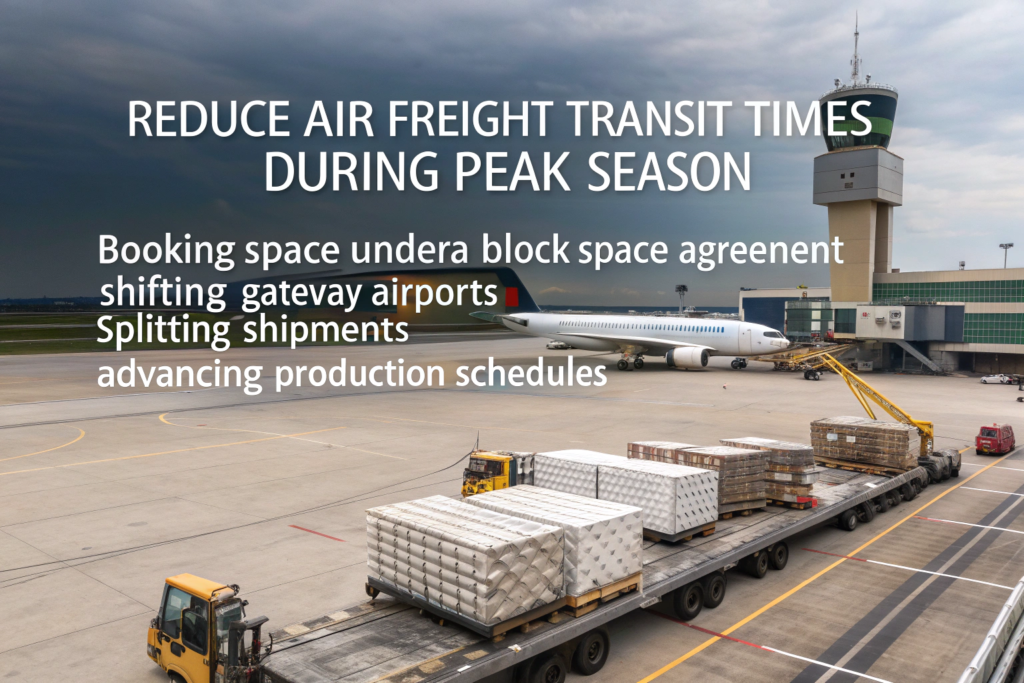
You can reduce air freight transit times during peak season by booking space under a block space agreement with a forwarder who holds guaranteed allocations, shifting your gateway airport to a less congested secondary hub, splitting large shipments into smaller packages that can move on passenger flights with more frequency, and advancing your production schedule so your cargo hits the airport in early September before the mid-October crunch. The forwarder’s capacity guarantee is your only real protection against a rolled booking.
I run a peak season air freight strategy session with every GeeseCargo client in August. We map out every purchase order, every launch date, and every Amazon restock trigger for the last quarter of the year. Then we lock in the space allocations and agree on a tiered routing plan. Let me share the specific tactics that keep my clients’ cargo moving when everyone else is stuck in the queue.
What is a block space agreement and how does it protect your timeline?
A block space agreement, or BSA, is a pre-purchased allocation of cargo space on a specific airline’s aircraft. Your freight forwarder commits to buying, for example, 5,000 kilos of space per week on a freighter flight from Shanghai to Los Angeles for the entire peak season. In return, the airline guarantees that those 5,000 kilos will fly on that flight, even when the flight is overbooked and other shippers are being rolled to the next departure. A forwarder with a strong BSA portfolio is the closest thing to an insurance policy on your air freight timeline. When you book with that forwarder, your cargo moves under the BSA umbrella and gets priority treatment at the airline’s cargo acceptance counter. I negotiate BSAs with multiple carriers across the major China-US lanes for my high-volume air freight clients. This also locks in the rate for the duration of the agreement, so you are not hit with the weekly spot rate spikes that can double the air freight cost in mid-October. You should ask your forwarder directly: "Do you have a block space agreement in place for this route during peak season, and can you confirm my shipment will be covered under it?" If the forwarder says they just book on the spot market, your cargo is at the bottom of the priority list and will be the first to get bumped when space tightens. The legal framework for these capacity agreements is based on the standard IATA Cargo Agency Program which governs the relationship between forwarders and airlines. A forwarder with an IATA Cargo Agent accreditation has met the financial and operational standards to negotiate BSAs directly.
How can you use secondary airport gateways to bypass congestion?
Los Angeles and New York are the elephant traffic jams of US air freight. Every forwarder routes cargo through LAX and JFK, and during peak season the terminals are overwhelmed with a flood of holiday merchandise. A simple routing shift can save you two to three days. Instead of flying into LAX and trucking to a warehouse in Dallas, fly directly into Dallas-Fort Worth International Airport. DFW is a major cargo hub with less congestion and faster terminal breakdown times. For Midwest destinations, Chicago O’Hare is a strong option. For the Southeast, Atlanta Hartsfield-Jackson is vastly underutilized compared to JFK. I also use secondary Chinese origin airports. Instead of fighting for space at the heavily congested Shanghai Pudong, I might truck the goods an extra two hours to Nanjing or Hangzhou airport and fly out of there. The trucking time is offset by the faster acceptance and processing at the smaller airport. You can research the cargo capabilities and flight frequencies of alternative airports using the official airport authority websites, such as the DFW Airport Cargo Services page, which lists the freighter operators and terminal facilities available. This approach requires a freight forwarder with a creative operations team willing to find routing alternatives, not just a sales agent who books the first flight option in the system. At GeeseCargo, I treat each shipment’s gateway airport as a decision variable, not a default setting. The right airport choice is often the single biggest difference between a 4-day transit and a 7-day transit during the chaotic peak months.
Conclusion
Air freight from China to the USA is the fastest commercial shipping option, but the "fast" label covers a wide range of real-world door-to-door timelines. The flight over the Pacific is always 12 to 14 hours. The time that gets added around that flight—the trucking to the origin airport, the consolidation warehouse buildup, the export clearance, the destination customs exam, and the cargo terminal breakdown—is what determines whether your total transit is 2 days, 5 days, or 8 days. The service tier you choose sets the baseline. Express moves your cargo as a priority on the tightest timeline. Standard consolidation saves money but adds warehouse handling days. Economy air is the slow boat of the sky, useful only when the goal is simply to beat the ocean by a few weeks.
The smartest air freight users think beyond the flight. They prepare customs documentation that clears without a hold. They use a forwarder with block space agreements so their cargo does not get rolled during peak season. They route through secondary airports to dodge the LAX and JFK congestion traps. And they make the air-versus-ocean decision based on the total business math—the carrying cost of inventory, the value of the sales window, and the true cost of a stockout—not just the freight invoice alone.
At GeeseCargo, I manage air freight as a supply chain acceleration tool, not a commodity rate. Your goods are not just moving from A to B; they are arriving to fulfill a promise you made to your customer. That promise has a deadline, and my job is to make sure the airplane, the truck, and the customs broker all honor it.