You have a product. The supplier in China is ready to ship. You open your laptop, search for "cheapest shipping from China," and fall into a pit of conflicting information. One site says ocean freight is always cheapest. Another says rail is the new budget option. A third says air freight can be cheaper for very small packages. You just want one clear answer, but the answer keeps changing depending on your shipment size, your destination, and your timeline. You feel like you need a logistics degree just to find the lowest cost option.
The cheapest way to ship internationally from China depends on three factors: your shipment volume, your destination, and your delivery timeline. For shipments over 2 cubic meters with a flexible timeline, ocean LCL or FCL is almost always the lowest cost per unit. For shipments under 0.5 cubic meters, air freight or express courier consolidations can be cheaper than ocean LCL minimum charges. For US East Coast destinations, rail-sea multimodal can undercut pure ocean Panama Canal routes. At GeeseCargo, we do not give you a generic answer. We run your actual shipment data through our quoting engine and show you the cheapest viable option for your specific situation.
Cheapest does not mean blind cheapest. The absolute lowest freight rate on a spot market website might come from a carrier with a 60% on-time record, hidden surcharges, and no customer support. The cheapest real-world option is the one that delivers your goods on time, without damage, with all costs disclosed upfront. I will show you how to find that option and how we structure our service to give you the lowest honest cost, not the lowest bait-and-switch quote.
How Does Ocean Freight Deliver the Lowest Cost Per Unit for Bulk Shipments?
You have 20 cubic meters of goods. You request quotes. The air freight quote is $8,500. The ocean FCL quote is $3,200. The ocean LCL quote is $2,800. The choice is obvious, but you do not understand why ocean is so much cheaper. You also do not know whether to choose LCL or FCL for your 20 cubic meters.
Ocean freight moves goods in massive quantities, spreading the fuel and crew costs across thousands of containers on a single vessel. A modern container ship can carry over 20,000 TEUs. The fuel cost per container is a tiny fraction of what an aircraft burns per equivalent cargo unit. For shipments over 15 cubic meters, ocean FCL provides the lowest cost per unit. For shipments between 2 and 15 cubic meters, ocean LCL is the cheapest door-to-door option. The trade-off is time. Ocean is 4 to 8 times slower than air freight.
The economics of ocean freight are driven by scale. A single ultra-large container vessel burns approximately 300 tons of heavy fuel oil per day at sea. That is a massive number, but divided by 20,000 containers, the fuel cost per container per day is modest. A cargo aircraft burns approximately 10 tons of jet fuel per hour, carrying perhaps 100 tons of cargo. The fuel cost per kilogram on a plane is 50 to 100 times higher than on a ship. This fundamental physics difference is why ocean freight will always be the cheapest mode for bulk cargo.
For your 20 cubic meter shipment, the FCL option is likely the cheapest per unit. A 20-foot container holds approximately 33 cubic meters. At 20 cubic meters, your utilization is 61%. The FCL rate is a flat fee for the entire container. The per-unit cost is the FCL rate divided by the number of units. If the FCL door-to-door cost is $3,200 and you ship 2,000 units, the cost per unit is $1.60. The LCL option might be $2,800, but it involves additional handling and a slightly higher per-unit risk of damage. For 20 cubic meters, FCL is the better value despite the slightly higher total cost because the per-unit cost is lower and the transit is faster.
The breakpoint between LCL and FCL is a critical number for cost optimization. Below roughly 15 cubic meters, LCL is cheaper in total cost. Above 15 cubic meters, FCL becomes cheaper per unit and faster. Our quoting engine calculates this breakpoint for every shipment. We do not let you choose LCL out of habit when your volume now justifies FCL.
What Is the Difference in Cost Structure Between Ocean LCL and FCL?
You see LCL quoted at "$85 per cubic meter" and FCL quoted at "$2,800 flat." You try to compare them directly. You cannot because the cost structures are fundamentally different.
LCL charges per cubic meter, with a minimum charge of one cubic meter. The quote includes the origin CFS handling, the ocean freight per CBM, and the destination CFS deconsolidation. FCL charges a flat rate for the entire container, regardless of fill level. The quote includes the origin trucking, the terminal handling, the ocean freight, and the destination terminal handling and drayage. For small volumes, the LCL per-CBM rate is cheaper than paying for an entire empty container. For larger volumes, the FCL flat rate divided by your high number of units produces a lower per-unit cost. We run both calculations and show you the cost per unit for each option.
How Does Ocean Freight Consolidation Lower Your Cost Even Further?
You have 5 cubic meters from Supplier A, 4 cubic meters from Supplier B, and 6 cubic meters from Supplier C. Individually, each is an LCL shipment. Together, they are 15 cubic meters, right at the FCL threshold.
We pick up all three partial loads and bring them to our consolidation warehouse. We combine them into one FCL container. You now pay one FCL rate instead of three LCL rates with three sets of CFS fees. The consolidation can reduce your total freight cost by 25% to 40% compared to shipping each supplier’s goods separately. Consolidation is the single most effective cost-reduction strategy for importers with multiple suppliers.
When Is Air Freight Surprisingly the Cheaper Option?
You have 0.3 cubic meters of sample products. The items are small, lightweight, and urgently needed. You request an ocean LCL quote. The quote is $450. You are shocked. How can half a cubic meter cost $450 by ocean? The answer is the LCL minimum charge.
For very small shipments under 0.5 cubic meters and under 100 kg, air freight or express courier consolidation can be cheaper than ocean LCL. The ocean LCL minimum charge covers the fixed costs of handling any shipment, regardless of size. Air freight per kilogram is expensive, but on a very small, lightweight shipment, the total cost can be lower than the ocean LCL minimum. We compare air and ocean for every small shipment and recommend whichever is actually cheaper.
The crossover point where air freight becomes competitive with ocean LCL is typically around 0.5 cubic meters and 50 to 100 kg. Below this threshold, the air freight cost for a small, dense package can be less than the ocean LCL minimum charge of one cubic meter. For example, a 30 kg box of smartphone cases at 0.2 cubic meters might cost $120 by air freight door-to-door and $380 by ocean LCL due to the minimum charge. Air freight is cheaper, and it arrives in 7 days instead of 30.
This is a counterintuitive reality that many first-time importers miss. They assume ocean is always cheaper and blindly choose LCL, overpaying for small shipments. Our quoting engine automatically checks both modes and flags when air freight is the lower-cost option. We do not profit from you making the wrong mode choice.
What Is the Air Freight Consolidation Model, and How Does It Reduce Cost?
You do not have enough cargo to fill an air freight pallet. You think you have to pay the full air freight rate for a small shipment, which seems prohibitively expensive.
Air freight consolidators combine small shipments from multiple shippers onto a single master air waybill. The consolidator negotiates a bulk rate with the airline. You pay a per-kilogram rate that is lower than booking directly with the airline for a small shipment. The transit time is still fast, typically 5 to 8 days door-to-door. This is the express air freight equivalent of ocean LCL.
How Does Dimensional Weight Impact Air Freight Cost?
You ship 100 empty gift boxes. They weigh 20 kg but occupy 0.8 cubic meters. You receive an air freight bill for 133 kg, not 20 kg. The cost is six times higher than you budgeted.
Airlines charge based on chargeable weight, which is the greater of actual weight and volumetric weight. Volumetric weight is calculated as length times width times height in centimeters, divided by 6000. For your gift boxes, the volumetric weight is 133 kg. You pay for 133 kg, not 20 kg. For ocean LCL, you pay based on volume, which in this case is 0.8 cubic meters. Ocean LCL might be cheaper for this specific shipment because the volume is moderate but the weight is very low. We calculate both the chargeable weight for air and the volume for ocean and show you the actual cost, not the theoretical rate.
How Can Rail and Multimodal Freight Offer a Middle-Ground Cost?
You ship to the US East Coast. The ocean freight quote via the Panama Canal is $4,200 and takes 35 days. The air freight quote is $11,000 and takes 8 days. You wish there was something in between. There is.
Rail-sea multimodal freight from China to the US East Coast offers a transit time of 20 to 25 days at a cost 30% to 50% less than air freight. The route uses the China-Europe rail network to a European port, then an Atlantic ocean crossing to the US East Coast. This is faster than the all-water Panama Canal route and significantly cheaper than air freight. For US East Coast and Gulf Coast destinations, rail-sea multimodal can be the cheapest option when the Panama Canal route is congested or when surcharges are high.
The China-Europe rail corridor has matured into a reliable freight option. The transit from a Chinese rail hub like Xi’an or Chongqing to a European port like Hamburg or Duisburg is 14 to 18 days. The Atlantic crossing from Europe to New York is 8 to 10 days. Total door-to-door is 22 to 28 days. This compares favorably to the 35 to 40 days for an all-water Panama Canal transit to the East Coast.
The cost is higher than direct ocean but much lower than air. For a 20-foot container, the rail-sea multimodal cost might be $5,500, compared to $4,200 for Panama Canal ocean and $14,000 for air. The rail option saves 10 to 15 days over ocean for a $1,300 premium. If your inventory carrying cost during those 10 to 15 days is more than $1,300, rail is actually cheaper than ocean when total cost is considered.
Our platform evaluates the rail-sea option for every East Coast and Gulf Coast shipment. We compare the total cost, the transit time, and the emissions. The recommendation is based on your specific shipment data and your stated priorities. Rail is an underutilized cost-optimization tool for US East Coast importers.
What Is the Exact Cost Comparison for a China-to-Chicago Shipment?
Your goods are destined for Chicago. You assume the only option is ocean to Los Angeles, then truck or rail to Chicago. You do not realize there are multiple port and mode combinations.
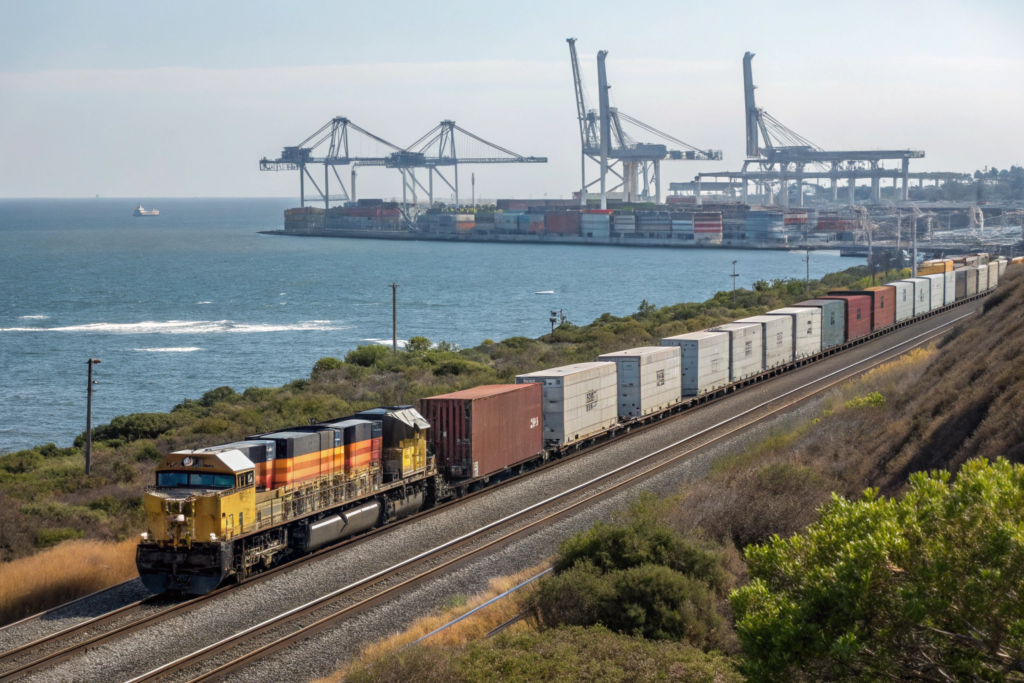
A typical 40-foot container from Shanghai to Chicago has three viable options. Option A is ocean to Los Angeles plus rail intermodal to Chicago, 18-22 days door-to-door, at approximately $4,500. Option B is ocean to Prince Rupert in Canada plus rail to Chicago, 20-24 days, at approximately $4,200. Option C is rail-sea via Europe to New York plus rail to Chicago, 25-30 days, at approximately $5,800. Option B is the cheapest. It uses the Canadian port of Prince Rupert, which has lower terminal fees and fast rail connections to the US Midwest. Many importers default to Los Angeles out of habit and miss the Prince Rupert savings.
How Do Port Congestion Surcharges Affect the True Cost Comparison?
The Port of Los Angeles announces a congestion surcharge of $500 per container due to labor slowdowns. Your standard LA route just got more expensive. The Houston route, unaffected by the labor issue, is now cheaper.
Our quoting engine incorporates real-time surcharge data. When a port adds a congestion surcharge, the cost for that routing updates immediately. The system may recommend an alternative port that avoids the surcharge. Dynamic routing around temporary cost spikes is a cost-reduction strategy that manual quoting cannot replicate.
How Do We Eliminate Hidden Costs That Make a "Cheap" Quote Expensive?
You receive a quote for $2,500. It is the cheapest you have found. You book the shipment. The final invoice arrives for $4,800. The difference is "accessorial charges" that were not included in the quote. You feel scammed. You were scammed.
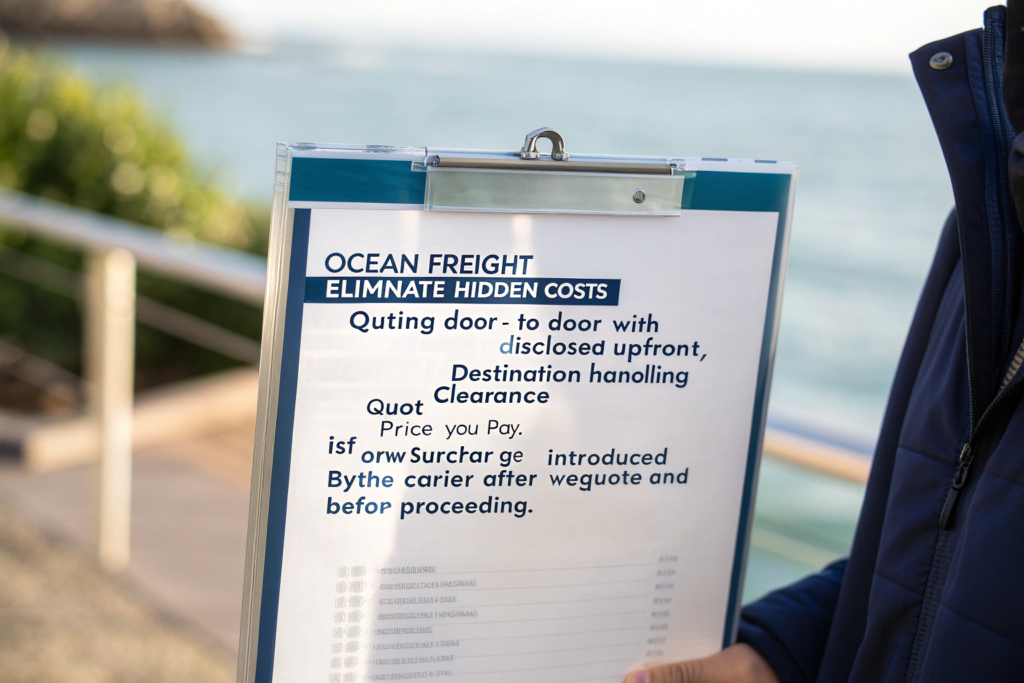
We eliminate hidden costs by quoting door-to-door with every line item disclosed upfront. Our quote includes the ocean freight, the BAF, CAF, and PSS surcharges, the origin and destination terminal handling, the customs clearance, the bond, the ISF filing, and the trucking. We do not quote a low teaser rate and then add mandatory surcharges later. The price we quote is the price you pay. If a new surcharge is introduced by the carrier after we quote and before you book, we tell you and get your approval before proceeding.
The low-quote-then-surprise-invoice model is unfortunately common in freight forwarding. The quoted "ocean freight" rate is a fraction of the total cost. The mandatory surcharges can double the quote. First-time importers are the most vulnerable because they do not know which surcharges are legitimate and which are padded.
We publish our all-inclusive pricing philosophy on our website. Every quote includes a line-item breakdown. You see exactly what you are paying for. We also guarantee that if we fail to include a known mandatory charge in the quote, we absorb it. This guarantee aligns our incentive with yours. We have every reason to be thorough in the quoting stage.
What Are the Most Common Hidden Charges in Freight Quotes?
You receive a quote that seems too good to be true. The base ocean freight is $800. You do not see the $450 BAF, the $150 CAF, the $400 origin THC, the $400 destination THC, the $125 chassis fee, and the $85 documentation fee.
A legitimate door-to-door quote for a 40-foot container from China to the US Midwest should include approximately fifteen line items. We list them all. We encourage you to compare our quotes against any competitor’s quote by insisting on a line-item door-to-door comparison. The exercise usually reveals that the competitor’s "cheaper" quote omitted several mandatory charges.
How Does Our Fixed-Price DDP Service Protect You from Cost Surprises?
You are tired of managing multiple vendors and reconciling multiple invoices. You just want one price that covers everything, including the duty. You want to know your total landed cost before you commit to the purchase order.
Our DDP service provides a single, fixed price from the factory to your door, including all freight, customs clearance, and import duties. We classify your product, calculate the exact duty, and include it in the quote. The price is fixed. If the duty rate changes after we quote, we absorb the difference for that shipment. If customs adds an exam fee, we cover it up to the standard exam fee amount. The DDP service is the ultimate protection against cost surprises. It is not always the absolute cheapest option, but it is the most predictable and often the best value when you factor in the administrative cost of managing multiple vendors.
How Do We Use Technology to Continuously Find You Lower Costs?
You have been shipping with the same forwarder for two years. Your rates have not changed. You suspect the market has moved, but you do not have the data to challenge your forwarder. You are probably overpaying.
Our AI rate management system continuously monitors the spot market, our contract allocations, and your shipment patterns. It identifies opportunities to reduce your cost. It might suggest consolidating two LCL shipments into one FCL. It might suggest shifting from a congested port to an alternative port. It might suggest adjusting your shipment timing to avoid peak season surcharges. Your account manager reviews these recommendations with you quarterly. Your freight cost is not set-and-forget. It is actively managed.
Technology is the long-term cost-reduction engine. A human forwarder can quote you a competitive rate today. An AI system can track your shipping patterns over months, compare them against market trends, and identify optimizations that a human would miss. The savings from these optimizations compound over time. A 5% reduction in freight cost achieved through load optimization, applied to $100,000 in annual freight spend, is $5,000 saved per year, every year.

How Does Carrier Performance Data Save You Money?
The cheapest carrier on paper has a 70% on-time record. The second-cheapest has a 93% on-time record. You choose the cheapest and save $200. The vessel is delayed by 5 days. You pay $350 in demurrage and miss a week of sales. The $200 savings cost you $350 plus lost revenue.
Our platform tracks carrier on-time performance, equipment availability, and claims history. The carrier recommendation considers total expected cost, not just the freight rate. The slightly higher freight rate is often the cheaper choice when reliability is factored in. We show you the data and let you decide.
How Does Our Quarterly Business Review Identify Cost Trends?
Your freight costs have crept up over the past year. You are not sure why. You do not have the time to analyze your shipment data manually.
Your account manager conducts a quarterly business review with you. The review covers your total freight spend, your average cost per unit, your cost by lane and by mode, and any significant variances. We identify the drivers of cost increases and propose specific actions to address them. This is a strategic service that goes beyond transactional freight forwarding. It is how we help you continuously improve your supply chain economics.
Conclusion
The cheapest way to ship internationally from China is not a single answer. It is a decision matrix that depends on your shipment volume, your destination, your timeline, and your tolerance for logistics involvement. Ocean LCL is cheapest for small-to-medium shipments. Ocean FCL is cheapest per unit for bulk shipments. Air freight consolidation can be cheapest for very small, lightweight shipments. Rail-sea multimodal can be cheapest for US East Coast shipments when total cost including inventory carrying cost is considered.
What is universally true is that the cheapest honest quote is not the lowest number on a rate sheet. It is the door-to-door price with all charges disclosed, from a forwarder with reliable operations that avoids demurrage, detention, and delivery failures. A low quote that results in a $750 demurrage bill is not cheap. A transparent quote from a forwarder who proactively manages your free days is.
At GeeseCargo, we combine instant, transparent quoting with AI-powered cost optimization and proactive operational management. We give you the cheapest real-world cost, not the cheapest marketing number. Our technology finds the optimal mode, route, and carrier for your specific shipment. Our people ensure the shipment executes smoothly so you avoid the hidden costs that inflate the final invoice.
If you want to know the cheapest way to ship your specific product from your specific factory to your specific warehouse, go to GeeseCargo.com and use our instant quote tool. Enter your shipment details. In under two minutes, you will see the cheapest viable options with all-inclusive pricing and realistic transit times. No hidden fees. No bait-and-switch. Just honest pricing from a forwarder who wants your business for the long term.