You found a product you love on Alibaba. The price per unit is amazing. You did the math, and the margin looks fantastic. You are ready to place your first order. Then the supplier asks: "Who is your freight forwarder?" You freeze. You do not have a freight forwarder. You do not even really know what one does. You just know that "freight" means cargo and "forwarding" means moving it forward. But the gap between that simple definition and actually getting 500 units of your product from a factory in Yiwu to your doorstep in Texas feels like a canyon.
A freight forwarder is your logistics architect and cargo travel agent rolled into one. We design and execute the physical journey of your goods from a factory in China to your warehouse or front door in the USA. We book the truck, the ship or plane, the customs clearance, and the final delivery. For a first-time importer, GeeseCargo replaces confusion with a single point of contact. We explain every step in plain English, we quote a fixed price with no hidden fees, and we hold your hand through the import process so your first shipment arrives smoothly and on budget.
You do not need to learn Incoterms or HTS codes on your first order. You need a partner who already knows them and can translate them into simple choices for your business. I built GeeseCargo to be that partner, especially for people who are shipping a container or a pallet for the very first time. Let me explain exactly what freight forwarding is, how it works, and why doing it with us is different from doing it alone or with a giant, impersonal logistics corporation.
What Exactly Does a Freight Forwarder Do for a First-Time Importer?
You have an Excel sheet with your product details, your supplier’s factory address, and your home address. You assume you just call a shipping company like you call a taxi. But the shipping company only moves a container from Port A to Port B. They do not pick up from a factory in a rural industrial park. They do not clear customs. They do not know what an ISF filing is. You need five different service providers, and you do not speak their language.
A freight forwarder coordinates every leg of the journey that a shipping line or airline does not cover. We arrange the truck to pick up from the factory. We receive and consolidate the goods in our warehouse. We book the vessel or aircraft space. We prepare and file the export customs declaration in China. We prepare and file the import customs entry in the USA. We pay the duties on your behalf. We arrange the truck to deliver from the destination port to your final address. You pay one bill and speak to one person for all of it.
Think of a freight forwarder as the general contractor for your shipment. You do not hire the electrician, the plumber, and the carpenter separately to build a house. You hire a general contractor who manages all the trades. We are that general contractor for your cargo. We have the trucking companies, the customs brokers, the ocean carriers, and the warehouse operators already contracted and integrated. You tell us the factory address and your delivery address. We tell you the price, the transit time, and the delivery date. Then we make it happen.
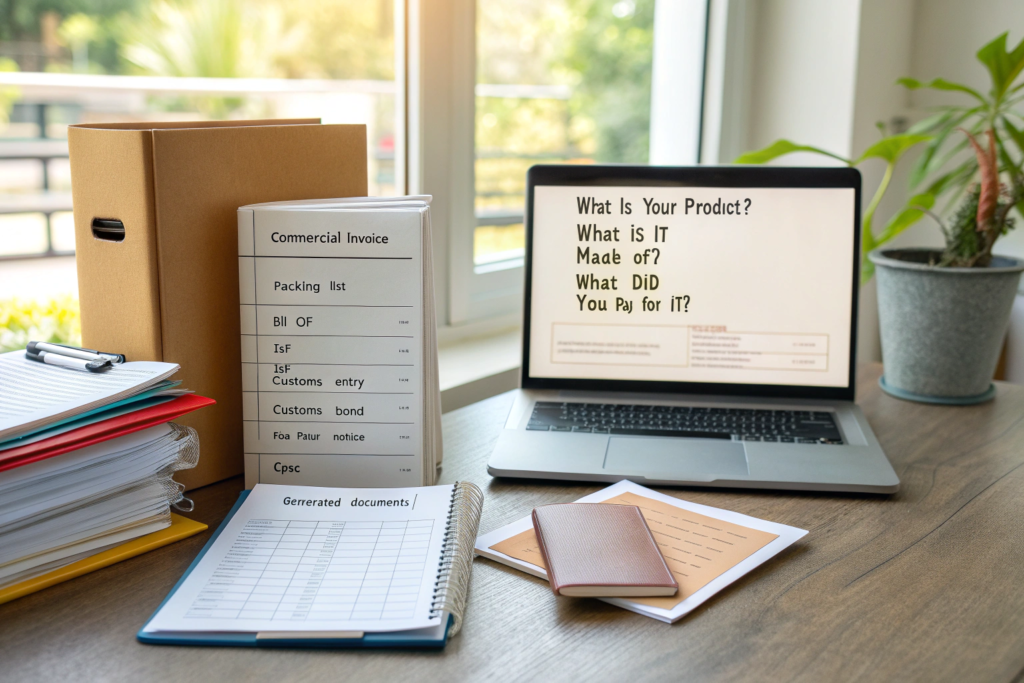
For a first-time importer, the most intimidating part is the paperwork. There is a commercial invoice, a packing list, a bill of lading, an ISF filing, a customs entry, a customs bond, and possibly a FDA prior notice or a CPSC certificate. A missing document can stall your shipment at the port and accrue daily storage charges. We generate all the required documents from the basic information you provide. We do not ask you to fill out a CBP Form 7501. We ask you: "What is your product? What is it made of? What did you pay for it?" We translate your answers into the correct customs data. This document preparation and filing service is the most valuable thing a forwarder does for a new importer. It turns a legal and bureaucratic obstacle course into a simple Q&A session.
What Is the Difference Between a Freight Forwarder and a Customs Broker?
You hear both terms and assume they do the same job. Or you hire a customs broker thinking they handle the trucking too. Then your goods clear customs and sit at the port because no one booked the delivery truck. You have a customs release, but the goods are not moving.
A customs broker is a licensed professional who specifically handles the import entry and clearance with US Customs and Border Protection. They are experts in tariff classification, duty rates, and customs regulations. A freight forwarder manages the physical transportation and the entire logistics chain. Most freight forwarders, including GeeseCargo, employ or contract licensed customs brokers as part of their integrated service. We do both. The physical movement and the customs clearance are managed under one roof. This integrated approach is critical for a first-time importer because a problem in customs directly affects the physical delivery. If the broker needs more product information, our team gets it instantly because we already have the packing list and the product specs from the consolidation stage. There is no finger-pointing between a separate forwarder and a separate broker when something goes wrong. Integrated freight forwarding with in-house customs brokerage is the standard for professional import logistics.
How Does a Freight Forwarder Book Space on a Ship or Plane?
You imagine us picking up a phone and calling a shipping line to ask if they have a spot. That is how it worked 40 years ago. Today, the process is digital, data-driven, and based on pre-negotiated contracts.
We have annual service contracts with the major ocean carriers and block space agreements with air cargo airlines. These contracts guarantee us a certain amount of container space or cargo weight capacity at a pre-negotiated rate on specific routes. When you book a shipment with us, we do not go to the spot market and hope for the best. We allocate one of our pre-reserved slots to your cargo. We transmit a digital booking request to the carrier’s system. The carrier confirms the space and the equipment. We receive a booking confirmation number. The empty container is released to our trucker at the designated depot. This entire process happens in hours, not days. For a first-time importer, this means your shipment is not at the mercy of market fluctuations. Your rate and your sailing date are locked in when you confirm with us. Our volume gives your small shipment the buying power of a much larger company.
What Are the Most Common Fears of First-Time Importers and How Do We Address Them?
You are lying awake at night, imagining worst-case scenarios. Your goods arrive damaged, and the factory blames the shipping company and the shipping company blames the factory. You pay a surprise $500 fee you never knew existed. Your shipment gets seized by customs because you declared the wrong value. Your product arrives and is completely different from the sample you approved. These fears are real, and they stop many people from ever placing their first order.
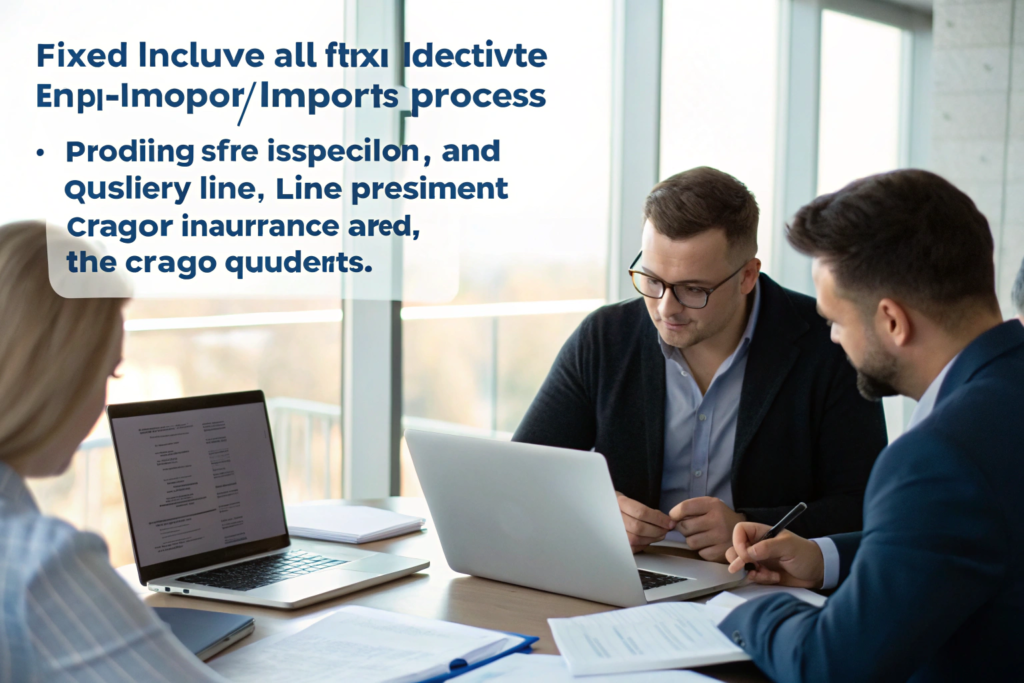
We address the top fears of first-time importers with transparent processes and hard guarantees. We provide a fixed, all-inclusive quote with every line item explained. We perform a pre-shipment inspection so you know the goods match your sample before they ship. We carry all-risk cargo insurance to cover damage or loss. We file customs with your correct transaction value, never falsifying invoices. We send you a step-by-step timeline after booking so you always know what is happening and what happens next. The unknown is the scary part. We make everything known.
The fear I hear most often is the fear of hidden costs. A first-time importer gets a low quote online, ships their goods, and then receives an invoice for "terminal handling charges," "congestion surcharge," "pier pass fee," "chassis usage fee," and "exam fee." They feel scammed. These fees are real, but they should have been included in the quote. Dishonest forwarders use a low base rate to win the business and then pile on the mandatory surcharges as "unexpected costs." We quote all-inclusive. Our door-to-door price includes the ocean freight, the terminal handling at both ends, the documentation fee, the customs clearance fee, the duty (if it is a DDP shipment), and the trucking to the final address. If any new surcharge is introduced by the carrier after we quote, we absorb it. We do not pass it on to you. This fixed-price promise is the foundation of trust with a first-time importer.
Another big fear is that the product will be wrong. You approved a sample six months ago. The factory has since produced 1,000 units. What if they substituted a cheaper material? We offer a pre-shipment inspection as a standard service for first-time importers. Our inspector goes to the factory, opens the cartons, and compares the production units against your sealed reference sample. He checks the color, the weight, the dimensions, the function, and the packaging. He takes clear photos and sends you a report. You see your goods and approve them before they leave China. If something is wrong, we stop the shipment and you negotiate with the factory while the goods are still in their possession. This inspection is the single most important safety net for a first order. It turns a leap of faith into a verified transaction.
How Does GeeseCargo Simplify the ISF Filing for a New Importer?
You have never heard of an Importer Security Filing. Then your forwarder sends you a form with ten data fields and a warning: "Must be filed 48 hours before vessel departure or $5,000 fine." You have no idea what a "consolidator" or "stuffing location" is. The form might as well be written in code.
We fill out the ISF for you. The Importer Security Filing, also known as 10+2, is a mandatory electronic submission to US Customs. It requires ten data elements from the importer and two from the carrier. We pull the required information from your commercial invoice and packing list. We know the factory address, the container loading location, and the consolidator details because we are the consolidator. We transmit the ISF via our customs broker’s ABI system at least 72 hours before the vessel departs. You receive a confirmation of filing. You do not fill out any forms. You just provide the basic order information, and we handle the regulatory compliance. This is a perfect example of how a good forwarder shields you from the complexity. You do not need to know what an ISF filing is to have one filed correctly on your behalf.
What Happens If Your First Shipment Is Selected for a Customs Exam?
You track your container and see "Held for CBP Exam." Your heart sinks. You imagine men in uniform tearing open your boxes and holding your goods hostage for weeks. You have no idea what to do or who to call.
We handle the exam process for you. A customs exam is a routine screening that happens to a percentage of shipments. It is usually not a sign of a problem. There are three types. A VACIS X-ray scan is non-intrusive and usually clears in a day. A tailgate exam involves opening the container doors and inspecting the first few cartons. An intensive exam involves unloading the entire container. If your shipment is flagged, our local exam team goes to the Centralized Examination Station. We are present when the container is opened. We make sure the officers open the cartons cleanly and we have a repacking crew ready to close everything back up. The exam fee is part of our quoted service. We do not send you a surprise bill for an exam that was always a statistical possibility. Most exams are cleared within 3 to 5 days. We update you on the status and the result. We do not let your cargo sit untouched in the exam queue. Our physical presence at the CES exam site speeds up the process and protects your goods from careless handling.
How Does the Shipping Process Work Step by Step with GeeseCargo?
You are ready to ship, but you do not understand the sequence. Does the factory call us, or do you? Does customs happen in China or in the US or both? How do you pay the duty? The process feels like a black box where goods go in one side and hopefully come out the other.
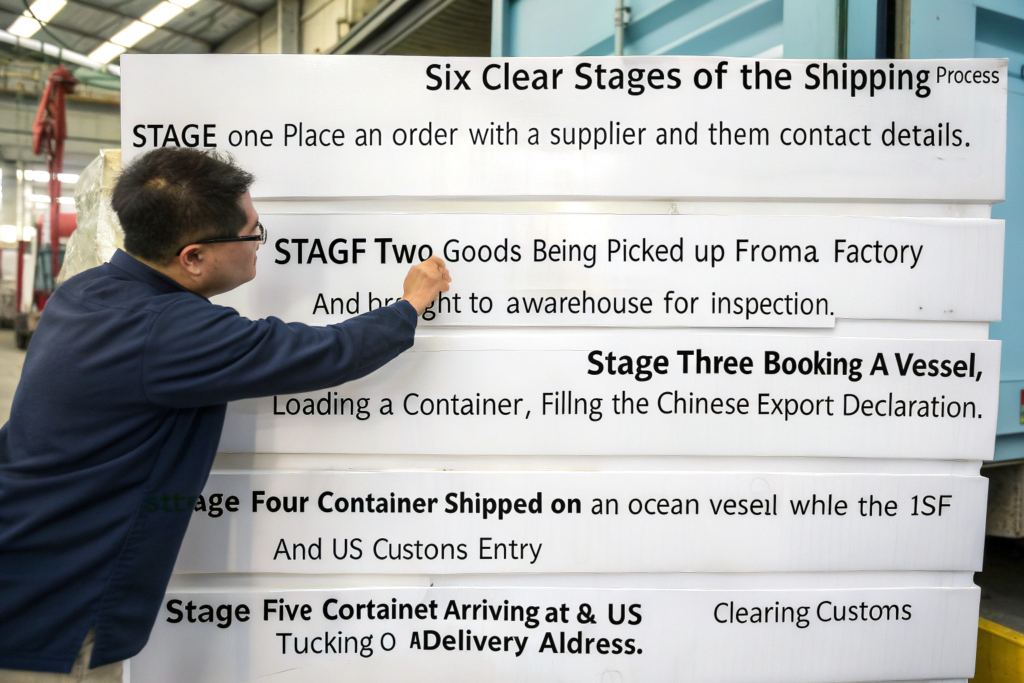
Our shipping process has six clear stages. One: You place your order with the supplier and give them our contact details as the forwarder. Two: We pick up the goods from the factory and bring them to our warehouse for quality inspection and consolidation. Three: We book the vessel, load the container, and file the Chinese export declaration. Four: The container is shipped on the ocean vessel while we file the ISF and the US customs entry. Five: The container arrives at the US port, clears customs, and is trucked to your delivery address. Six: You receive your goods and we send you the final documentation package. You know where your shipment is at every stage.
Let me walk through a real first-time shipment from a recent client. She found a supplier for woven cotton throw blankets on Alibaba. She ordered 500 units, and the total carton volume was 12 cubic meters. She told the supplier that GeeseCargo was the nominated forwarder and gave the supplier our contact information. The supplier finished production and sent us the packing list. We quoted her a door-to-door LCL rate from the factory in Nantong to her home in Portland, Oregon. She approved the quote and paid our invoice.
We arranged a truck to pick up the 12 cartons from the factory on a Tuesday. The truck arrived, the driver counted the cartons and signed the pickup receipt. The goods arrived at our Shenzhen consolidation warehouse on Friday. We inspected the cartons for external damage, scanned the barcodes, and confirmed the SKU count. We loaded the cartons into a shared LCL container with other goods destined for the Pacific Northwest. The container was gated into Yantian port on Monday. The vessel departed on Wednesday. We filed the ISF on Monday, two days before departure. While the ship was at sea, we filed the US customs entry. The blanket HTS code was 6301.30.0010, duty rate 8.3%. We paid the duty on her behalf. The vessel arrived in Los Angeles 14 days later. The container was discharged and moved to a CFS warehouse for deconsolidation. Our trucking partner picked up her 12 cartons and delivered them to her residential address in Portland three days after vessel arrival. Total transit time: 24 days door-to-door. Total cost: as quoted, no surprises. She received her blankets and started selling them on her Etsy store the same week.
What Documents Will You Receive as a First-Time Importer?
You assume the only document you need is a tracking number. But international shipping generates a paper trail for customs, for your accounting, and for your future importing record. You need to know what to keep and why.
You will receive the Commercial Invoice, the Packing List, the Bill of Lading (BOL), the Customs Entry Summary (CBP Form 7501), and the Delivery Receipt. The Commercial Invoice is the transaction record between you and the supplier. The Packing List details the carton contents. The Bill of Lading is the carrier’s contract of carriage and your proof of ownership of the goods. The Entry Summary is the official record of your customs entry, showing the HTS code, the duty rate, and the duty paid. The Delivery Receipt is the signed proof that the goods were delivered to your address. Keep all of these documents for at least seven years. They are your defense in a customs audit and your records for tax purposes. We provide all documents in digital format, stored in your client portal. You can download them anytime. This import documentation package is your import history. It builds your credibility as an established importer over time.
How Do You Pay for Your First Shipment?
You think you need to set up a customs account with the US government, get a bond, and have a wire transfer ready for the duties. The payment process seems like another bureaucratic hurdle you are not ready for.
We invoice you a single amount before the shipment departs. The invoice includes the ocean freight, the origin handling, the customs clearance, the duty and tax, and the destination delivery. You pay our invoice via bank transfer, credit card, or an online payment platform. We then pay the ocean carrier, the customs broker, the trucking company, and US Customs on your behalf. You do not make multiple payments to multiple parties. You do not set up a customs bond. You pay us, and we disburse the funds to the relevant parties. This consolidated payment process is part of our DDP service for first-time importers. It reduces the administrative burden to a single transaction. You focus on getting your marketing and sales ready while your goods are on the water.
Why Is GeeseCargo a Better Choice Than a Giant Multinational Forwarder for a Small Importer?
You email the big-name global forwarder that has a contact form on their website. Three days later, a sales representative in a different time zone sends you a generic PDF quote with 27 line items you do not understand. You call with a question, and you get a call center. You are a small fish in a very big pond, and the service reflects that.
We are built for small and mid-sized importers. Your first 500-unit shipment is important to us. We do not have a minimum shipment size that makes you "worth our time." You get a dedicated account manager who knows your name, your product, and your supplier. You can call or message me directly on WeChat or WhatsApp. We answer your questions in plain, jargon-free English. We celebrate your first successful delivery with you because your growth is our growth. Big forwarders want a hundred containers a month from a multinational corporation. We want to help you grow from one pallet to ten containers a year.
The giant forwarders operate on scale. Their business model depends on moving massive volumes for massive clients. A first-time importer with a single LCL shipment is a distraction, not a valued customer. You will be handled by a rotating cast of junior coordinators who are measured on call volume, not customer outcomes. Your questions will be answered with template emails. Your unique needs will be ignored because the process is standardized for a different type of client.
At GeeseCargo, we built our process around the first-time and growth-stage importer. We know you need more communication, not less. You need us to explain what a demurrage charge is before it happens, not apologize after. You need us to anticipate the questions you do not know to ask. When you ship your first container, I personally review the paperwork before it is filed. That level of attention is impossible at a global logistics conglomerate. Our size is our strength. We are large enough to have the carrier contracts and the bonded warehouse, but small enough that your shipment is never just a number in a queue. We choose to serve importers who are building something. Your business matters to us, and the relationship we build on your first shipment is one we intend to keep for your hundredth.

Do You Have Local Support for First-Time Importers in the US?
You worry that your freight forwarder is just an office in China. If a problem happens at the US port, who is physically there to fix it? You do not want to wake up at 3 AM to call China about a container stuck in Los Angeles.
We have a physical operations presence in the United States. Our team in Los Angeles manages the West Coast port arrivals, customs exams, and trucking coordination during US business hours. When your container is discharged at Long Beach, a local GeeseCargo coordinator oversees the pickup and the delivery. If a customs exam happens, our person is at the CES site. If the trucker is delayed, our person calls them and gets a real ETA. You communicate with us during your normal working hours. You are not managing a time zone gap during a logistics crisis. This local destination support is critical for a first-time importer who cannot afford a days-long delay in communication. The combination of our China origin team and our US destination team gives you 24-hour coverage on your shipment.
How Does Our Pricing Model Protect First-Time Importers from Surprises?
You receive a quote from a forwarder that says "$2,500 – Port to Port." You book it. The final invoice arrives for $4,800. The difference is "accessorial charges." You are told these are "standard" and you "should have known." You feel cheated, but you have no choice but to pay because the forwarder has a lien on your cargo.
We quote door-to-door, all-inclusive. Our quote includes the ocean freight, the BAF (Bunker Adjustment Factor), the CAF (Currency Adjustment Factor), the peak season surcharge if applicable, the terminal handling charges at origin and destination, the customs clearance fee, the bond fee, the ISF filing fee, the duty and tax (for DDP shipments), and the trucking to the final address. We list every component so you understand what you are paying for. If an unexpected cost arises that is truly outside our control and was not reasonably foreseeable, we call you, explain it, and get your approval before incurring it. We never hold your cargo hostage over a charge we failed to disclose. This transparent all-inclusive pricing model is the standard we set for ourselves and the reason our first-time importers become long-term clients.
Conclusion
Freight forwarding is the engine that makes global trade possible for small businesses. It is the process that takes a product from a factory you have never visited, in a country where you may not speak the language, and delivers it to your doorstep across an ocean. It is complex in its details but simple in its promise: your goods move from A to B, and you are informed and in control throughout the journey.
For a first-time importer, the choice of a freight forwarder is the single most important supply chain decision you will make. The wrong forwarder turns your first import into a nightmare of hidden fees, cryptic paperwork, and missed delivery dates. The right forwarder turns it into a repeatable, predictable system that powers your business growth.
At GeeseCargo, we chose to be the right forwarder for people just like you. We are professional, reliable, and competitive, just like our slogan says, but we are also patient, educational, and transparent. We remember what it was like to ship our first container. We know the questions you have because we have answered them a thousand times, and we are still happy to answer them again.
If you are sitting on a quote from a supplier and you are ready to take the leap into importing, go to GeeseCargo.com and send me the details. Tell me about your product, your factory address, and your delivery address. I will send you back a clear, all-inclusive quote and a step-by-step timeline. Let’s make your first shipment the start of a successful importing journey, not a cautionary tale.