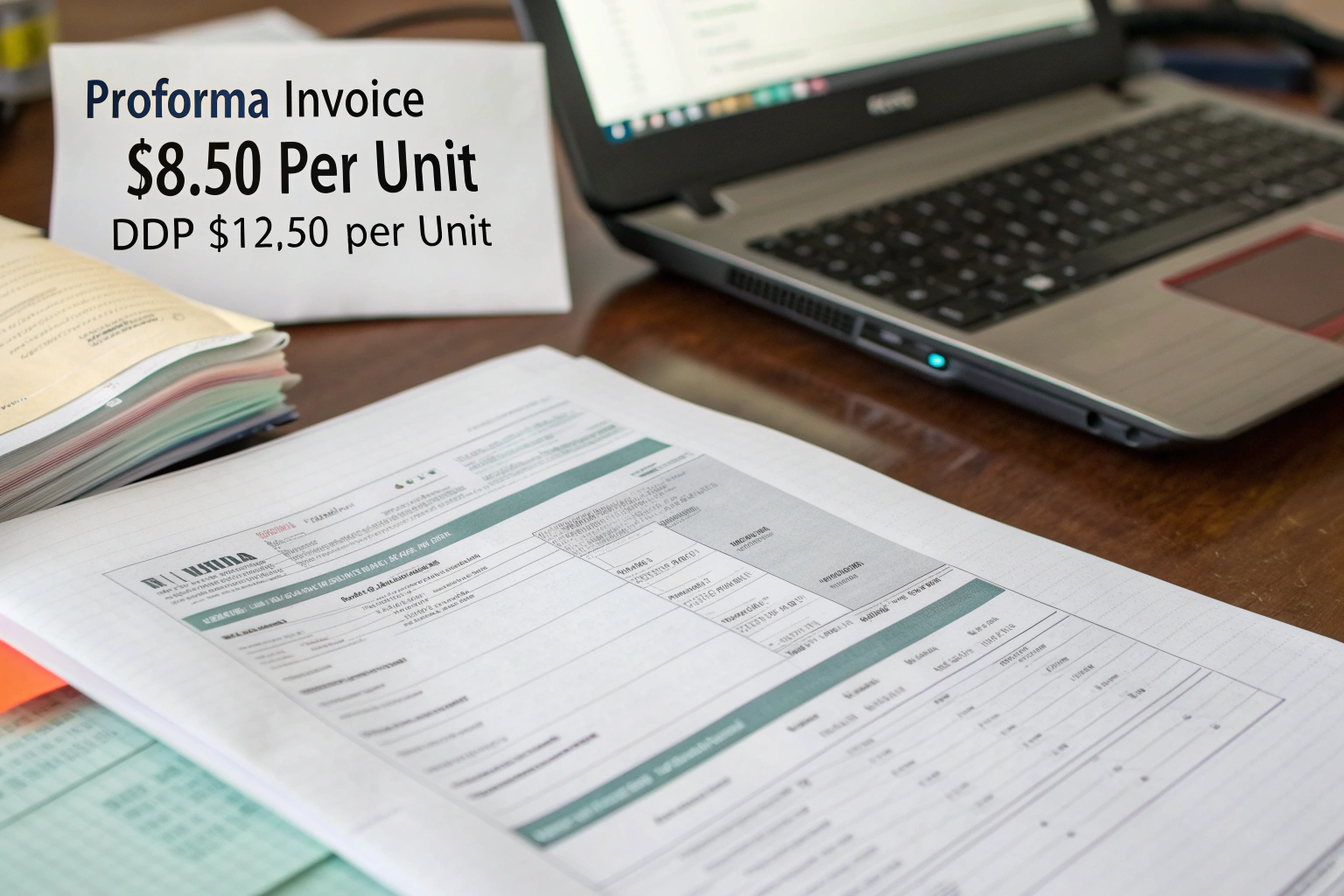
You found a supplier on Alibaba. You negotiated the product price down to $8.50 per unit. You are ready to pay. Then the supplier sends the proforma invoice with a shipping term you do not recognize: "DDP $12.50 per unit." You do the math. The shipping is $4.00 per unit. That seems high. You ask the supplier for the FOB price instead. They quote $8.50 FOB. You think you just saved $4.00 per unit. Then the container arrives at the US port, and you receive separate invoices from the customs broker, the port terminal, the trucking company, and US Customs for duties you did not know you owed. The actual cost per unit is $14.20. Your "savings" was a mirage.
DDP stands for Delivered Duty Paid. It is an Incoterm where the seller assumes all responsibility and cost for delivering the goods to the buyer’s named destination, including the freight, the insurance, the import customs clearance, and the import duties and taxes. For a US importer, a true DDP shipment means the goods arrive at your warehouse door with everything paid. You receive one invoice. You do not file customs paperwork. You do not pay a separate duty bill. You do not hire a trucker. The transaction feels like buying from a domestic supplier. At GeeseCargo, we offer a forwarder-managed DDP service that gives you this simplicity with full transparency and customs compliance.
DDP is the ultimate convenience Incoterm for importers. It is also the most misunderstood. Many importers confuse supplier-arranged DDP with forwarder-arranged DDP. The difference has significant legal and financial implications. Let me explain exactly how DDP works, who does what, and why our DDP service might be the right choice for your imports.
What Exactly Does DDP Mean Under Incoterms 2020?
You see "DDP" on a quote and assume it just means "shipping included." The reality is more specific, and the specifics protect you legally. DDP is not a vague promise. It is a defined legal term with specific obligations for the seller and the buyer.
Under Incoterms 2020, DDP means the seller delivers the goods to the buyer at the named place of destination, cleared for import, with all duties and taxes paid. The seller bears all costs and risks up to that point. The buyer’s only obligation is to unload the goods from the arriving vehicle. DDP represents the maximum obligation for the seller and the minimum obligation for the buyer. It is the only Incoterm that requires the seller to handle import customs clearance and pay the import duties. For a US importer, this means the seller or their logistics agent acts as the Importer of Record into the United States.
The legal definition is important because it defines who is responsible when something goes wrong. Under DDP, if the container is lost at sea, the seller bears the loss. If US Customs assesses additional duties, the seller pays them. If the truck crashes on the way to your warehouse, the seller’s insurance covers it. You are not responsible for anything until the goods are physically at your address.
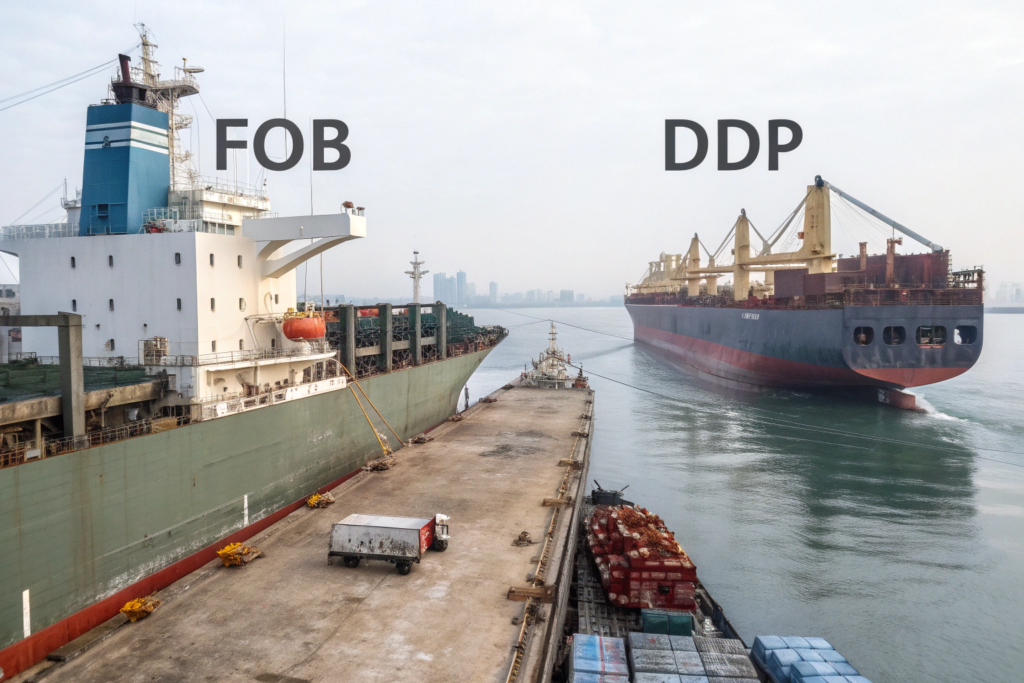
Compare this to FOB, the most common alternative. Under FOB, the seller’s responsibility ends when the goods cross the ship’s rail at the Chinese port. From that moment, you bear the risk of loss, you pay the ocean freight, you handle the US customs clearance, you pay the duties, and you arrange the delivery. FOB gives you control but also responsibility. DDP gives the seller control and responsibility. The choice between them is a choice between control and convenience.
What Is the Difference Between DDP and DAP?
You see DAP on a supplier’s quote and wonder if it is the same as DDP. The names are similar, but the duty payment obligation is different. This difference can surprise you with a customs bill you did not expect.
DAP stands for Delivered at Place. Under DAP, the seller delivers the goods to the named destination, cleared for import, but the import duties and taxes are NOT paid by the seller. They are paid by you, the buyer. The seller handles the freight and the customs clearance logistics, but you get the duty bill. DDP is DAP plus the duty payment. If you are comparing supplier quotes and one says DAP and one says DDP, the DDP quote includes the duty. The DAP quote does not. Add the estimated duty to the DAP quote before comparing.
Who Is the Importer of Record Under a DDP Shipment?
This is the most critical legal question in any DDP arrangement. The Importer of Record is the entity legally responsible to US Customs for the entry. The IOR’s name and tax ID are on the customs entry. If there is a compliance issue, CBP comes after the IOR. You need to know who this is.
In a supplier-arranged DDP, the supplier or their customs broker is typically the IOR. You are not named on the customs entry. This sounds convenient, but it means you have no access to the customs records. If CBP audits the entry three years later, they may contact you as the recipient of the goods, and you will have no documentation to provide. In our forwarder-managed DDP, GeeseCargo acts as the IOR using our continuous customs bond. We are the IOR, but you are our client, and we provide you with the complete entry documentation, including the CBP Form 7501. You have full visibility and a partner to handle any audit. This is a more transparent and compliant model.
How Does Our Forwarder-Managed DDP Service Work Step by Step?
You are interested in DDP, but you are not sure how the process differs from FOB. You do not want to hand over control of your entire supply chain to a supplier who may not prioritize your interests. You want the convenience of DDP with the transparency of working with your own logistics partner.
Our DDP service combines the convenience of a single-point-of-contact door-to-door delivery with the transparency and compliance of a licensed US customs broker acting as your Importer of Record. The process has six steps. One: you provide your supplier’s details, your product information, and your delivery address. Two: we quote a single, all-inclusive door-to-door price that includes the freight, the customs clearance, and the estimated duty. Three: we coordinate the pickup from your supplier. Four: we ship the goods, clear US customs under our bond, and pay the duties. Five: we deliver to your warehouse. Six: we send you the final documentation package. You pay one invoice. You have one point of contact.
Let me walk through a real example. A client found a supplier for 1,000 units of stainless steel water bottles. The supplier was in Ningbo. The client’s warehouse was in Phoenix, Arizona. The client wanted DDP because they had never imported before and did not want to learn customs clearance on their first shipment.
Step one: the client sent us the supplier’s contact, the product description and photos, the carton dimensions and weight, the unit price, and the delivery address. We contacted the supplier in Mandarin to confirm the pickup details and the product specifications.
Step two: we classified the water bottles under HTS code 9617.00.1000. The duty rate was 6.5%, and Section 301 added another 7.5%, for a total of 14%. We calculated the estimated duty on the declared value of $4,500 as $630. We built the door-to-door quote including the origin pickup, the ocean freight, the surcharges, the customs clearance, the bond, the ISF, the duty, and the delivery to Phoenix. The total was $3,850. The client approved the quote. One invoice was issued and paid.
Step three: we arranged the pickup from the Ningbo factory. Our trucker collected the cartons, verified the count, and transported them to our consolidation warehouse.
Step four: the goods were consolidated, the container was loaded, the vessel sailed, we filed the ISF and the customs entry, and we paid the $630 duty to CBP from our duty account.
Step five: the container arrived in Los Angeles, cleared customs, was transloaded, and the goods were trucked to the client’s warehouse in Phoenix.
Step six: the client received the goods, signed the delivery receipt, and we sent the final documentation package including the BOL, the commercial invoice, and the CBP Form 7501 showing the duty paid.
The client’s total involvement was providing the initial information, approving the quote, paying the invoice, and receiving the goods. Everything in between was handled by us.
How Does Duty Payment Work in Our DDP Model?
You are worried the duty amount in the DDP quote is an estimate that will change after delivery, leaving you with an unexpected bill. In our DDP model, the duty is fixed and included.
We calculate the duty during quoting based on your product’s HTS code and your declared transaction value. We look up the current duty rate and any applicable Section 301 tariffs. We include this exact amount in the quote. When we file the customs entry, we pay CBP directly from our continuous bond. If the actual duty matches the estimated duty, the transaction is closed. If there is a discrepancy because of a reclassification at the port, we absorb minor variances. You do not receive a post-delivery duty bill. This fixed-duty guarantee is a core part of our DDP service.
What Happens If Customs Holds the Shipment for Examination?
You chose DDP to avoid dealing with customs problems. Then you hear the shipment is in exam. You worry you will be asked to provide documents you do not have or pay fees you did not budget for.
Under our DDP, the exam is our problem. Our local team at the destination port manages the exam process. We are present when the container is opened. We handle any documentation requests from CBP. The exam fee is covered by us up to the standard exam fee amount. If the exam results in a duty reclassification, we handle the adjustment. You are informed of the exam and the outcome, but you are not required to take any action.
What Are the Benefits of DDP for Different Types of Importers?
You are not sure if DDP is right for your specific situation. You ship regularly, but you do not have a logistics team. You value simplicity, but you also value cost control. You want to know if DDP is worth the premium over FOB.
DDP is ideal for three types of importers. First-time importers who want a low-risk, low-complexity entry into global sourcing. They avoid the steep learning curve of customs clearance and freight management. Small-to-medium businesses without a dedicated logistics team. They outsource the entire logistics function to us and focus their time on product and sales. Importers shipping to Amazon FBA for the first time. Amazon requires strict delivery compliance, and DDP ensures the goods arrive at the fulfillment center with all duties paid and all paperwork in order. DDP is also valuable for any importer who simply prefers the predictability of a single, all-inclusive cost.
The premium for DDP over FOB is not just a convenience fee. It is the cost of transferring the logistics workload and the customs risk from you to us. For FOB, you or your team must coordinate the freight booking, the customs broker, the duty payment, and the delivery trucker. You must manage the timing of each step. You must respond to customs queries. This labor has a cost, even if you do not pay yourself a logistics salary. The time you spend on logistics is time you do not spend on growing your business. DDP frees that time.
For a first-time importer, DDP is almost always the right choice. The risk of making a costly mistake on your first FOB shipment, such as misclassifying your product, underpaying duty, or missing the ISF filing deadline, is high. DDP protects you from those mistakes while you learn the process. After a few DDP shipments, you will understand the process well enough to consider FOB if you want more control and potentially lower costs.

Is DDP More Expensive Than FOB in the Long Run?
You ran the numbers. The DDP quote from a supplier was 25% higher than the FOB price plus your estimated freight and duty. You suspect the DDP markup is high. You are correct to be suspicious of supplier DDP pricing, but forwarder DDP is different.
Supplier DDP is often inflated. The supplier marks up the freight and the duty to create an additional profit center. The markup can be 20% to 40% above the actual costs. Forwarder DDP, where you contract directly with us for the door-to-door service, is transparent. The cost is the same freight, duty, and fees you would pay under FOB, plus a service fee for managing the process. The total is typically comparable to FOB when you account for the administrative cost of managing FOB yourself. We encourage you to compare. Ask us for a DDP quote and an FOB plus freight quote for the same shipment. See the difference. The transparency allows you to make an informed choice.
Can DDP Be Used for Amazon FBA Shipments?
Amazon requires FBA shipments to be delivered to specific fulfillment centers with the duties paid and the cartons labeled to FBA specifications. You are not sure if DDP is compatible with FBA requirements.
DDP is highly compatible with FBA. In fact, we offer a dedicated DDP-to-FBA service. We handle the freight, the customs clearance, the duty payment, and the FBA-compliant labeling and palletizing. The goods arrive at the Amazon fulfillment center ready for receiving. Amazon does not act as the IOR. We do. The delivery is a domestic delivery with all duties paid. This is the smoothest way to get your first FBA shipment into Amazon’s network.
How Does Our DDP Service Ensure Customs Compliance?
You have heard horror stories about DDP shipments where the forwarder under-declared the customs value to save on duty. The goods were seized, and the importer was investigated. You want the convenience of DDP without the compliance risk.
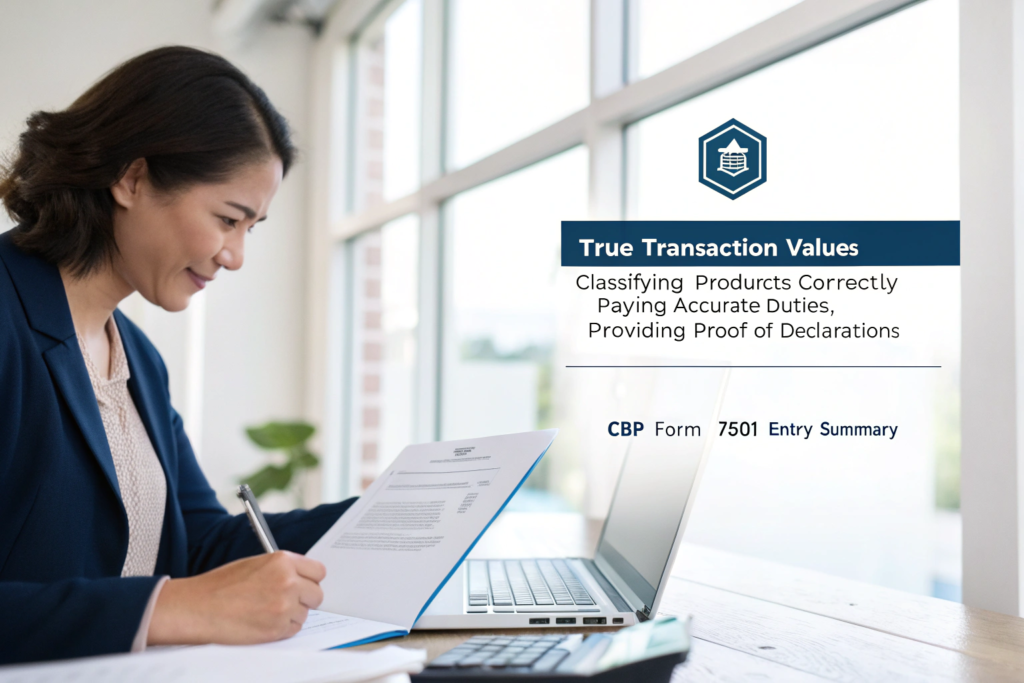
Our DDP service is built on strict customs compliance. We declare the true transaction value from your commercial invoice. We classify your product under the correct HTS code, supported by a binding ruling if necessary. We pay the accurate duty. We do not under-declare values. We do not misclassify goods. We provide you with the CBP Form 7501 Entry Summary as proof of the declaration. Our compliance record protects you from audits, penalties, and seizures. Cheap DDP that cuts compliance corners is not cheap in the long run.
The compliance risk in DDP arises when the Importer of Record is a shell entity or a supplier’s agent who prioritizes minimizing the duty bill over following the law. The most common violation is undervaluation. The commercial invoice shows a value of $2,000, but the goods are worth $10,000. The duty is paid on $2,000. CBP’s targeting system detects the anomaly. The shipment is seized, and the beneficial owner, which is you, is investigated.
We do not engage in these practices. Our US customs broker license is at stake. Our relationship with CBP is built on a history of accurate filings. We declare the value you tell us is the true transaction value. If you are unsure about the correct value, we explain the legal standard: the price actually paid or payable for the goods. This is your purchase price from the supplier, not a lower number designed to save duty. Compliance is not negotiable. It is the foundation of a sustainable import business.
What Documentation Do You Receive for Customs Records?
You are concerned about an audit. CBP sends a Form 28 Request for Information three years after a shipment. You need the customs entry and the commercial invoice. You do not know if your DDP forwarder will provide them.
We provide the full documentation package after every shipment. The package includes the commercial invoice, the packing list, the bill of lading, the ISF confirmation, and the CBP Form 7501 Entry Summary. The documents are stored in your client portal, accessible anytime. If CBP audits you, you have the records. You do not need to chase a supplier or a forwarder who may no longer be in business.
How Do We Handle Anti-Dumping or Countervailing Duties?
Your product is subject to an anti-dumping duty order. You did not know this. A non-compliant DDP forwarder might ignore the AD/CVD order and file the entry without the required case number and cash deposit. The shipment clears initially, but CBP issues a penalty bill months later.
We screen every product against the active AD/CVD orders during the quoting stage. If your product is covered, we tell you. We explain the additional duty rate and the filing requirements. We file the entry correctly with the case number and the cash deposit. We do not ship products subject to AD/CVD without your informed consent. This screening protects you from the retroactive penalty bills that can bankrupt a small import business.
Conclusion
DDP shipping is the simplest way to import goods from China to the USA. You pay one price, and the goods arrive at your door with all logistics, customs clearance, and duties handled by your forwarder. The key distinction is between supplier-arranged DDP and forwarder-managed DDP. Supplier DDP is opaque and often non-compliant. Forwarder DDP, like our service at GeeseCargo, is transparent, compliant, and gives you full access to your customs records.
For a first-time importer, DDP removes the fear and complexity of international logistics. You do not need to learn customs clearance, bond types, or duty rates to get started. You focus on your product and your sales. We handle the journey. For an experienced importer, DDP offers a managed service option for specific shipments or channels where you prefer to outsource the logistics workload.
If you are considering DDP for your next shipment, go to GeeseCargo.com and request a DDP quote. Provide your supplier details, your product information, and your delivery address. I will send you a single, all-inclusive price and a clear breakdown of what is included. You can compare it against your FOB costs and make an informed decision. Let us handle the complexity so you can focus on growing your import business.