Your shipment has arrived at the Port of Los Angeles. The vessel is docked, the containers are being discharged, and your trucker is standing by. Then your customs broker calls. "We’re missing the packing list with the correct carton-level details, and the commercial invoice value doesn’t match the manufacturer’s declaration. Customs has flagged your entry for a document review." Your container sits in the terminal, accruing demurrage at $150 per day, while you frantically email your factory in China at midnight their time. I have rescued countless importers from this exact scenario. The difference between a shipment that clears customs in 4 hours and one that sits in a bonded warehouse for two weeks is the accuracy and completeness of the paperwork prepared before the vessel even leaves China.
The mandatory documents for US customs clearance from China are the Commercial Invoice, the Packing List, the Bill of Lading or Air Waybill, and the Customs Entry Summary (CBP Form 3461 or 7501). Depending on your product, you may also need an Importer Security Filing (ISF or "10+2"), a customs bond, and additional agency certificates such as FDA, FCC, or TSCA forms. Missing or inaccurate information on any of these documents is the number one cause of customs holds and storage fee nightmares.
You do not need a law degree to get your paperwork right. You need a clear checklist and a forwarder who audits your documents before the cargo ships. At GeeseCargo, I review every document package with a pre-clearance audit to catch errors while the goods are still on the water. Let me walk you through each required document, what it must contain to satisfy US Customs and Border Protection, and how to coordinate with your factory so the paperwork supports a smooth clearance every time.
What Are the Core Shipping Documents Required for Every Import?
You ask your factory for "the shipping documents." They email you three PDFs with Chinese characters in the file names. You forward them to your US customs broker and assume the job is done. The broker replies that the commercial invoice is missing the country of origin, the packing list does not show the individual carton weights, and the bill of lading consignee name does not match your importer of record number. The clearance process has not even started, and you are already in correction mode. The core documents are not just a formality; they are legal declarations to the US government, and the information on them must be consistent and complete across every single page.
The three core shipping documents required for every US customs clearance are the Commercial Invoice, the Packing List, and the Bill of Lading for ocean freight or the Air Waybill for air freight. The Commercial Invoice is the legal sales document that declares the value, the buyer and seller, the country of origin, and the detailed product description. The Packing List is the physical inventory of the shipment showing how the goods are packed. The Bill of Lading is the carrier’s receipt and contract of carriage. All three must align perfectly on the shipper, consignee, product description, and quantity.
I treat these three documents as a single connected set. A mistake on one ripples to the others and triggers a CBP hold. At GeeseCargo, I send every new client a "Document Alignment Checklist" that maps out exactly which fields must match across the Commercial Invoice, the Packing List, and the Bill of Lading. Let me break down each document’s specific requirements and the common errors that cause clearance failures.
What specific information must a commercial invoice contain for US Customs?
The Commercial Invoice is the most important document in your clearance package. CBP uses it to determine the transaction value, which is the basis for your duty calculation. If the invoice is vague, undervalued, or missing mandatory fields, CBP will hold your shipment and potentially issue a penalty for a non-compliant entry. A legally sufficient commercial invoice must contain: the seller’s full name and address, the buyer’s full name and address as the Importer of Record, a detailed description of each product in plain English, the quantity of each item, the unit price and total price, the currency of the sale, the country of origin of the goods (which must say "China" for goods manufactured in China), and the terms of sale or Incoterm. The product description is the most common failure point. "Clothing" is not acceptable. "Women’s 100% Cotton Knitted T-Shirts, Style Number 45B" is acceptable. "Gifts" is a red flag that triggers an automatic examination. The invoice must also declare whether the goods are sold or consigned. If the transaction is between related parties, the relationship must be disclosed. You can find the full list of required invoice elements on the official CBP Commercial Invoice Requirements page. I require my clients to send me a draft commercial invoice before the factory ships the goods. I review the product descriptions against the HTS code we are using for the entry. If the description on the invoice does not match the HTS description, we fix the invoice before it becomes a customs problem.
Why does the packing list need carton-level detail and not just total quantities?
The Packing List is not just a summary of what you shipped. It is a physical map of the container or pallet. CBP officers use the packing list during inspections to locate specific cartons and verify that the contents match the declaration. A packing list that says "Total: 500 units of shirts" is useless for an inspection. A packing list that says "Carton 1 of 10: 50 units of Style 45B, size Medium, carton weight 12kg, carton dimensions 60x40x30cm" is exactly what CBP needs. The carton-level detail also protects you. If CBP pulls one carton for examination and finds a discrepancy, a detailed packing list limits the problem to that specific carton batch rather than the entire shipment. The packing list must also show the total gross weight and total cubic measurement of the entire shipment, which must match the Bill of Lading weight declarations. A weight discrepancy between the packing list and the Bill of Lading triggers a VGM (Verified Gross Mass) violation that can delay the vessel loading at origin and flag the entry at destination. The Freight Packaging Standards from NIST provide guidance on proper weight and measure documentation for freight. I train my clients’ factories to use a standardized packing list template that fills in the carton-level data automatically from the production management system. At GeeseCargo, I audit the packing list against the commercial invoice line by line before the Bill of Lading is cut, because once the Bill of Lading is issued, any change incurs an amendment fee and flags the entry for a secondary review.
What Is the Importer Security Filing (ISF) and When Must It Be Filed?
You have never heard of ISF. Your forwarder never mentioned it. Your cargo arrives at the US port, and CBP issues a "Do Not Load" notice or a $5,000 penalty for a late ISF filing. You are now on CBP’s non-compliance list, and every future shipment will face increased scrutiny. ISF is not an optional add-on; it is a mandatory electronic filing required by US law for all ocean freight imports. It must be filed before the vessel departs from the foreign port, not when it arrives. Failure to file, late filing, or inaccurate filing carries the same financial penalty, and CBP enforces this rule with automated systems that generate penalty notices without human review.
The Importer Security Filing, commonly called ISF or "10+2," is a mandatory electronic submission to CBP that must be filed at least 24 hours before the vessel departs from the foreign port. The "10" refers to ten data elements the importer must provide: the manufacturer name and address, the seller name and address, the buyer name and address, the ship-to address, the Importer of Record number, the consignee number, the country of origin of the goods, and the first eight digits of the Harmonized Tariff Schedule code. The "+2" refers to two data elements the carrier must provide: the vessel stow plan and the container status messages.
I treat the ISF filing as the trigger that starts the entire customs clearance process. At GeeseCargo, I file the ISF for my clients within 24 hours of receiving the final commercial invoice and packing list, and always at least 48 hours before the vessel departure to allow for any CBP rejection and re-filing. Let me explain what happens if the ISF is wrong and how to structure the filing responsibility between you and your forwarder.
What happens if your ISF is filed late or contains incorrect data?
CBP assesses a liquidated damages penalty of $5,000 per late or inaccurate ISF filing. This penalty is not discretionary; it is automatically generated by the CBP Automated Targeting System when the ISF timestamp is later than 24 hours before vessel departure or when the submitted data does not match the Bill of Lading data that the carrier files. The penalty notice arrives months after the shipment, and you must either pay it or file a mitigation petition explaining the error and requesting a reduction. Mitigation is possible for a first-time, good-faith mistake, but CBP keeps a compliance record, and repeat offenders face escalating penalties and potential cargo holds on arrival. The most common ISF error is an incorrect manufacturer name. The ISF requires the legal name and physical address of the entity that actually manufactured the goods, not the trading company or the exporter. If your factory is "Dongguan Xinghua Garment Co., Ltd." and your supplier is a trading company called "Shenzhen Global Trading," the ISF must list the factory name. Listing the trading company triggers a mismatch with the Bill of Lading shipper data and generates an automatic ISF violation. You can read the full ISF enforcement guidelines on the official CBP ISF Requirements Page which details the data elements, the timing requirements, and the penalty structure. I always verify the manufacturer’s business license document to extract the exact legal name and registered address for the ISF filing. A two-minute verification prevents a $5,000 penalty.
Who is responsible for filing the ISF, the importer or the forwarder?
The legal responsibility for the ISF filing rests with the Importer of Record, which is you, the US buyer. However, you can authorize your customs broker or freight forwarder to file the ISF on your behalf using a Power of Attorney. Most small and medium importers delegate the ISF filing to their freight forwarder because the forwarder already holds all the shipment data and can file efficiently. The key is that the Power of Attorney document must be on file with CBP and specifically authorize the forwarder to file ISF. A general freight booking authorization does not cover the ISF filing requirement. I require every new GeeseCargo client to sign a CBP-compliant Customs Power of Attorney before I file any ISF or customs entry on their behalf. This document designates my licensed customs broker as the authorized agent for ISF and entry filing. Even if I file the ISF, the client remains legally liable for the accuracy of the data because the client provides the commercial invoice and manufacturer information. I bridge this gap by sending the client a draft ISF summary before filing. The client confirms in writing that the manufacturer name, the HTS code, and the ship-to address are correct. This confirmation email serves as the record that the data was provided by the importer. If CBP later challenges an element, we have a clear audit trail showing the client approved the filing data.
What Additional Documents Are Required for FDA, FCC, and TSCA Regulated Goods?
Your shipment of plush toys arrives at the port. CBP puts an "Intensive Exam" hold on the container. The issue is not the customs entry; it is the lack of a required CPSC certificate for children’s products. Your toys contain small parts that require lead and phthalate testing, and you did not include the test reports in the document package. The container is moved to a Centralized Examination Station, where it waits three weeks for an inspector to pull samples and send them to a lab. The storage fees, exam fees, and lab fees accumulate daily. Regulated products are not just dutiable; they are subject to agency reviews that go beyond the CBP entry process. If your product touches the human body, uses a radio frequency, or is marketed to children, you must prepare additional documents before you ship.
Additional US customs clearance documents are required for products regulated by the Food and Drug Administration (FDA), the Federal Communications Commission (FCC), and the Environmental Protection Agency (EPA) under the Toxic Substances Control Act (TSCA). FDA-regulated goods like cosmetics, food contact materials, and medical devices require prior notice filings and facility registrations. FCC-regulated electronics require an FCC compliance declaration or certification. Children’s products require a Children’s Product Certificate (CPC) with ASTM and CPSC lab test reports. Failure to provide these documents results in an automatic detention and a refusal of entry.
I learned early in my career that "general cargo" does not mean "no agency review." A simple silicone spatula is FDA-regulated as a food contact substance. A USB charging cable is FCC-regulated as an intentional radiator. At GeeseCargo, I classify every product by its regulatory agency before quoting the freight. Let me walk through the three most common agency requirements that catch importers by surprise.
How do you file FDA prior notice for cosmetic and food contact goods?
The FDA requires a Prior Notice filing for any article of food, dietary supplement, cosmetic, or food contact material imported into the United States. The Prior Notice must be submitted electronically to the FDA through the CBP interface system, and it must be filed and confirmed before the goods arrive at the US port. The Prior Notice requires the FDA registration number of the foreign manufacturer and the US consignee, the product’s FDA product code, and the country of production. If the factory in China is not registered with the FDA, the shipment will be refused entry at the border. Registration is free and done online, but it must be completed before the Prior Notice is filed. Cosmetics face an additional requirement as of 2024: the Modernization of Cosmetics Regulation Act (MoCRA) now requires the "Responsible Person" in the US to register the facility and list each cosmetic product with its ingredients before import. You can check the current requirements on the official FDA Prior Notice System page. At GeeseCargo, I coordinate with an FDA-registered customs broker to file the Prior Notice simultaneously with the CBP entry. I require my client to provide the manufacturer’s FDA registration number and the product’s FDA product code at least five days before the vessel departure. If the client does not have this information, I connect them with an FDA compliance consultant to get the registrations in place. Shipping FDA-regulated goods without the Prior Notice is not a risk; it is a guaranteed detention.
What FCC documentation does your electronic accessory product need?
An electronic product that emits radio frequency energy, such as a Bluetooth speaker, a wireless charger, a smart home device, or even a simple LED light with a digital driver, requires FCC authorization before it can be legally imported and sold in the United States. The FCC has two paths: Certification for devices that are most likely to cause interference, and a Supplier’s Declaration of Conformity (SDoC) for devices that are less likely to cause interference. The path depends on the specific device type and is defined by the FCC rules. The required import document is either the FCC grant of equipment authorization for certified devices, or the SDoC compliance information statement for self-declared devices. The FCC label must be physically affixed to the product or its packaging. CBP officers will look for the FCC logo or the FCC ID number on the product during an examination. If the product has no label and no documentation, CBP will detain the shipment and refer it to the FCC for a determination, which can take 30 days or more. The full requirements are detailed on the official FCC Equipment Authorization page. I advise my clients to have their factory provide a copy of the FCC test report and the FCC grant certificate before the goods ship. I include a digital copy of these documents in the customs entry package sent to the broker. The broker uploads the FCC documentation to the CBP Document Imaging System so it is immediately available to the CBP officer reviewing the entry. A missing FCC document is a fast track to a detention and an FCC referral that will cost more in storage fees than the testing itself.
How Can a Customs Broker Help You Prepare and Submit These Documents?
You have the commercial invoice, the packing list, the ISF, and the FDA prior notice. You try to file the customs entry yourself through the ACE portal and quickly realize the system speaks a language of HTS codes, entry type codes, bond rider codes, and PGA (Partner Government Agency) flags. You do not know which box to check for "Informal Entry versus Formal Entry" or how to calculate the Merchandise Processing Fee. A licensed customs broker is not an optional middleman; they are a legally required professional for formal entries valued over $2,500. Even for entries under that threshold, a broker’s knowledge of the PGA requirements and their relationship with the CBP port office is the difference between a 1-hour release and a 3-day hold.
A customs broker prepares and submits your clearance documents by translating your commercial invoice into the formal CBP entry using the correct HTS classification, calculating the duties and fees, filing the entry through the ACE electronic system, posting the customs bond, and interfacing with CBP officers to resolve any exam or document review flags. The broker acts as your legal agent with CBP under a Power of Attorney, and their license is your assurance that the entry is compliant with the complex web of CBP regulations and partner agency requirements.
I partner with a team of licensed customs brokers at every major US gateway port. When a GeeseCargo client’s shipment arrives, the broker has already received the document package from me five days in advance. The entry is pre-filed, the duties are pre-paid, and the release is often secured before the vessel even docks. Let me explain how to choose a qualified broker and how the entry summary process works after the goods are released.
How do you choose a customs broker with experience in your product category?
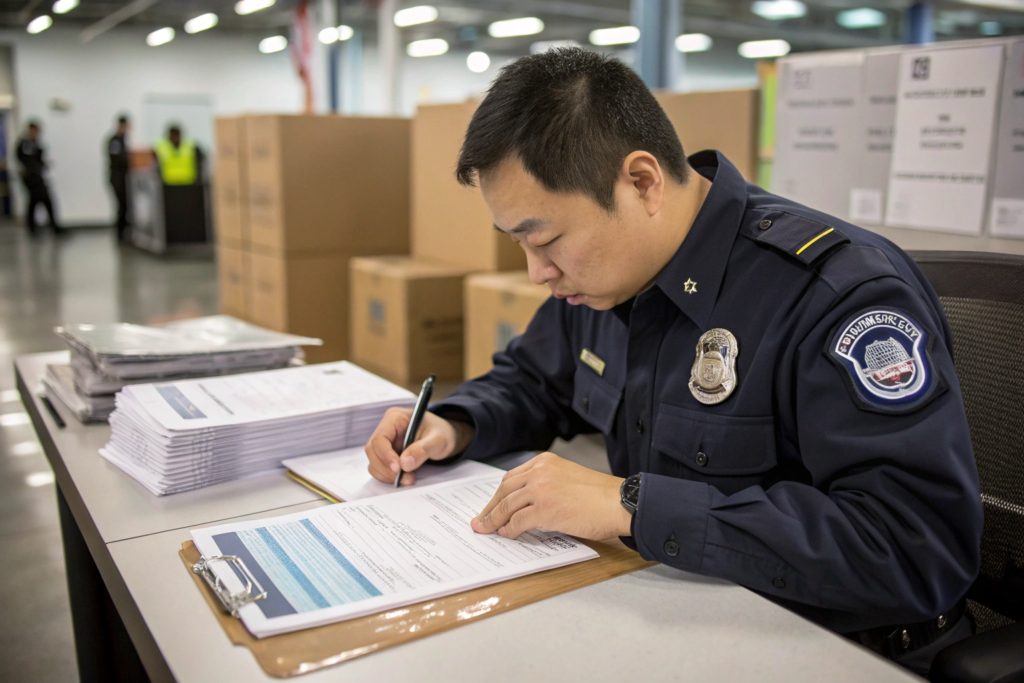
Not all customs brokers are the same. A broker who clears bulk agricultural commodities every day may have no experience with the PGA requirements for FDA-regulated cosmetics or CPSC-regulated children’s products. You need a broker who regularly clears goods in your specific product category. Ask the broker directly: "How many entries per month do you file for clothing and accessories from China?" "What is your process for handling an FDA hold on a cosmetic shipment?" "Do you have an in-house PGA specialist, or do you outsource the FDA and FCC filings?" The answers will reveal whether the broker is a generalist who will learn on your shipment or a specialist who knows the specific detention triggers for your product type. The broker must hold an active license from CBP and be a member of the National Customs Brokers & Forwarders Association of America. You can verify a broker’s license status on the official CBP License Verification page. I also ask for a reference from a client who imports a similar product. A broker who clears baby products for one client understands the CPSC requirements for stuffed animals and will not miss the children’s product certificate. At GeeseCargo, I match each client with a broker who specializes in that client’s product category. A clothing importer gets a broker who knows the textile visa requirements and the Section 301 tariff exclusions for apparel. A gift importer gets a broker who knows the marking requirements for country of origin on gift packaging. This specialization prevents the generic broker mistakes that turn a routine clearance into a detained shipment.
What happens during the customs entry and entry summary process?
The customs clearance process has two stages: the entry, which releases the goods, and the entry summary, which finalizes the duty payment. When the vessel arrives, the broker files CBP Form 3461, the Entry/Immediate Delivery, through the ACE system. This entry includes the HTS codes, the invoice value, and the bill of lading number. CBP reviews the entry electronically. If the entry matches the CBP risk criteria and has no PGA flags, CBP issues a release within minutes. Your trucker can pick up the container. The entry summary, CBP Form 7501, is filed within 10 days of the entry. This is the formal accounting of the duties owed. The broker calculates the final duty based on the entered value, the HTS duty rate, and the applicable Section 301 tariffs. The broker pays the duties to CBP through a periodic monthly statement if you have a continuous bond. You must remit the duty payment to the broker within the agreed payment terms. The CBP Entry Summary Filing page explains the difference between entry and entry summary. I ensure my clients understand that the release of the goods is not the end of the process. The entry summary must be accurate because CBP audits entries for up to five years after the release. If CBP finds an undervaluation or a misclassification during an audit, you pay the back duties plus interest and penalties. A broker who files a "clean" entry that sacrifices accuracy for speed is creating a future liability. I insist on accurate HTS classification and declared values that match the transaction value, even if it means paying a higher duty. A CBP audit with penalties is far more expensive than the correct duty payment at the time of entry.
Conclusion
The documents you need for US customs clearance from China are not a bureaucratic maze designed to trap you. They are a logical set of declarations that tell CBP exactly what you are importing, where it came from, how much it is worth, and whether it meets the safety and compliance standards of the US regulatory agencies. The Commercial Invoice declares the value and the product. The Packing List maps the physical shipment. The Bill of Lading is the carrier’s contract. The ISF is the pre-arrival security filing that must be submitted before the vessel leaves China. And the additional agency documents—FDA Prior Notice, FCC certification, CPSC children’s product certificates—are mandatory for specific product categories and missing any one of them triggers an automatic detention.
The process works smoothly when you treat document preparation as a pre-shipment discipline, not a post-arrival scramble. Your factory should provide the draft commercial invoice and packing list before the cargo leaves the factory floor. Your freight forwarder should audit those documents against the ISF requirements and the HTS classification. Your customs broker should receive the complete document package five days before the vessel arrival and pre-file the entry so the goods are released on arrival. Every document must align on the shipper name, the consignee name, the product description, the quantity, and the declared value. A single inconsistency across these documents is the spark that ignites a customs hold.
At GeeseCargo, I manage the document workflow as a core part of the freight service. I do not wait for the client to send me the paperwork and hope it is right. I request the drafts early, review them against the regulatory requirements, and coordinate the filing between the origin team in China and the customs broker in the US. When the documents are right, the clearance is routine. And a routine clearance is the foundation of a predictable, profitable import supply chain.