You are on a call with a freight forwarder, and they say, "Your FCL will need a chassis at the CY, and watch out for demurrage if the exam hits." You nod along, pretending to understand. You hang up and Google five terms in a row. The definitions are written in formal industry language that only confuses you more. You are not alone. Every importer starts here, feeling like international shipping has its own secret language designed to keep outsiders confused.
At GeeseCargo, we believe the secret language should not be secret. We want every client to know the core freight terms that affect their costs, their timelines, and their decisions. This guide defines and explains the thirty most important terms you will encounter when shipping from China to the USA. I organize them into five logical groups: shipment types, pricing and charges, documents, equipment and handling, and customs and compliance. By the time you finish reading, you will be able to sit on that freight call and understand exactly what is being said, and more importantly, ask the right questions.
You do not need to memorize a dictionary. You need a practical, plain-English reference that connects each term to your actual shipment experience. I wrote this guide to be that reference. Keep it bookmarked. Send it to your team. The next time a freight term comes up, you will know where to look.
What Are the Core Shipment Type Terms: FCL, LCL, and Consolidation?
Your freight forwarder asks, "Is this FCL or LCL?" You hesitate. You know it has something to do with container size, but you are not sure which one is which. You guess "FCL" because it sounds more professional. You later find out you paid for a full container when you only had 3 cubic meters of goods.
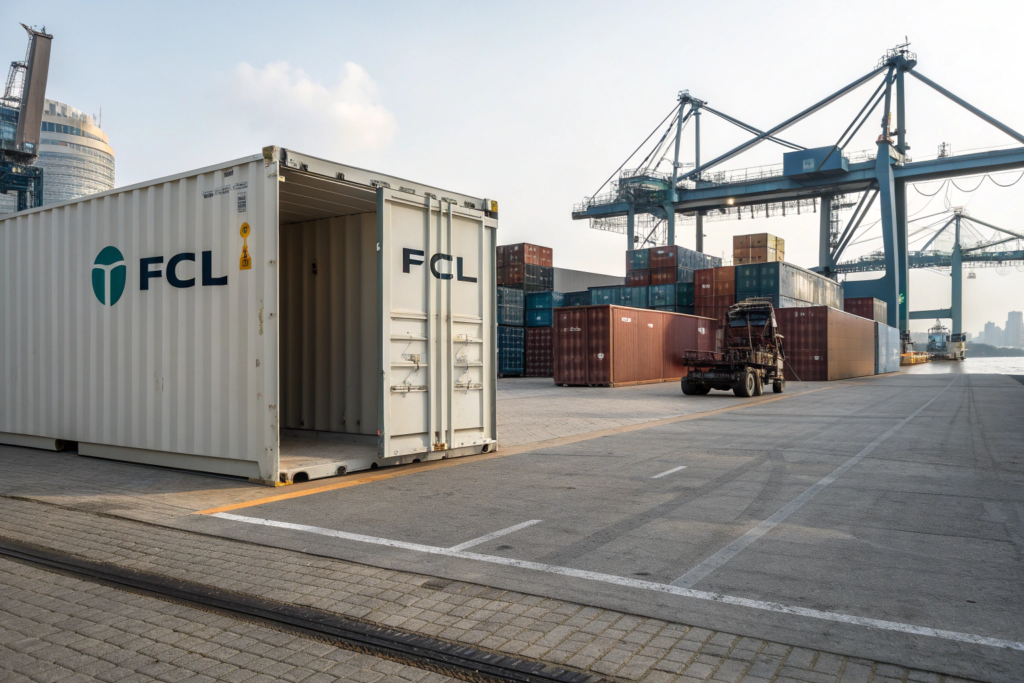
FCL stands for Full Container Load. You are renting the entire container, regardless of how full it is. LCL stands for Less than Container Load. You are sharing a container with other importers and paying only for the space your goods occupy. Consolidation is the process of combining multiple LCL shipments into one FCL container to achieve the lower per-unit cost of FCL. Knowing these three terms tells you how your goods will travel and how you will be charged.
FCL is like renting an entire moving truck. The truck is yours. You can fill it to the ceiling or put one chair in it. The price is the same. A 20-foot container holds about 33 cubic meters. A 40-foot container holds about 68 cubic meters. A 40-foot high-cube container holds about 76 cubic meters and has an extra foot of height. If your shipment is above roughly 15 cubic meters, FCL becomes cost-competitive with LCL on a per-unit basis. FCL is also faster because the container is not opened at a warehouse for deconsolidation. It travels sealed from the origin warehouse to your door.
LCL is like sharing a moving truck with three other people. You each have a few boxes. You split the cost of the truck based on how much space your boxes take. Your cost is calculated per cubic meter or per cubic foot. The minimum charge is often one cubic meter, even if your shipment is smaller. LCL is the economical choice for shipments under 15 cubic meters. The downside is time. LCL shipments require consolidation at the origin and deconsolidation at the destination. Each of these steps adds a few days to the total transit. We help you calculate the FCL breakpoint for your specific shipment so you make the decision based on hard numbers, not guesswork.
When Should You Choose LCL Over FCL?
You have 6 cubic meters of goods. The FCL quote is tempting because it sounds simpler. But 6 cubic meters is less than 20% of a 20-foot container. You will be paying for 80% empty space.
LCL is the right choice when your shipment volume is below the FCL breakpoint, typically 15 cubic meters. Below this volume, the LCL rate per cubic meter, plus the origin and destination CFS fees, is usually lower than the FCL rate for the whole container. We show you the side-by-side math. For 6 cubic meters, the LCL door-to-door cost might be $850. The FCL cost might be $2,800. The LCL saves you $1,950. The transit time for LCL is about 5 to 7 days longer. If your inventory buffer can absorb that extra week, LCL is the smart financial choice. We help you assess both the cost and the time trade-off.
What Is a Buyer’s Consolidation?
You have orders with three different suppliers: one in Yiwu, one in Shantou, and one in Dongguan. Each has 5 cubic meters of goods. Individually, they are three LCL shipments. Together, they are 15 cubic meters, which is close to a full 20-foot container.
A buyer’s consolidation is the service of collecting your partial shipments from multiple suppliers and combining them into one full container at our warehouse. You pay three domestic trucking pickups and one FCL ocean freight. This reduces your per-unit freight cost significantly compared to shipping three separate LCLs. The consolidation window adds a few days for the collection, but the ocean transit is faster because the container is an FCL that bypasses the destination CFS deconsolidation. Buyer’s consolidation is the logistics strategy that turns multi-supplier orders from a cost liability into a cost advantage.
What Are the Pricing and Charge Terms You Need to Understand?
You receive a freight invoice. It has line items like "BAF," "CAF," "PSS," "THC," and "Chassis Fee." You have no idea what these acronyms mean. You assume they are made-up fees to inflate the bill. Some of them are mandatory surcharges. Some of them are avoidable. You need to know which is which.
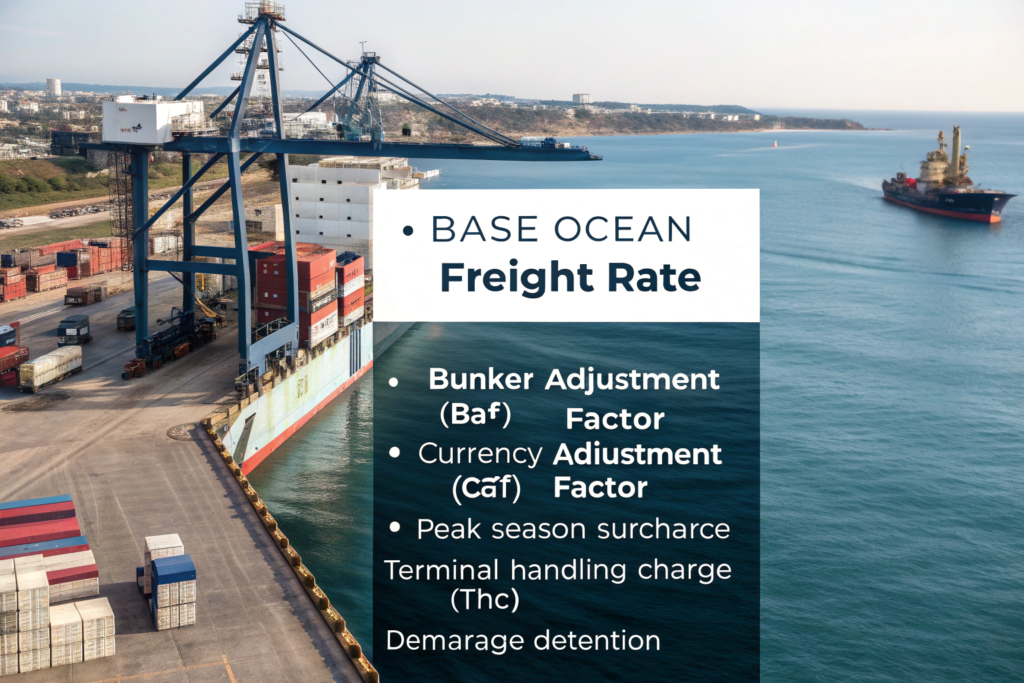
Freight pricing is composed of the base ocean freight rate plus a series of surcharges that reflect fuel costs, currency fluctuations, seasonal demand, and terminal handling. The base rate is the negotiated cost of moving the container on the vessel. BAF is the Bunker Adjustment Factor, a fuel surcharge. CAF is the Currency Adjustment Factor, a foreign exchange surcharge. PSS is the Peak Season Surcharge, applied during high-demand months. THC is the Terminal Handling Charge at the origin and destination ports. Demurrage is the daily charge for holding a container at the terminal beyond the free days. Detention is the daily charge for holding a container outside the terminal beyond the free days. Per Diem is the combined term for both.
The most important distinction for you as an importer is between charges we quote upfront and charges you control by your own actions. Demurrage and detention are charges you control. The carrier gives you a certain number of "free days" at the destination, typically 4 to 7 calendar days. This is the time you have to pick up the container from the terminal, unload it at your warehouse, and return the empty container to the depot. If you exceed the free days, the daily charges start and increase in tiers. The first few extra days might cost $100 per day. The next tier might cost $200 per day. The charges escalate quickly. A container left at the port for two weeks can generate thousands of dollars in demurrage and detention. We track your free days and remind you before they expire. We also build realistic delivery timelines that include your free day window. The charges we cannot control, like BAF and CAF, are included in our all-inclusive quotes. You never see a surprise BAF bill from us.
What Is the Difference Between Demurrage and Detention?
You use the words interchangeably. You say, "I got charged demurrage because I kept the container too long." You might be right, but you might mean detention. The ports and the carriers treat them differently, and the charges accrue differently.
Demurrage is charged when the full container sits at the terminal beyond the allotted free days. This happens when customs clearance is delayed, or a delivery appointment cannot be secured. The container is occupying valuable terminal space. Detention is charged when you keep the empty container outside the terminal beyond the allotted free days. This happens when the warehouse takes too long to unload the container and return it to the depot. The carrier needs the container back for the next booking. Both charges are avoidable with good planning. We help you avoid demurrage by clearing customs early and booking the delivery appointment the moment the vessel discharges. We help you avoid detention by coordinating with your warehouse to ensure a crew and a dock are ready on delivery day.
What Are Accessorial Charges, and Which Ones Are Legitimate?
A freight forwarder sends you a bill with an "Accessorial Charges" line. The amount is vague. You suspect it is a junk fee. Sometimes it is. Sometimes it is a real charge for a real service you requested or that was necessary.
Accessorial charges are fees for services beyond the standard port-to-port or door-to-door movement. Legitimate accessorials include customs exam fees when CBP selects your container, ISF filing fees, customs bond fees, change of destination fees, re-routing fees, and waiting time charges when a trucker waits beyond the allotted free time at your warehouse. Illegitimate accessorials are vague "administration fees," "release fees," or "processing charges" that are not clearly defined. We list every accessorial charge in our quote and explain what triggers it. We do not hide behind a generic "accessorials" line item. If a customs exam happens, we show you the CBP exam fee invoice. You pay the actual cost, not a marked-up estimate. Transparency is the difference between a partner and a vendor.
What Are the Essential Shipping Documents You Will Handle?
You are told to provide a "CI," a "PL," and a "CO." You do not know what these letters stand for. You search your email for "CI" and find nothing. The forwarder is waiting for documents you did not know you needed. The shipment is delayed because of a paperwork gap.
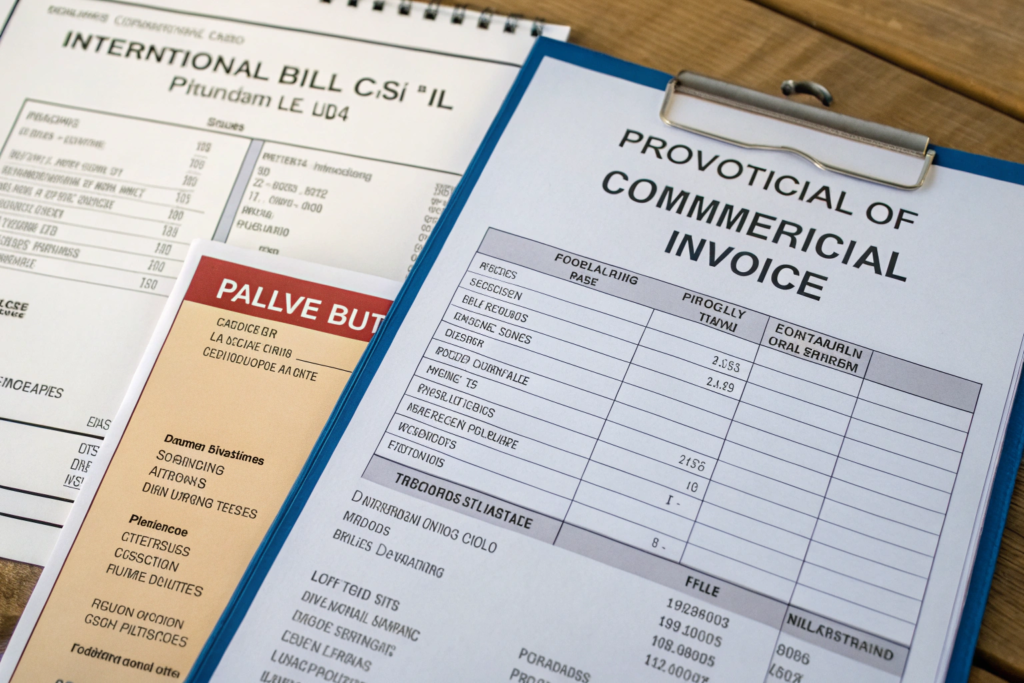
The three fundamental documents in every international shipment are the Commercial Invoice (CI), the Packing List (PL), and the Bill of Lading (BOL). The Commercial Invoice is the bill of sale between you and the supplier. It states the products, the quantities, the unit prices, the total value, the Incoterm, and the buyer and seller information. The Packing List details how the goods are packed: the number of cartons, the dimensions, the weight per carton, and the contents of each carton. The Bill of Lading is the carrier’s receipt, contract of carriage, and document of title. Additional documents you may need include the Certificate of Origin, the ISF filing confirmation, and the Customs Entry Summary.
The Commercial Invoice is the most important document for customs valuation. US Customs uses the transaction value on the Commercial Invoice as the basis for calculating your import duty. The invoice must be accurate and honest. An under-declared value is customs fraud. An over-declared value causes you to overpay duty. We review your Commercial Invoice before filing the customs entry. We check that the product descriptions are specific enough for HTS classification, that the Incoterm is stated, and that the buyer and seller information is complete. A clean Commercial Invoice leads to a clean customs clearance.
The Packing List is the operational document. It tells the warehouse, the carrier, and the customs broker exactly what physical packages are in the shipment. The carton count, dimensions, and weight on the Packing List must match the physical reality. If the factory writes "500 cartons" but packs 480, the discrepancy causes a problem at every handover point. We verify the carton count and weight at our warehouse against the Packing List. We flag discrepancies before the container is loaded. The Packing List is not just a formality. It is the physical inventory of your shipment.
What Is a Certificate of Origin, and When Do You Need One?
Your supplier is in China. Your goods are clearly made in China. The customs broker asks for a Certificate of Origin. You wonder why you need a separate piece of paper to state the obvious.
A Certificate of Origin is a formal document, often stamped by a chamber of commerce, certifying the country where the goods were manufactured. You need it for two main reasons. First, to claim preferential duty rates under a free trade agreement. If your goods were made in a country with a US FTA, the CO certifies this and allows duty-free or reduced-duty entry. For goods made in China, there is no FTA, so a CO is not needed for preferential rates. Second, some products require a CO for other government agency requirements, such as anti-dumping compliance or quota restrictions. Some retail buyers also require a CO as part of their supply chain documentation. We tell you upfront if your product requires a CO. If it does, we help you obtain the correct format from the supplier or the local chamber of commerce.
What Is the ISF Filing, and What Happens If It Is Late?
You have never heard of the Importer Security Filing. Then you receive an urgent email: "ISF not filed. Vessel departing in 12 hours." You have no idea what to do.
The ISF, or 10+2 filing, is a mandatory electronic submission to US Customs and Border Protection. It must be filed at least 24 hours before the vessel departs the foreign port. It contains ten data elements from the importer, including the seller, buyer, importer of record, consignee, manufacturer, ship-to party, country of origin, and HTS code. Late filing incurs a fine of $5,000 per violation. A severely late or missing ISF can result in a "Do Not Load" order, where the container is not allowed onto the vessel. We file the ISF for every shipment at least 48 to 72 hours before the vessel departure. We pull the required data from your Commercial Invoice and Packing List. You do not file the ISF yourself. You simply provide us with the accurate information, and we ensure it is transmitted to CBP on time. You receive an ISF confirmation number in your shipment update email.
What Are the Equipment and Handling Terms That Affect Your Shipment?
Your forwarder says, "We need a chassis with a tri-axle and a drop frame for this CY delivery." You have no mental picture of what a chassis is, let alone why it needs three axles. The equipment terminology of container shipping is physical and practical, but the words are unfamiliar until you see the equipment in action.
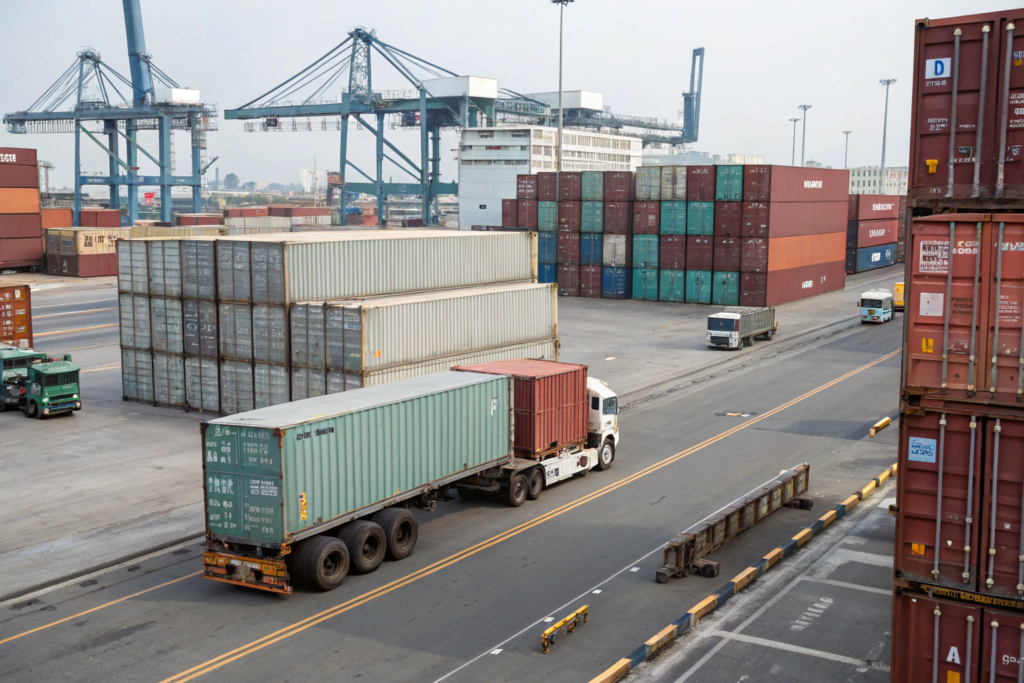
A container is the standard metal box that holds your goods. Common types are the 20-foot General Purpose (20GP), the 40-foot General Purpose (40GP), and the 40-foot High Cube (40HC), which is one foot taller. A chassis is the wheeled trailer frame that the container sits on for truck transport. The CY, or Container Yard, is the designated area within the port terminal where full containers are stored and exchanged. Drayage is the short-distance trucking of a container between the port and a nearby warehouse or rail ramp. Transloading is the process of unloading a container and reloading the goods into a domestic trailer at a warehouse near the port.
The chassis shortage is a recurring problem at US ports. The container comes off the ship, but there is no chassis available to put it on. The container cannot leave the terminal without a chassis. This is a bottleneck that can add days to your delivery timeline. We have a chassis pool agreement in place at major ports to mitigate this risk. When we arrange your drayage, we confirm chassis availability at the time of booking the delivery appointment. We do not dispatch a trucker to a terminal without a confirmed chassis. This is a detail that inexperienced forwarders miss, leading to dry runs and delayed deliveries.
Drayage is a specific term worth understanding. It is not just "trucking." It is the specialized, short-haul movement of an ocean container between the port and the first inland point, usually a warehouse, a rail ramp, or a transload facility. Drayage is priced per container move and is subject to port congestion, appointment availability, and chassis availability. It is the most operationally complex leg of the inland journey. We manage drayage with a dedicated coordinator who monitors the port conditions daily.
What Is a Transload, and Why Would You Use One?
Your container arrives at the Port of Los Angeles, but your warehouse is in Dallas, 1,400 miles away. You can dray the container all the way to Dallas, but you are paying for the heavy container chassis fuel on a long highway haul. The container also needs to be returned to the port empty, generating an empty return trip.
Transloading is the process of unloading the ocean container at a warehouse near the port and reloading your goods into a standard 53-foot dry van trailer. The dry van trailer is lighter than a container chassis, so the line-haul fuel cost is lower. The dry van trailer is also more maneuverable at your warehouse dock. The empty ocean container is returned to the port quickly, avoiding detention charges. The dry van trailer does not need to be returned to the port; it goes back into the domestic trucking network. Transloading adds a day to the total transit and a handling cost, but it saves money on the long-haul trucking and eliminates the empty container return mileage. For shipments traveling more than 500 miles from the port, transloading is often the most cost-effective inland delivery strategy.
What Is the Difference Between a Standard Container and a High Cube?
Your product boxes are 65 centimeters tall. You stack five layers on a pallet, and the total height is 3.25 meters. A standard container has an internal height of about 2.39 meters. Your pallets do not fit. You need a High Cube.
A standard 40-foot container has an external height of 8 feet 6 inches, or about 2.59 meters. The internal height is slightly less. A 40-foot High Cube container has an external height of 9 feet 6 inches, or about 2.90 meters. The extra foot of height is critical for tall pallets, bulky lightweight goods, or any cargo that maximizes vertical stacking. The High Cube is the dominant container type for consumer goods because it provides extra volume at a minimal cost premium. We automatically recommend a High Cube if your cargo volume exceeds the standard container’s internal height capacity or if you are shipping bulky, lightweight items where the volume, not the weight, is the limiting factor.
What Are the Customs and Compliance Terms You Must Know?
Your customs broker says, "The HTS code for this is 9403.89.6005, and we will file a type 01 entry under your continuous bond." You hear a string of numbers and acronyms. You smile and say "sounds good." You have no idea what you just agreed to. If that code is wrong, you are legally responsible for the misclassification.
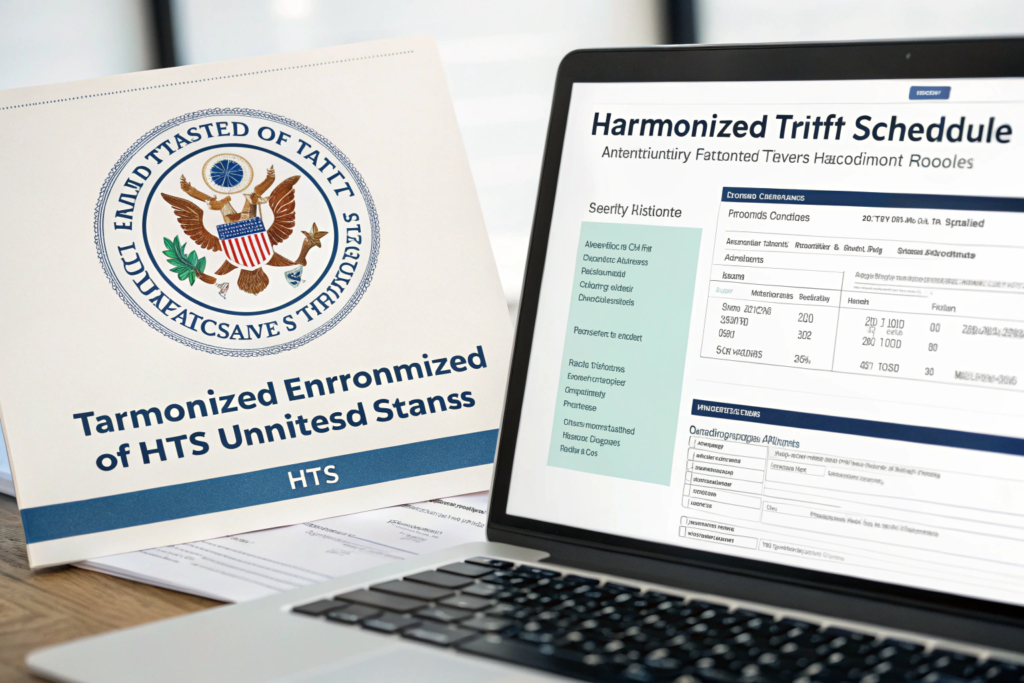
The Harmonized Tariff Schedule of the United States (HTSUS) is the classification system that assigns a duty rate to every product imported into the USA. The HTS code is the ten-digit number that identifies your specific product. The Importer of Record (IOR) is the legal entity responsible for the customs entry, duty payment, and compliance. A Customs Bond is a financial guarantee between the importer, a surety company, and CBP that ensures duties and fees will be paid. The ACE system is the Automated Commercial Environment, the electronic platform through which all customs entries are filed and processed.
HTS classification is the single most important compliance decision in your import process. The duty rate, the Section 301 tariff applicability, and the partner government agency requirements all flow from the HTS code. A misclassification can result in underpaid duties, penalties, and a customs audit. We classify your product based on the material composition, the function, and the applicable General Rules of Interpretation. We do not guess. We research the binding rulings database and the Explanatory Notes. We provide the HTS code and the duty rate before you ship. You approve the classification. This collaborative process ensures accuracy and shared responsibility.
The Importer of Record is a role, not just a title. The IOR is legally accountable to CBP. On our DDP shipments, GeeseCargo acts as the IOR using our continuous bond. On FOB shipments where you handle your own customs clearance, your company is the IOR. You must have your own bond, or we can provide a single-entry bond for your shipment. The IOR’s name and tax ID are on the CBP Form 7501. This is the entity CBP will contact in an audit. Know who your IOR is and ensure the information is accurate.
What Is an HTS Code, and How Is It Different from an HS Code?
You see "HS Code" and "HTS Code" used interchangeably online. You think they are the same thing. They are not, and the difference matters for US imports.
An HS Code is the international Harmonized System code, which is a six-digit number used by customs authorities worldwide. The first six digits are globally standardized. The HTS code is the US-specific version, which extends the six-digit HS code to ten digits. The extra four digits are US statistical suffixes that determine the exact US duty rate. For example, HS code 6204.62 is "Women’s trousers, of cotton." The HTS code 6204.62.8011 is "Women’s cotton blue denim trousers." The HTS code determines the duty rate you pay to US Customs. When you are asked for your product code, provide the full ten-digit HTS code. The six-digit HS code is insufficient for US entry filing.
What Is a Customs Bond, and Do You Need One?
Your forwarder asks, "Do you have a continuous bond, or do you need a single-entry bond?" You do not know the difference. You choose the cheaper option without understanding the implications.
A customs bond is required for all formal entries into the United States. A single-entry bond covers one shipment and costs less upfront. A continuous bond covers all your shipments for a full year and costs more upfront but is cheaper per shipment if you import regularly. If you ship more than two or three times a year, a continuous bond is more economical. We help you assess your import frequency and recommend the right bond type. For our DDP clients, we use our own continuous bond, and you do not need to purchase a bond. For FOB clients handling their own customs, we can arrange either a single-entry bond or a continuous bond through our surety partners. The bond is a non-negotiable requirement. You cannot clear customs without one.
Conclusion
Freight terminology is a tool, not a barrier. Every industry has its vocabulary, and international shipping is no different. The difference is that in shipping, misunderstanding a term can cost you real money. A demurrage charge you did not anticipate. An LCL shipment you booked when FCL would have been cheaper. An HTS code you approved without understanding.
At GeeseCargo, we never want a client to approve something they do not understand. We explain these terms on calls, in emails, and now in this written guide. We believe that an educated client makes better decisions, and better decisions lead to smoother shipments and healthier businesses. The terms I have defined here are the ones that come up in nearly every shipment conversation. FCL, LCL, consolidation, demurrage, detention, drayage, transload, HTS, IOR, ISF. These are the building blocks of freight literacy.
You do not need to learn the entire logistics dictionary. You need to learn the thirty terms that affect your costs and your decisions. You now have them, in plain English, organized by category. Refer back to this guide when you review a quote, an invoice, or a shipment update. The more you use the terms, the more they will become second nature.
If you have a quote, an invoice, or a document from us with a term you do not recognize, do not guess. Go to GeeseCargo.com and message me. Ask me to explain the term in the context of your specific shipment. I will reply with a clear explanation, just like the ones in this guide. Your understanding is the foundation of our partnership. Let’s build it together.