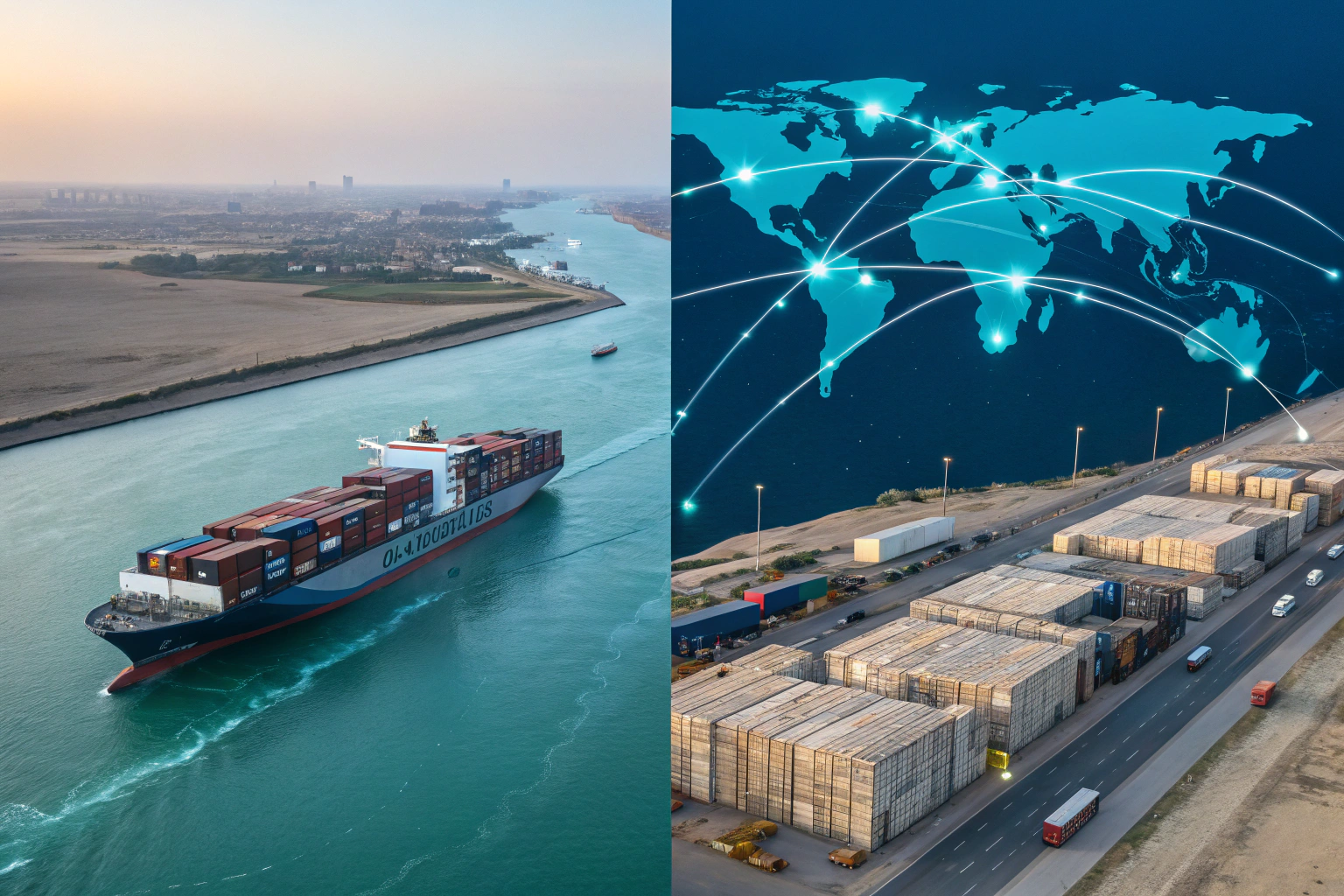
I get a sinking feeling when I see importers basing their annual budgets on a single screenshot of a spot rate index they found on social media. They assume that number is the final price, then they get hit with a fuel surcharge spike, a peak season levy, and a chassis fee they never saw coming. That outdated or incomplete number just blew a hole in their profit forecast. I have been navigating the trade lanes from China to Europe for years, and I can tell you that a freight rate is never just one number. It is a constantly moving target driven by geopolitics, fuel, and sheer capacity.
Current ocean freight rates from China to Europe in 2026 are settling into a new normal following the post-Red Sea disruptions. You can expect spot rates for a 40-foot container from Shanghai to Rotterdam to range between $2,800 and $4,500 USD, depending on the quarter, while long-term contract rates are offering stability at the lower end of that spectrum for high-volume shippers. The single biggest factor right now is the phased return of container vessels to the Suez Canal route.
You need hard data to make smart decisions, not just a headline number. You also need to know why the rate is what it is and how to lock in a price that won’t betray your business plan six months from now. I’ll walk you through the real-time market conditions shaping your shipping costs in 2026 and how my team at GeeseCargo structures deals to protect our clients from the wild swings.
What Factors Are Driving Ocean Freight Prices from China to Europe Right Now?
You are quoted a rate on Monday, and by Friday the forwarder says the space is gone and the price has jumped by $800. It feels arbitrary, like someone is making up numbers. This frustration usually happens because the forwarder is not explaining the real-time physical constraints on the water. Your price is not just a number on a spreadsheet; it is a direct reflection of a ship’s physical journey through conflict zones, crowded canals, and stormy seas. Understanding the "why" behind the price is your best defense against overpaying.
Ocean freight prices from China to Europe in 2026 are being driven primarily by the full-scale operational return to the Suez Canal, new environmental fuel surcharges under the EU Emissions Trading System (ETS), and ongoing carrier capacity management through blank sailings. These three factors create a price floor that was not there during the cheap pre-pandemic years, but they also offer stability that was absent during the chaotic Red Sea detour era.
At GeeseCargo, I sit down with my clients every quarter to update the route outlook. You cannot control geopolitics, but you can build a flexible logistics budget that absorbs these shocks. Let me break down the specific gears turning inside the freight machine so you can see why your invoice looks the way it does.

How has the Suez Canal normalization impacted transit time and costs in 2026?
The biggest story of 2026 is the "Great Return" to the Suez Canal. After years of diversions around the Cape of Good Hope, most major alliances have fully shifted back to the Suez routing for Asia-North Europe strings. This cut the physical sailing distance by thousands of nautical miles. The immediate benefit for you is a transit time that has dropped back down to roughly 30-35 days from Shanghai to Rotterdam, instead of the 45-plus days we suffered during the diversions. The cost impact is complex. Returning to Suez drops the carrier’s direct fuel cost, but the Egyptian transit fees are high and the risk premium for war-risk insurance remains a line item. I tell my clients that the true savings appear in the inventory carrying cost. When your goods arrive ten days faster, you free up a huge amount of working capital. The actual ocean freight spot rate might not crash as low as you hope because carriers are disciplined. They are slowly reintroducing capacity so the market is not flooded. You can track the vessel queue times using the live data from the Suez Canal Authority to see how smoothly the convoys are moving on any given day. A bottleneck there directly signals a potential rate spike for your next booking.
How does the EU Emissions Trading System (ETS) surcharge increase your shipping costs?
You might notice a new line item on your freight invoice called "ETS Surcharge" or "Carbon Surcharge." This is not a made-up fee. Since shipping was included in the EU Emissions Trading System, carriers must purchase carbon allowances for the emissions generated on voyages to and from EU ports. In 2026, the phase-in period is over, and carriers are paying for a higher percentage of their total emissions. This cost is passed directly to you. The surcharge varies depending on how modern the vessel is. A newer, eco-friendly methanol-ready vessel has a much lower surcharge than an older fuel-burning ship. When I negotiate a contract for a client shipping clothing and accessories to Germany, I specifically request space on the "eco-loop" services. These ships often have a slightly higher base rate but a much lower ETS surcharge, making the all-in cost cheaper and your brand’s carbon footprint smaller. You should also ask your forwarder about the verified emissions data. Under the new regulations, you have a right to a certified statement of the CO2 emissions linked to your specific container move. This is not just environmentalism; it is a financial document, as it justifies the surcharge amount. The EU ETS Maritime Regulation provides the official timeline and percentage liabilities for the coming years, and a smart importer factors these incremental increases into their 2027 budget right now.
Is It Cheaper to Ship FCL or LCL from China to Europe in 2026?
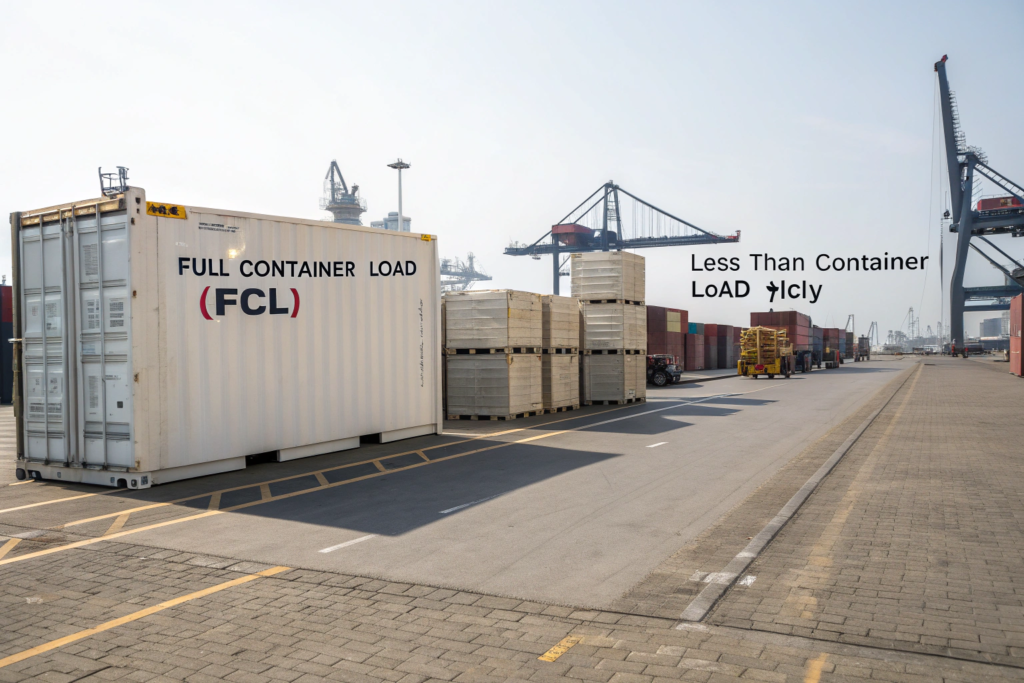
You have a shipment that fills half a container. Your instinct is to book Less than Container Load (LCL) because why pay for air? Then the LCL invoice arrives and you see the destination charges, the deconsolidation fees, and the pallet inspection costs. Suddenly, the cost per unit is higher than if you had just shipped the empty space. This is a math trap that catches a lot of growing brands who are stuck in the grey zone between small and mid-size. The decision between FCL and LCL in 2026 has flipped some old logic on its head.
In 2026, it is often cheaper to ship a Full Container Load (FCL) for volumes as low as 10 to 12 cubic meters if your goods are heavy or high-value, because LCL consolidation rates from China to Europe are carrying historically high destination terminal handling and security inspection surcharges. The breakeven point has shifted. For lightweight, low-value items under 8 cubic meters, LCL still makes sense, but the gap is closing fast.
I help my clients run a "total landed cost" simulation before every booking. You can’t just look at the ocean freight cost per cubic meter. You have to simulate the arrival experience. Let’s look at how to calculate the real break-even point in 2026 and how to avoid the nasty surprises waiting for you at the European destination warehouse.
How do destination port charges make small LCL shipments so expensive?
The trap with LCL lies at the destination port in Europe. The ocean freight quote might look like a bargain—say, $95 per cubic meter. But when the container arrives at Rotterdam or Hamburg, it goes into a Container Freight Station (CFS). The consolidated box must be unloaded, sorted, and stored. Each supplier’s goods inside that box need a separate customs entry and physical examination process. You get billed for the deconsolidation, the facility fee, the administrative entry, and the truck waiting time. These destination terminal handling charges are fixed costs that barely change whether you ship 1 cubic meter or 10 cubic meters. I have seen a $300 ocean freight bill turn into a $950 total bill at the door because of these add-ons. You need to insist on a "door-to-door" simulation quote that includes the full chain. A crucial document to understand is the Bill of Lading terms for an LCL shipment. Unlike an FCL House Bill of Lading, an LCL shipment often relies on a forwarder’s cargo receipt which offers less direct legal protection if the goods are damaged during the deconsolidation process. For clothing and accessories, where boxes can look identical, the risk of short-shipment or damage during sorting is real. An FCL container sealed at your factory in China stays sealed until it reaches your warehouse door in Europe. That security of a single seal chain is worth a lot more than the marginal ocean freight savings.
When should you use air freight as a faster alternative to LCL?
Sometimes the numbers scream at you to just use air freight, and you ignore them because "air is expensive." But stack up the true cost of a messy 45-day LCL consolidation process against a 5-day air freight service, and the math shifts. If you are shipping a new clothing sample collection for a buyer meeting in Paris, or limited edition accessories for a launch event, the time cost is the main factor. You lose the sale if the goods are late. I also see a shift where the cost of carrying inventory during a long LCL transit eats up the savings. For high-value electronics or premium garments with a value over $60 per kg, the insurance cost on a long sea voyage plus the warehousing fees often make air freight through a service like Air Freight Consolidation competitive on a "total cost of ownership" basis. I often use a hybrid model. My client ships the bulk order via FCL sea freight and sends the immediate top-up stock via air freight. This keeps the retail shelves full while the slow boat crosses the ocean. It also avoids the Amazon FBA long-term storage fees that hit if you send everything by sea and it arrives late in the season. You should treat sea and air not as enemies, but as two tools in the same box.
How Can I Get the Best Long-Term Contract Rate from China to Europe?
You watch the spot market like a hawk, trying to jump in at the bottom. You catch a dip, high-five your team, and then the service level is terrible. Your container gets rolled three times because the carrier prioritizes their contracted clients. You saved 10% on the rate but lost 30% on a missed delivery window. Winning in freight is not about timing the spot market perfectly. It is about locking in a long-term rate that treats your cargo like a priority, not an afterthought.
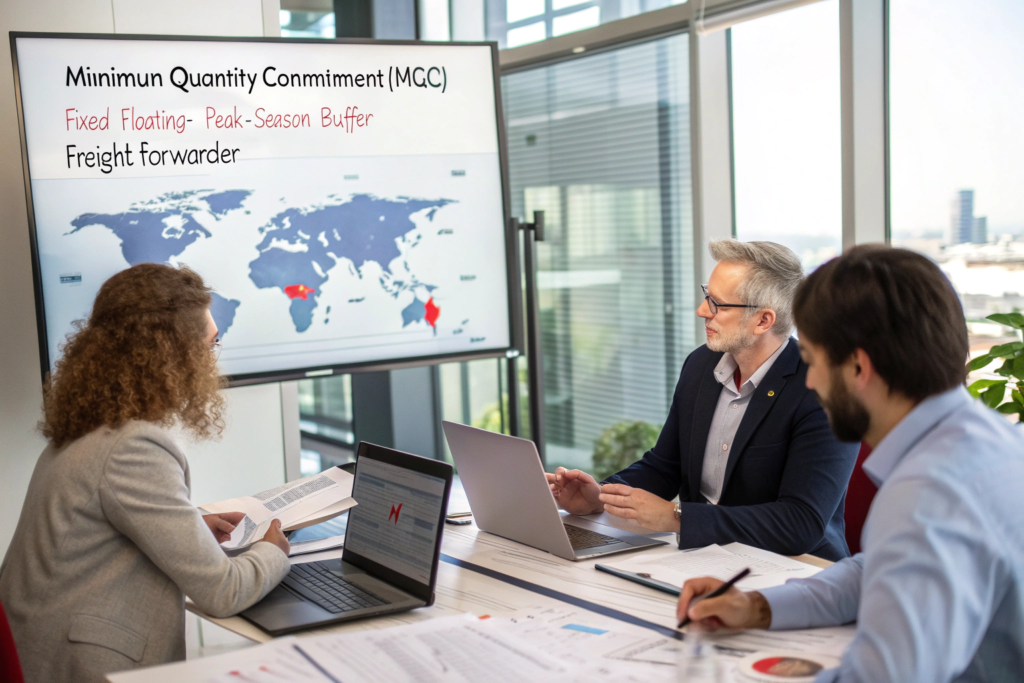
You can get the best long-term contract rate from China to Europe in 2026 by committing to a Minimum Quantity Commitment (MQC) across two or more quarters, negotiating a fixed floating-peak-season buffer, and using a freight forwarder who aggregates volume from multiple shippers to gain buying power with ocean carriers like Maersk, MSC, and CMA CGM. You swap the market’s volatility for planning certainty and guaranteed space.
I take a long view with my clients at GeeseCargo. We map out your entire year of purchase orders, predict your busy months, and then I walk into the carrier’s office to negotiate a block of space. You sleep better knowing that your holiday goods have a reserved seat on the ship, even when everyone else is scrambling for space.
How does Minimum Quantity Commitment (MQC) buy you both rate and space stability?
A carrier wants to know one thing: "Are you a regular, predictable shipper, or are you just looking for a one-time cheap deal?" An MQC answers that question with a promise. You agree to ship, say, fifty 40-foot containers over six months on a specific route. In return, the carrier allocates that dedicated space on their vessels. This changes your status. You move from a "spot cargo" risk to a "base cargo" partner. The rate you get is typically a blended average, lower than the peak season spikes but slightly higher than the absolute troughs. I think of it like fixing your mortgage rate instead of renting month-to-month. You budget accurately. When the market spikes to $5,000 in Q3, your contracted boxes might still ship at $3,200. The key is in the fine print of the carrier contract, specifically the no-roll clause. You want a clause that states if the carrier rolls your container, they must put it on the next vessel out or pay a penalty. You can link your contract performance metrics to the general Ocean Carrier Guidelines for service reliability to have an objective standard for delivery. A freight forwarder acting as your agent consolidates your MQC with ten other importers, giving us the power to negotiate a volume block that you could never get alone.
How do you build flexibility into a fixed annual freight contract?
A fixed contract sounds scary because you worry about being locked into a high price while the market crashes. I protect my clients from this with a "floating index cap" clause. We agree that the base rate is fixed, but if the Shanghai Containerized Freight Index (SCFI) drops below a certain threshold for four consecutive weeks, we trigger a rate review. This ensures you are never paying grossly above the market. You also need flexibility on the volume side. A good contract has a tolerance band of plus or minus 15-20% without penalty. If you have a slow sales month and ship less, you don’t get hit with a massive dead-freight charge. Conversely, if you have a sudden sales spike, the forwarder should be able to pull extra space from their allocated pool without charging you a premium spot rate. This is where my relationships at the major Chinese ports pay off. If a client suddenly needs an extra ten boxes out of Ningbo, I can call the line’s capacity manager and negotiate the extra lift based on our overall book of business. The documentation for these contracts uses standard Federation of Freight Forwarders (FIATA) model agreements, which provide a fair legal framework recognized globally. This protects you from one-sided clauses that small print carriers might try to slip in. Before you sign any long-term deal, ensure the forwarding agent is licensed with a clear FIATA or IATA number, which is your guarantee they operate on a recognized ethical standard.
What Are the Customs and VAT Implications When Shipping to Major EU Ports?
You celebrate when the ship docks in Rotterdam. Three days later, your goods are still sitting in the terminal, and you are getting emails about a customs hold. The problem? Your commercial invoice declared the value of the goods for the US market, not the EU, or the HS code does not match the European TARIC database. Customs in Europe is a different beast than in America. You are not just importing goods; you are dealing with 27 different member state tax authorities looking at your paperwork.
The major customs and VAT implication when shipping to the EU in 2026 is the strict enforcement of the Import One-Stop Shop (IOSS) for e-commerce goods under €150 and the mandatory use of a fiscal representative for non-EU businesses. You cannot just use a generic HS code; you must classify goods precisely to avoid paying double duty or facing a seizure of your shipment.
I have seen a whole container of gift items flagged for destruction because the factory used non-compliant wood packaging and the EU inspector spotted bark insects. The cost of a customs mistake is not just a delay; it is a total loss. Let’s walk through the VAT system you are entering and how to structure your shipping to stay compliant and penalty-free.
Why is the IOSS system crucial for direct-to-consumer sales from China?
If you sell clothing and accessories to consumers online in France or Germany and the value is below €150, you must understand IOSS. Without it, your customer pays the VAT, a customs clearance fee, and a handling charge at the door. They get a nasty surprise, refuse the package, and demand a refund from you. With the IOSS, you charge the VAT at the point of sale and pay it to a single EU portal. The goods then sail through customs because the tax is pre-paid. The customer has a perfect experience. For goods over €150, you pay import VAT and duties via the standard clearance process. You need a fiscal representative established in the EU to do this. My DDP service includes this representative in the destination country. When we file the customs entry, we use a European TARIC Code lookup to classify the goods, not just a generic global HS code. A sundress might be cotton, but the exact tariff depends on whether it is knitted or woven. Getting this wrong by one digit can shift the duty rate by 8%. The verification happens through the EU Customs Surveillance system, which cross-references your declared value against a database of similar goods. If you under-declare to save on duty, the algorithm flags your shipment for a physical inspection. You pay the fine, the storage, and the recalculated duty. Honesty is cheaper.
How do you avoid EU wood packaging material (WPM) violation penalties?
You think a wooden pallet is just a wooden pallet. EU customs sees a potential host for the Asian longhorn beetle. The EU has strict regulations on Wood Packaging Material known as the ISPM 15 standard. Every wooden pallet, crate, or dunnage must be heat-treated or fumigated and stamped with an official mark. If an inspector at the Port of Hamburg opens a container and finds a single piece of untreated wood with live pests, they do not just remove the pallet. They issue an emergency order to re-export the entire container back to China, or they demand immediate destruction of the goods at your expense. For a shipment of gifts or clothing, this is a catastrophic end. I enforce a strict photo-verification step at the factory in China. My loading supervisor checks the ISPM 15 Wood Packaging Mark on every pallet before the container doors close. We also check that the mark is clearly visible and not painted over. A blurred stamp is treated as non-compliant. If your product is heavy enough, I might suggest switching to recycled plastic pallets for the European route. The cost difference is often offset by the elimination of the risk of a full shipment quarantine. Also, you gain an advantage because plastic pallets are exempt from ISPM 15 checks, which accelerates the physical inspection process by customs. This small switch can cut a full day off the clearance time.
Conclusion
The ocean freight market from China to Europe in 2026 is defined by a return to normal routing but with a permanent overlay of new costs—carbon surcharges and complex destination fees that are not going away. You cannot control the global fuel price or the Suez Canal toll increase, but you can control how you structure your shipping agreements. You gain an edge when you stop chasing the lowest spot rate and start securing long-term contracts that give you space stability and pricing predictability.
The biggest financial trap I see is importers ignoring the destination cost structure. Whether it is the LCL deconsolidation trap at the European CFS or the VAT shock from not using the IOSS system, the "last mile" of the import process is where the real money is lost. A full container sealed at origin gives you legal security and a lower unit cost at the door. A well-negotiated MQC with a freight forwarder gives you the muscle to demand that your container is not rolled during peak season. And a meticulous approach to EU customs, from the TARIC code to the wood pallet stamp, keeps your goods moving through the border without a demand for a ransom fee.
At GeeseCargo, I believe your shipping strategy should be as professional as your product design. You make a great product; my job is to make sure it arrives in your customer’s hands without a story of disaster and delay. The rates in 2026 are what they are, but the cost of a bad logistics decision is always higher than the freight bill.