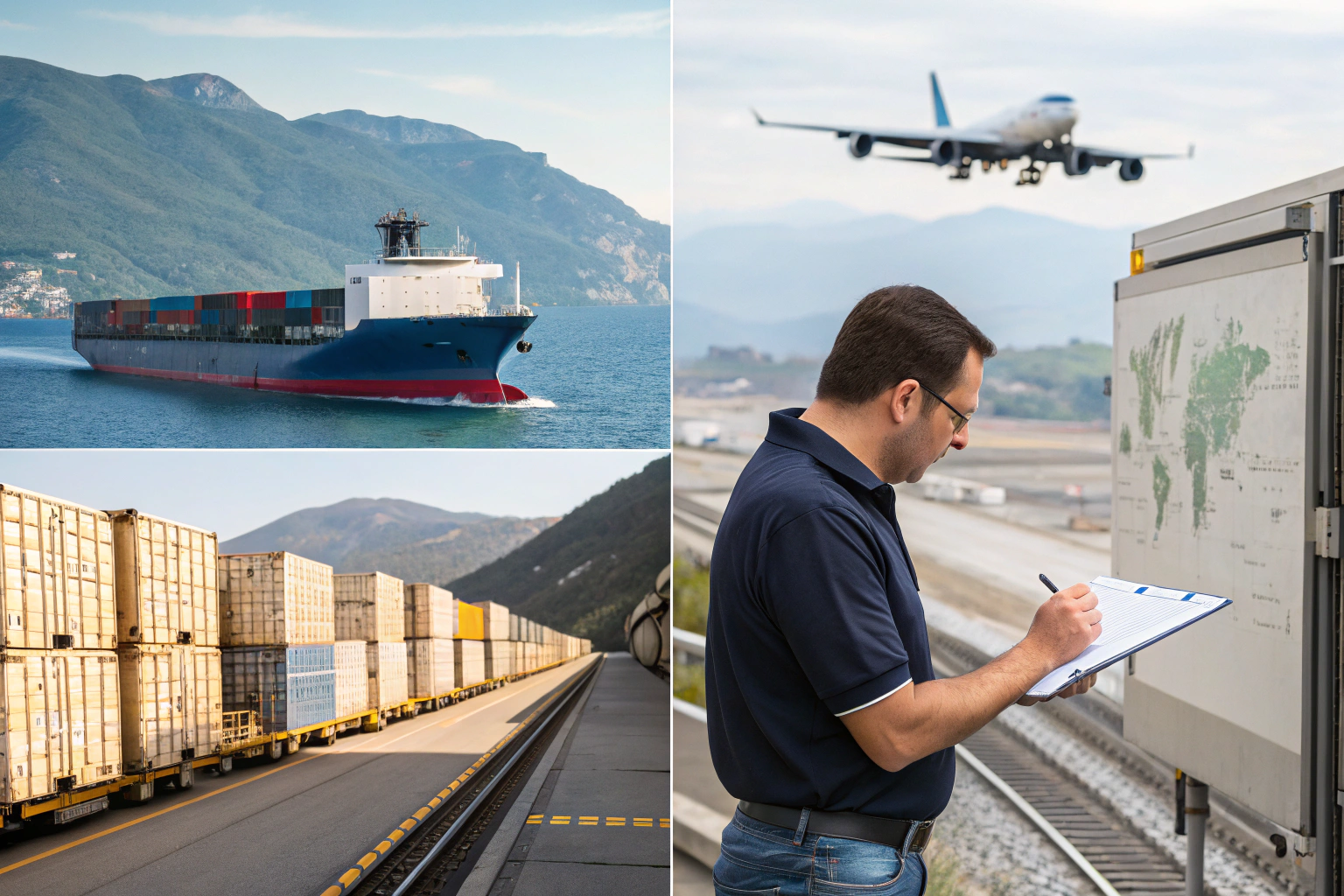
You are staring at three freight quotes on your screen. Ocean is cheap but slow. Air is fast but expensive. Rail sits somewhere in the middle, but you have never used it and you are not sure it is reliable. You have 15 cubic meters of kitchenware sitting in a factory in Yiwu, and your sales forecast says you need it in your Dallas warehouse in 25 days. Pick wrong, and you either blow your margin on freight or miss your restock window and lose sales. The pressure is real.
At GeeseCargo, we do not push every shipment onto one mode. We recommend ocean, air, or rail freight based on a four-factor analysis: your shipment volume and weight, your required transit time, your budget per unit, and your product type. Ocean is the cost leader for shipments over 2 cubic meters with a 25-to-35-day timeline. Air is the speed leader for time-critical shipments under 3 cubic meters. Rail is the emerging middle lane for shipments to the US East Coast, offering a 20-to-25-day transit at a cost 30% to 50% less than air. We present all viable options with real transit times and real costs from your factory to your door.
You do not need to become an expert in freight mode selection. You need a partner who will model the options with your actual shipment data and recommend the mode that balances your need for speed and your need for margin. Let me walk you through how each mode works, what it really costs, and how we help you make the right call every time.
How Does Ocean Freight from China to the USA Work, and When Is It Best?
You assume ocean freight is one thing: slow and cheap. But there are actually multiple ocean service tiers. A consolidation LCL service might take 35 days. An express FCL service might take 18 days. The difference is not just the vessel speed. It is the waiting times at the origin and the destination. Choosing "ocean freight" without understanding these tiers is like choosing "a car" without knowing if you need a sedan or a pickup truck.
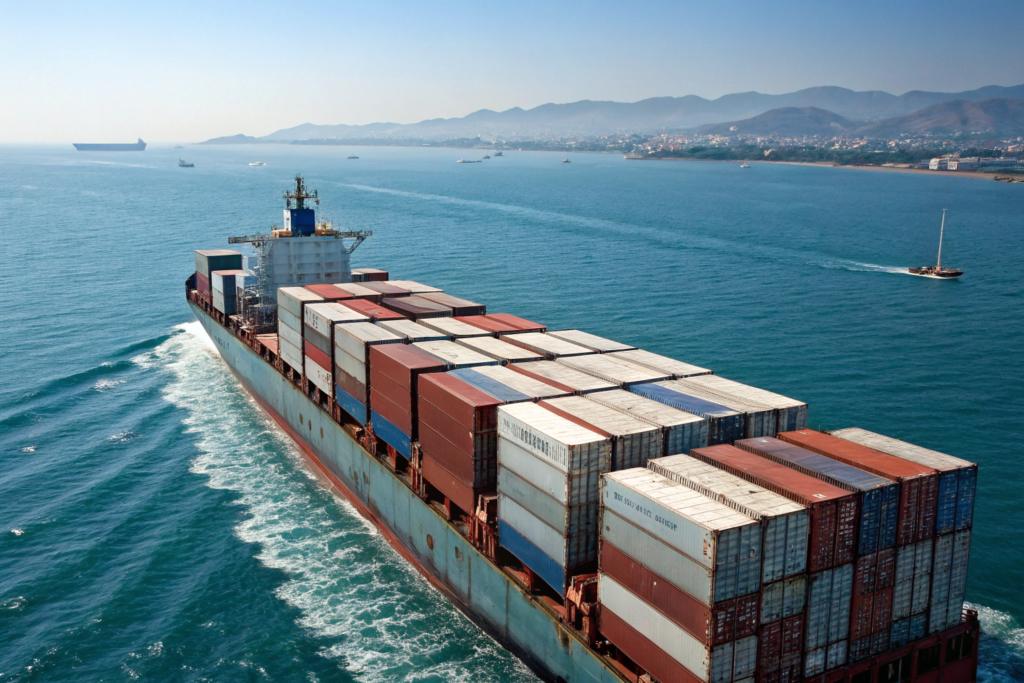
Ocean freight moves your goods in standardized shipping containers on cargo vessels. For most consumer goods shipments from China to the USA, ocean is the most cost-effective mode. The transit time from a major Chinese port to a major US West Coast port is 12 to 16 days at sea. The total door-to-door time, including pickup, consolidation, customs, and delivery, ranges from 18 days for an express FCL to 35 days for an economy LCL. Ocean is best when your shipment is over 2 cubic meters, your restock timeline allows at least 25 days, and your priority is the lowest cost per unit.
Ocean freight is the backbone of global trade. Over 90% of the world’s goods move by sea. The economics are unbeatable for bulk shipments. A 40-foot container can hold 68 cubic meters of goods. The cost per cubic meter drops to a level that air freight cannot even approach. For a typical consumer goods shipment, the ocean freight cost per unit might be $0.50 to $1.50, while air freight would be $5.00 to $12.00 per unit. If your product margin is 40%, air freight can wipe it out entirely. Ocean freight preserves your margin.
But the time cost is real. Ocean transit itself is 12 to 16 days port-to-port on the Pacific route. The hidden time is in the consolidation and deconsolidation. For LCL shipments, your goods might wait three days at our origin warehouse for a full container to build. At the destination port, they might wait another three days for the container to be deconsolidated at a CFS. Customs clearance, trucking, and delivery add more days. The total door-to-door time for a standard LCL shipment is usually 28 to 35 days. For an FCL shipment, where the container is exclusively yours, the waiting times are nearly eliminated. The container is loaded and sealed at origin, then opened only at your warehouse. The total door-to-door time for an express FCL is 18 to 22 days. We help you understand this time breakdown and choose the ocean service tier that matches your restock calendar. If you have 30 days of inventory cover left, standard LCL is fine. If you have 18 days, express FCL is the ocean option that saves you.
What Are the Different Ocean Freight Service Tiers We Offer?
You asked for an ocean freight quote. You received one price. You think that is the only ocean option. But ocean freight is not a single product. It is a menu with different speeds and different price points.
We offer three ocean service tiers. Economy LCL is our lowest-cost option. Your goods are consolidated with other shipments at our Shenzhen warehouse. The container sails on a standard vessel. At the destination, the container is deconsolidated at a CFS. Total door-to-door time is 30 to 35 days. This is best for baseline stock replenishment when time is not critical. Standard FCL is our mid-tier option. You book a full container. It sails on a standard vessel. Total door-to-door time is 22 to 28 days. This is best for shipments over 15 cubic meters. Express FCL is our fastest ocean option. We use priority loading at the origin port and off-pier chassis pickup at the destination. The container is the last on and the first off. Total door-to-door time is 18 to 22 days. This is best for high-volume shipments that need to beat the standard ocean timeline but cannot justify air freight. We quote all three tiers for FCL-eligible shipments. You choose based on your inventory buffer and your cash flow.
How Does Ocean Freight Consolidation Reduce Your Per-Unit Cost?
You have 3 cubic meters of goods from one factory and 5 cubic meters from another. Individually, they are two LCL shipments with two sets of origin and destination fees. Combined, they are 8 cubic meters, still LCL but with a lower rate per cubic meter because the volume is higher.
Consolidation is the art of combining smaller shipments into larger, more efficient units. We pick up both factory loads and bring them to our warehouse. We combine the 8 cubic meters into a single shipment. The LCL rate per cubic meter is tiered. The rate for 3 to 5 cubic meters is higher than the rate for 5 to 10 cubic meters. By consolidating, you move up a pricing tier and pay less per cubic meter. You also pay one set of documentation fees, one customs clearance fee, and one destination delivery charge instead of two. The savings from consolidation often pay for the domestic trucking to bring the goods to our warehouse. If your combined volume reaches 15 cubic meters, we can sometimes consolidate into a full container, shifting the shipment from LCL pricing to the even lower FCL per-unit cost.
How Does Air Freight from China to the USA Work, and When Is It Worth the Cost?
You have 500 units of a new product launching next week. Your influencer campaign is live. Your website has a countdown timer. The ocean shipment is delayed by two weeks. You need the goods now, and you are willing to pay to get them. But you have never booked air freight before, and the quotes you see online range from $3.50/kg to $8.00/kg. You do not know what is real.
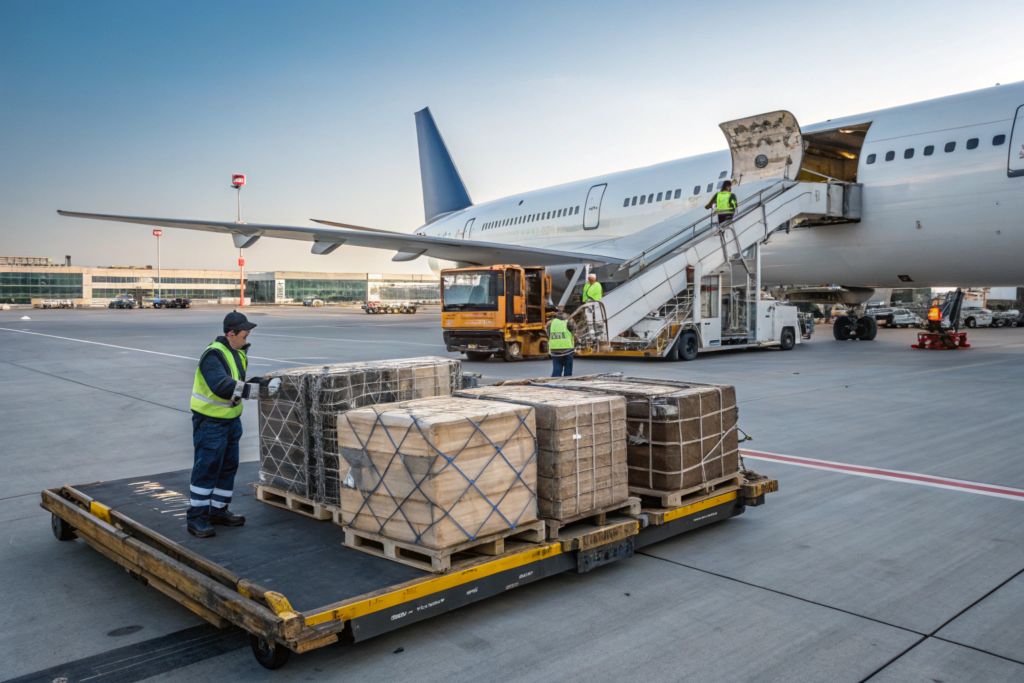
Air freight moves your goods on passenger aircraft belly space or dedicated cargo freighters. The transit time from a major Chinese airport to a major US airport is 1 to 2 days in the air. The total door-to-door time, including pickup, export clearance, flight, import clearance, and delivery, is 5 to 8 days. Air freight is worth the cost when your shipment is under 3 cubic meters, your stock-out cost is higher than the freight premium, or you are launching a new product with a hard marketing deadline. The cost is 5 to 8 times more than ocean freight per kilogram.
Air freight is the emergency room of logistics. It is not where you want to send every shipment, but when you need it, nothing else will do. The math that justifies air freight is not the freight cost versus the ocean cost. It is the freight cost versus the cost of not having the goods. If you lose $10,000 in sales because a product is out of stock for two weeks, and the air freight premium to fill the gap is $2,000, air freight is a profitable decision. We help our clients run this stock-out cost calculation.
The air freight process is faster in every dimension. Pickup from the factory to the airport takes one day. Chinese export clearance takes hours, not days. The flight is under 24 hours to the US West Coast. US import clearance for air freight is often completed while the plane is in the air. The goods are available for pickup the same day the flight lands. The final delivery trucking takes one to two days. The entire door-to-door chain is compressed. But the cost is high because aircraft space is scarce and fuel is expensive. We manage the cost by optimizing the dimensional weight. For bulky, lightweight items like pillows or empty gift boxes, the chargeable weight is based on volume, not actual weight. We vacuum-pack or nest products to reduce the volume and lower the chargeable weight. This dimensional weight optimization is how we make air freight affordable for products that are not dense.
What Is the Real Door-to-Door Transit Time for Air Freight?
You see "3 to 5 days" on a forwarder’s website. You assume that means your goods will be in your hand 3 days after you call. The 3 to 5 days is the flight and customs time. It does not include the factory pickup, the airport processing, or the delivery trucking.
The realistic door-to-door time for air freight is 5 to 8 days. Day one: pickup from the factory and transport to the origin airport. Day two: export customs clearance, security screening, and loading onto the aircraft. Day three: flight departure, transit, and arrival at the US gateway airport. Day four: import customs clearance and release. Day five to six: trucking from the airport to your final address. We quote door-to-door, not airport-to-airport. We include the ground handling at both ends. We also account for weekends and customs holidays. A shipment picked up on Friday might not fly until Monday. We give you a realistic delivery date, not a best-case-scenario flight time.
How Does Dimensional Weight Affect Your Air Freight Cost?
You ship 100 empty gift boxes. They weigh 20 kg in total but fill a full pallet. You get an air freight bill for 80 kg. You are charged for 80 kg because the boxes take up the space of 80 kg of dense cargo. You feel cheated. This is not a hidden fee. This is the dimensional weight rule.
Airlines charge based on the chargeable weight, which is the greater of the actual gross weight and the volumetric weight. The volumetric weight is calculated as (Length x Width x Height in centimeters) divided by 6000, or in inches divided by 166. Your 100 gift boxes might have a volume of 120cm x 100cm x 100cm. That is 1.2 cubic meters. Divided by 6000, the volumetric weight is 200 kg. If the actual weight is 20 kg, you pay for 200 kg, not 20 kg. We prevent this shock by calculating the dimensional weight before we quote. We also offer packing optimization. We can flat-pack the gift boxes, reducing the volume by 80%, and the chargeable weight drops from 200 kg to 40 kg. The air freight cost drops proportionally. This is a service we provide proactively for any shipment with a high volume-to-weight ratio.
How Does China-to-USA Rail Freight Work as a Middle Option?
You have only heard of the Trans-Siberian Railway in history books. You did not know containerized rail freight from China to the USA was a viable commercial option. It sounds like an obscure niche. But for shipments to the US East Coast, it is a rapidly growing corridor that combines Chinese rail networks, Russian or Central Asian transit, European rail hubs, and Atlantic ocean shipping to the US East Coast. The total transit time is competitive with ocean to the East Coast, and the cost is far below air.
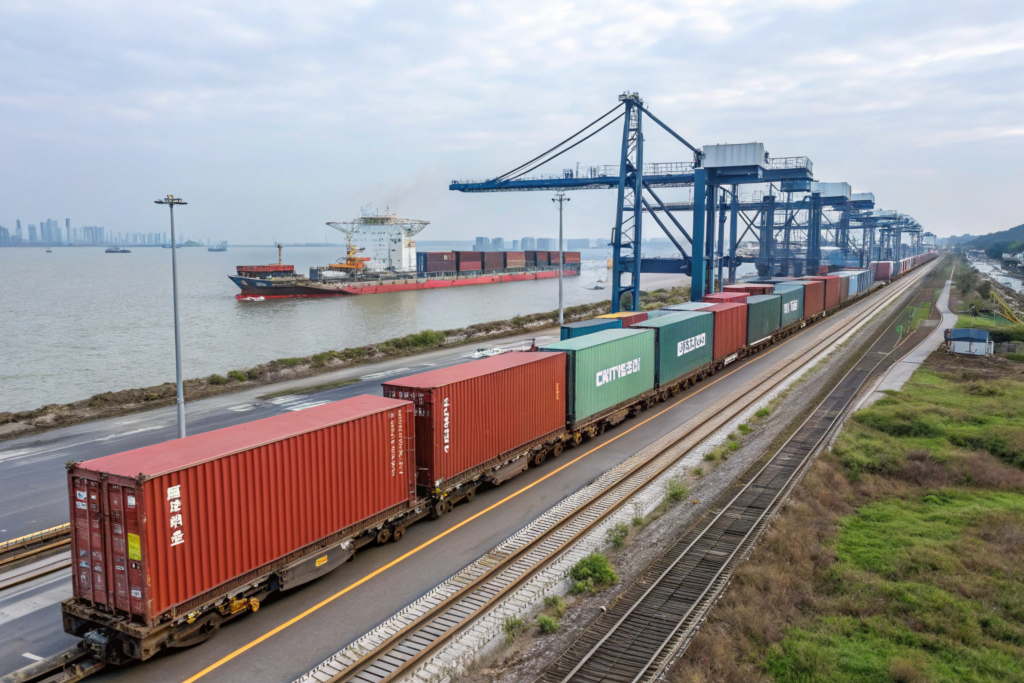
Rail freight from China to the USA is a multimodal solution. Containers travel by rail from major Chinese rail hubs like Xi’an, Chongqing, or Zhengzhou across Eurasia to European ports like Hamburg or Duisburg. From there, the containers are loaded onto ocean vessels for the Atlantic crossing to US East Coast ports like New York or Savannah. The total door-to-door transit time is 20 to 25 days to the US East Coast. The cost is approximately 50% to 70% less than air freight and 20% to 40% more than ocean freight. Rail is best for US East Coast destinations, medium-weight shipments, and timelines that are too tight for ocean but cannot justify air.
The China-Europe rail corridor, known as the Belt and Road Initiative rail link, has matured significantly in recent years. The transit time from a Chinese rail terminal to a European port is 12 to 18 days. The ocean leg from Europe to the US East Coast adds another 7 to 10 days. The total is 20 to 25 days. Compare that to a traditional ocean sailing from China to the US East Coast via the Panama Canal, which takes 30 to 40 days. Rail saves 10 to 15 days on East Coast deliveries. The Panama Canal has also become a bottleneck with drought restrictions and transit slot auctions. Rail avoids the canal entirely.
We recommend rail freight specifically for shipments destined for the US East Coast or Gulf Coast where the Panama Canal routing is the alternative. For West Coast destinations, traditional ocean is faster and cheaper than rail. The rail route goes west to Europe and then east across the Atlantic. That makes no geographical sense for a Los Angeles delivery. But for a New York, Savannah, or Miami delivery, the rail-and-sea combination is a legitimate middle lane. The cost per kilogram is roughly halfway between ocean and air. We present rail as an option when you tell us your delivery address is on the East Coast and your timeline is 20 to 25 days. It is not the right choice for every shipment, but it is the right choice for a specific set of circumstances that many importers do not realize they have.
What Is the Exact Route and Transit Time for China-to-USA Rail Freight?
You imagine a single train track from Beijing to New York. That does not exist. The route is multimodal. The container moves by rail, then by ship. The handover points matter because each one adds time and risk.
The typical route starts at a Chinese rail hub. Xi’an is the largest for consumer goods. The container is loaded onto a dedicated freight train. The train travels through Kazakhstan, Russia, Belarus, and Poland. The gauge changes at the Belarus-Poland border, requiring a chassis swap that takes a few hours. The train arrives at a German hub, typically Hamburg or Duisburg, in 14 to 16 days. The container is then transloaded at the port and loaded onto a container vessel bound for the US East Coast. The Atlantic crossing takes 8 to 10 days to New York. Total origin rail terminal to destination port is 22 to 26 days. Add origin trucking and destination delivery, and the door-to-door time is 25 to 30 days. This is still 5 to 15 days faster than an all-water Panama Canal routing for East Coast delivery.
What Are the Risks and Insurance Considerations for Rail Freight?
Rail freight crosses multiple countries, each with different rail operators, customs regimes, and security standards. You worry about cargo theft on a remote rail siding in Central Asia, or a container lost in a transshipment yard in Europe.
The rail corridor has matured, and security has improved. Containers are sealed at origin with a high-security bolt seal. The seal number is recorded and checked at each major handover point. GPS tracking is available for the entire rail journey. We use satellite trackers on rail shipments, just as we do on ocean shipments. Cargo insurance for the rail leg is available under standard marine cargo policies, as the Institute Cargo Clauses cover multimodal transport. We ensure your insurance covers the entire journey from the Chinese factory to the US warehouse, regardless of the transport mode changes. The claims history on the China-Europe rail corridor is comparable to ocean freight. Theft and pilferage are not significantly higher. The real risk is transit delay, not cargo loss. A border congestion or a gauge-change bottleneck can add 2 to 3 days. We build a buffer into the quoted timeline and monitor the train’s progress daily.
How Does GeeseCargo Help You Compare the Three Modes and Make a Decision?
You now understand ocean, air, and rail. But understanding the modes in theory is different from choosing one for your actual shipment. You have a specific shipment volume, a specific origin, a specific destination, and a specific delivery deadline. You need a tailored comparison with real numbers.
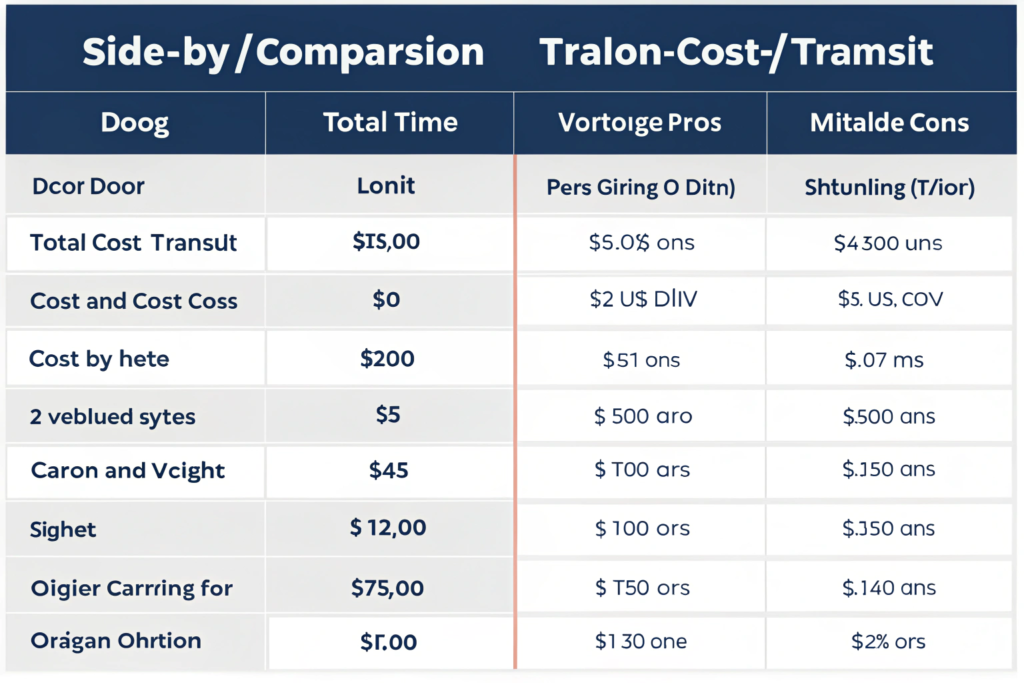
We generate a side-by-side comparison table for your specific shipment. The table shows the door-to-door transit time, the total cost, the cost per unit, and the pros and cons for each viable mode. We do not just email you a generic rate sheet. We input your actual carton dimensions, weight, origin, and destination into our system. The system produces a comparison that reflects the real service options available to your shipment on that specific day. You see the trade-offs clearly and make a data-driven decision in minutes.
Here is a real example from a client shipping 500 units of ceramic mugs from a factory in Yiwu to a warehouse in Dallas, Texas. The shipment was 12 cartons, 1.8 cubic meters, 180 kg. The client needed the goods in 21 days for a scheduled retail promotion. We ran the comparison.
| Mode | Door-to-Door Transit | Total Cost | Cost Per Unit | Best For |
|---|---|---|---|---|
| Ocean LCL | 30 days | $580 | $1.16 | Lowest cost, flexible timeline |
| Rail + Ocean | 25 days | $1,420 | $2.84 | East Coast delivery, but Dallas is not East Coast |
| Air Freight | 7 days | $1,860 | $3.72 | Hitting the 21-day promotion deadline |
Ocean LCL was the cheapest at $1.16 per unit, but 30 days missed the promotion window. Rail was not geographically suitable for Dallas and offered no time advantage over ocean for a West Coast routing. Air freight at $3.72 per unit was the only option that met the 21-day deadline. The client chose air freight. The mugs arrived in 7 days. The promotion launched on time and generated $15,000 in sales. The air freight premium of $1,280 over ocean was recovered in the first two hours of the promotion. The comparison table made the decision clear. We produce this analysis for every shipment where the mode choice is not obvious.
How Do We Calculate the Total Landed Cost for Each Mode?
You see a freight rate of $2.50 per kilogram for air freight and $500 per cubic meter for ocean LCL. You try to compare them directly. You cannot. The units are different, and the rate is only one part of the total cost.
We calculate the total door-to-door cost, including every charge from factory pickup to final delivery. The total cost includes the origin trucking, the export clearance, the origin terminal handling, the main carriage freight, the fuel and security surcharges, the destination terminal handling, the customs clearance, the customs bond, the duty and tax, and the destination trucking. We present this as a single number: the total landed cost. We then divide that by the number of units in the shipment to give you the cost per unit for each mode. This is the number that matters for your margin calculation. The freight rate per kilogram or per cubic meter is an input. The cost per unit is the output that drives your decision. We do the conversion math so you do not have to.
What If Your Timeline Requires a Hybrid Approach?
You need 5,000 units in your warehouse in 15 days. But 5,000 units at 12 cubic meters would cost $14,000 by air freight. That is more than the product cost. You cannot justify it. But you cannot wait 30 days for ocean either.
We design a hybrid solution. We ship 80% of your inventory, 4,000 units, by our express ocean FCL service. The transit is 18 days. We ship the remaining 20%, 1,000 units, by air freight. The transit is 7 days. The air freight bridge stocks you for the first 11 days of sales. The ocean shipment arrives on day 18 and takes over the inventory. Your total freight cost is a weighted average of the ocean cost and the air cost. It is much lower than air-freighting the entire 5,000 units. It is much faster than waiting 30 days for the ocean shipment alone. This hybrid approach is how sophisticated e-commerce brands manage the trade-off between freight cost and stock-out risk. We recommend it when your shipment is large enough to split and your timeline is tight enough to require a bridge.
Conclusion
Choosing between ocean, air, and rail freight is a business decision, not a logistics trivia question. The right mode preserves your margin, hits your delivery deadline, and matches your product’s physical characteristics. The wrong mode eats your profit with unnecessary freight spend or starves your sales channel of inventory.
Ocean freight is the workhorse. It moves the vast majority of consumer goods at the lowest cost per unit. Within ocean, we offer economy LCL for baseline replenishment, standard FCL for volume shipments, and express FCL for faster restocks without the air freight premium. Air freight is the sprinter. It moves time-critical goods in under a week at a premium price. It is not for every shipment, but when a stock-out costs more than the air freight, it is the profitable choice. Rail freight is the emerging middle lane. It serves US East Coast destinations with a transit time that beats the Panama Canal and a cost that undercuts air freight.
At GeeseCargo, we do not force your shipment into a single mode. We model all viable options for your specific cargo, your specific origin, and your specific destination. We show you the door-to-door time, the total cost, and the cost per unit for each mode. You make the decision with clear eyes and hard numbers.
If you have a shipment sitting in a Chinese factory and you are not sure whether to put it on a boat, a plane, or a train, go to GeeseCargo.com and send me the packing list and the delivery address. I will run the comparison and send you a one-page analysis of your options. Let’s find the mode that keeps your shelves stocked and your margins healthy.


