You are sitting on a supplier quote for 2,000 units of your product. The product cost is locked in. Now you need the freight cost to calculate your total landed cost and set your retail price. You search "40ft container shipping cost China to USA" and get numbers ranging from $2,500 to $8,500 for the same route. One website says rates are falling. Another says they are spiking. You do not know which number to trust, what is included in each quote, and whether the price you see today will be the price you pay at delivery. The uncertainty is freezing your purchasing decision.
The cost to ship a 40-foot container from China to the USA in 2026 typically ranges from $3,200 to $5,500 door-to-door to a West Coast destination, and $4,500 to $7,500 to an East Coast destination. This range covers the full door-to-door service: origin pickup, Chinese export clearance, ocean freight, all surcharges, US customs clearance, duty (for DDP shipments), and destination delivery. The exact price depends on the specific origin and destination cities, the time of year, the carrier, and the service level. At GeeseCargo, we provide an instant, all-inclusive, binding quote based on your specific shipment details, not a generic range that leaves you guessing.
The wide range of prices you see online reflects the difference between port-to-port base rates and door-to-door total costs. A port-to-port quote of $2,500 can easily become a door-to-door cost of $5,000 once all the mandatory surcharges, handling fees, customs clearance, and trucking are added. I will break down exactly what goes into a 40-foot container shipment cost, what factors cause the price to fluctuate, and how to get an accurate, honest quote that you can actually budget against.
What Are the Core Components of a 40ft Container Shipping Cost?
You receive a quote that says "$2,800 – Port to Port." You think this is the total cost. You budget $2,800. The final invoices total $5,200. You were not lied to. The $2,800 was the ocean freight. The other $2,400 was the mandatory additional charges that were not included in the port-to-port rate.
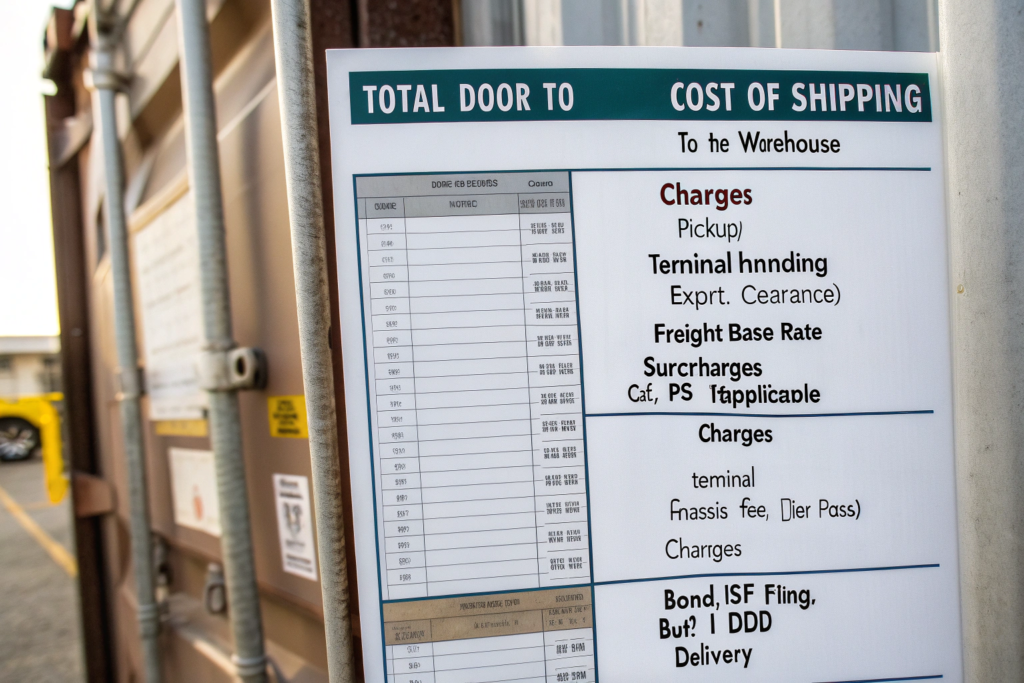
The total door-to-door cost of shipping a 40-foot container has six core components. First, the origin charges: factory pickup, origin terminal handling, and Chinese export clearance. Second, the ocean freight base rate. Third, the ocean surcharges: Bunker Adjustment Factor or BAF, Currency Adjustment Factor or CAF, and Peak Season Surcharge or PSS if applicable. Fourth, the destination charges: destination terminal handling, chassis fee, and pier pass or similar port infrastructure fees. Fifth, the customs charges: customs clearance fee, customs bond, ISF filing, and import duty if DDP. Sixth, the destination delivery: drayage from the port and inland trucking to your warehouse. A legitimate quote includes all six.
Let me walk through each component with real numbers from a typical Shanghai to Los Angeles 40-foot container shipment in mid-2026.
The origin charges include the trucking from the factory to the port, which depends on the distance. A factory within 100 kilometers of the port might cost $250 to $400. The origin terminal handling charge, or THC, is what the port terminal charges to receive and load the container. This is typically $300 to $450. Chinese export customs clearance adds another $80 to $120.
The ocean freight base rate is the headline number you see quoted. For a 40-foot container from Shanghai to Los Angeles in mid-2026, this is approximately $1,800 to $2,800 depending on the carrier and the service level. This is the rate that fluctuates the most based on market conditions.
The ocean surcharges are added to the base rate. BAF, the fuel surcharge, adjusts based on bunker fuel prices. It typically adds $400 to $800 for a 40-foot container on the transpacific route. CAF, the currency surcharge, adjusts for exchange rate fluctuations between the US dollar and the carrier’s cost currencies. It typically adds $50 to $150. PSS, the peak season surcharge, applies during the August-to-October peak and adds $300 to $800.
The destination charges include the terminal handling at the US port, which is typically $400 to $600. The chassis fee, which is the rental of the wheeled frame to move the container, is $75 to $150. Pier pass or similar port infrastructure fees add $40 to $80.
The customs charges include the customs clearance fee of $125 to $250, the ISF filing fee of $35 to $75, the customs bond fee of $75 to $150 for a single-entry bond, and the import duty, which varies by product.
The destination delivery depends on the distance from the port. Drayage to a local warehouse within 50 miles is $350 to $600. Inland trucking to a warehouse 500 miles away is $1,200 to $2,000. Rail intermodal to a Midwest destination is $1,500 to $2,500.
Add all these components, and the Shanghai to Los Angeles door-to-door total for a 40-foot container in mid-2026 is approximately $4,200 to $5,800. That is the number you budget. Not the $2,800 ocean freight base rate.
What Is the Difference Between a Port-to-Port and a Door-to-Door Quote?
You are comparing two quotes. One is $2,800. One is $4,800. You assume the $2,800 forwarder is cheaper. They are quoting different things. The $2,800 quote is port-to-port. The $4,800 quote is door-to-door. The door-to-door quote is not more expensive. It is more complete.
A port-to-port quote covers the ocean freight and the ocean surcharges from the Chinese port to the US port. It excludes the origin pickup, the origin THC, the destination THC, the customs clearance, the duty, and the delivery. A door-to-door quote includes everything. When you compare quotes, you must compare the same scope. Ask the $2,800 forwarder for a door-to-door breakdown. Their door-to-door total will likely be similar to the $4,800 quote. The difference is transparency, not price.
How Much Does Import Duty Add to the Total Cost?
You are shipping furniture with a 12% duty rate and a 7.5% Section 301 tariff. The product value is $30,000. The duty is not included in standard freight quotes. You need to add it separately.
For a DDP shipment with us, the duty is included in the quote. The duty is calculated as the HTS duty rate plus any applicable Section 301 tariff, multiplied by the declared customs value. For a $30,000 shipment with a combined 19.5% duty and tariff rate, the duty is $5,850. This is often the single largest line item after the ocean freight. We calculate the exact duty during quoting so there are no surprises.
What Factors Cause the Price to Fluctuate Throughout the Year?
You receive a quote in March for $4,200. You delay your order. You request the same quote in September. The price is now $6,500. You think the forwarder is gouging you. The price increase is driven by seasonal market dynamics that affect the entire shipping industry.
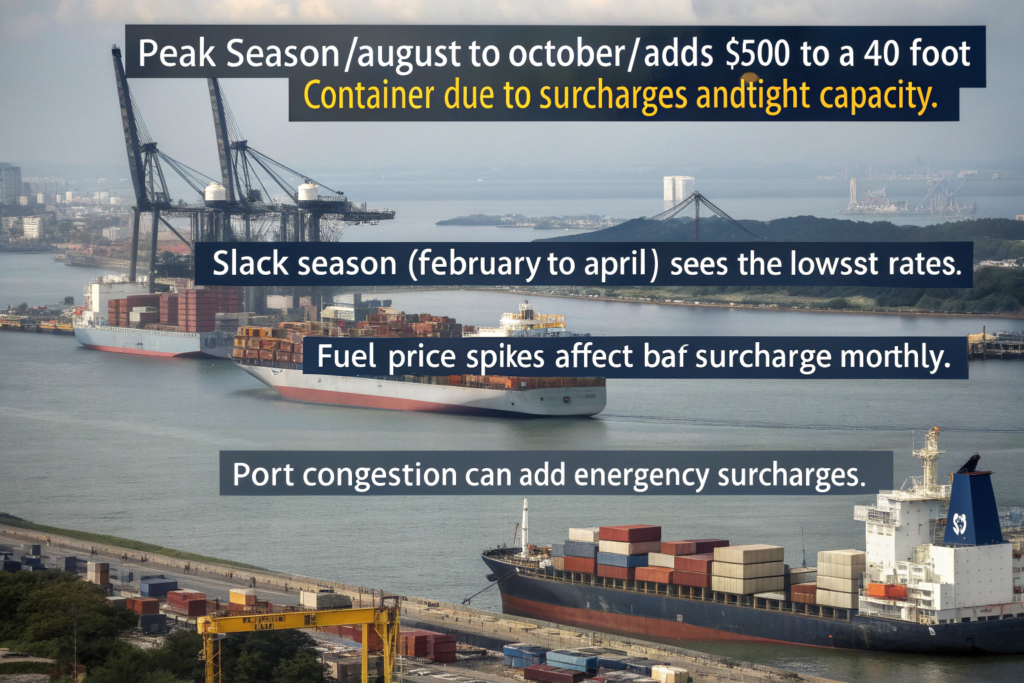
The primary factors that cause container shipping prices to fluctuate are seasonal demand cycles, port congestion, fuel prices, and carrier capacity management. The peak season from August to October consistently adds $500 to $1,500 to the cost of a 40-foot container due to peak season surcharges and tight capacity. The slack season from February to April often sees the lowest rates. Fuel price spikes affect the BAF surcharge monthly. Port congestion events can add emergency surcharges with little notice. Understanding these factors helps you time your shipments to capture lower rates.
The seasonal cycle is the most predictable factor. Retailers importing for the holiday season book heavily from August through October. This surge in demand fills vessels, and carriers implement peak season surcharges and general rate increases. Container space becomes scarce, and spot rates rise. If your inventory timeline allows flexibility, shipping your baseline stock in the February-to-April window can save 15% to 25% on freight costs compared to peak season.
Fuel prices affect the BAF, which is adjusted quarterly or monthly by most carriers. When crude oil prices rise, bunker fuel prices follow, and the BAF increases. A $20 per barrel increase in crude oil can add $200 to $400 to a 40-foot container’s BAF. This is a direct pass-through cost that no forwarder can absorb.
Port congestion and labor disruptions are unpredictable but impactful. A labor slowdown at US West Coast ports can add congestion surcharges and increase demurrage risk. The Panama Canal drought restrictions have periodically limited transits and increased costs for East Coast routings. We monitor these factors in real-time and advise on alternative routings when a disruption threatens your cost or timeline.
How Can You Time Your Shipments to Get the Lowest Rate?
Your purchasing is flexible. You can produce in January and ship in February, or produce in July and ship in August. You want to target the lowest freight rate window.
The historical data is clear. The lowest transpacific container rates are typically found in the February-to-April window, after Chinese New Year and before the summer peak begins. A secondary low window occurs in November after the holiday peak orders have shipped. If you can schedule your production to hit these windows, you save significantly. We provide a seasonal rate forecast to help you plan your production calendar around freight economics.
What Is the Impact of the Panama Canal on East Coast Pricing?
You ship to New York. The all-water route via the Panama Canal has historically been the cheapest option. But drought restrictions have reduced canal transits and increased transit slot auction prices.
The Panama Canal situation has made East Coast routing more dynamic. When canal surcharges are high, the rail-sea route via the US West Coast or the Prince Rupert rail intermodal route can become cheaper than the all-water canal route. Our system compares the all-in cost of all viable routings and recommends the cheapest at the time of booking.
How Does Our Instant Quote Tool Give You an Accurate Price?
You are tired of emailing forwarders and waiting days for a quote that may or may not be accurate. You want a binding price now so you can finalize your purchase order and your retail pricing.
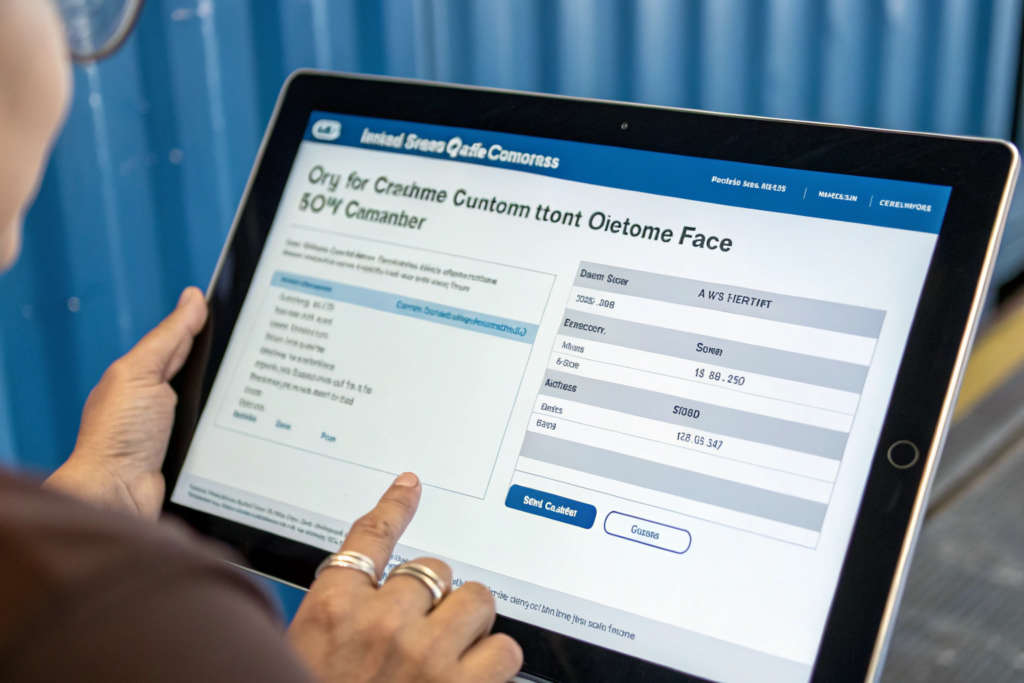
Our website’s instant quote tool generates a binding door-to-door price for a 40-foot container in under two minutes. You enter the origin factory address, the destination warehouse address, the product type, and the declared value. The system pulls live ocean rates from our carrier contracts, calculates all surcharges based on current BAF and CAF tables, estimates the origin and destination handling based on the specific ports, and calculates the estimated duty. The price is comprehensive and bookable immediately. You do not wait. You do not wonder if the quote is complete.
The technology behind the instant quote is a significant competitive advantage. Traditional forwarders manually build quotes in spreadsheets using rate sheets that may be days or weeks old. Our system is connected via API to live carrier rate databases. When you request a quote, the system queries current rates, applies the correct surcharges, and generates the quote instantly. The rate is executable. If you book within the rate validity period, typically 7 days, the price is locked.
The quote includes every line item, not just the ocean freight. You see the origin pickup, the origin THC, the ocean freight, the BAF, the CAF, the destination THC, the customs clearance, the bond, the ISF, the estimated duty, and the destination delivery. You see the total door-to-door cost. You can download the quote as a PDF and share it with your team.
Can You Save a Quote and Come Back to It?
You are comparing multiple supplier options. You need quotes for three different factory locations. You want to generate all three quotes now, save them, and compare them later.
Every quote you generate is saved to your account. You can name each quote with the supplier or product name. You can view them side by side in your quote history. When you are ready to proceed, you select the quote and click "Book Now." The saved quote retains the rate validity date, so you know if the rate is still bookable.
How Do We Handle Price Changes Between Quote and Booking?
You generated a quote on Monday. You come back to book on Friday. The market has moved, and the carrier rate has increased. The original quote is no longer valid.
The instant quote clearly displays a rate validity date. If you book within that date, the price is locked. If the rate has expired, the system generates an updated quote with the current rate. We do not honor expired quotes at a loss, and we do not surprise you with a higher price after booking. The price at booking is the price you pay.
What Is the Difference in Cost Between West Coast and East Coast Destinations?
You are deciding whether to ship to Los Angeles and truck to your Dallas warehouse, or ship all-water to Houston. The port choice significantly affects the total cost and the transit time.
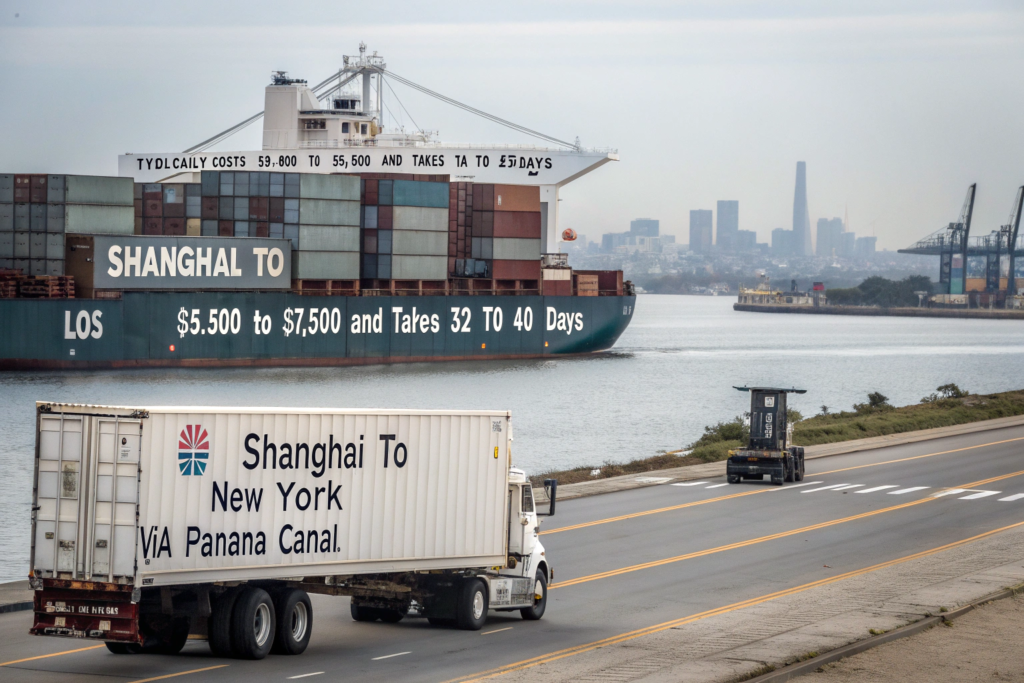
A 40-foot container from Shanghai to Los Angeles door-to-door typically costs $3,800 to $5,500 and takes 18 to 25 days. The same container to New York via the Panama Canal costs $5,500 to $7,500 and takes 32 to 40 days. The East Coast premium is driven by the longer ocean transit, the Panama Canal transit fees, and the additional fuel. For central US destinations, West Coast port entry plus rail intermodal is often cheaper and faster than an all-water Gulf or East Coast routing.
The cost difference between West Coast and East Coast is structural, not temporary. The distance from Shanghai to Los Angeles is approximately 5,700 nautical miles. The distance from Shanghai to New York via Panama is approximately 10,500 nautical miles. The extra 4,800 nautical miles add approximately 10 to 14 days of sailing, more fuel, and higher Panama Canal tolls. The canal toll for a 40-foot container is typically built into the ocean freight rate and adds $400 to $800 to the total cost.
For destinations in the central US, the decision is a trade-off between port entry cost and inland transportation cost. Los Angeles entry has a lower ocean cost but a higher inland truck or rail cost. Houston entry has a higher ocean cost but a lower inland cost for Texas and surrounding states. Our system models both and recommends the lowest total door-to-door cost.
What About Gulf Coast Ports Like Houston?
Your warehouse is in Austin, Texas. Houston is the closest major port. You assume Houston entry is the cheapest option. Sometimes it is. Sometimes Los Angeles entry plus a cross-country intermodal is cheaper, especially if Gulf Coast congestion is high.
We compare the all-in door-to-door cost for every viable port entry. For a shipment to Austin, the system compares Los Angeles entry plus truck to Austin, Houston entry plus truck to Austin, and possibly a rail intermodal option. The system picks the lowest cost that meets the transit time requirement.
How Much Does Inland Transportation Add to the Total?
Your container arrives in Los Angeles. Your warehouse is in Denver, 1,000 miles away. The ocean freight to LA was $2,500. The inland trucking to Denver adds $2,800.
Inland transportation is the sleeper cost that surprises importers who focus only on the ocean freight rate. Trucking a 40-foot container 1,000 miles can cost $2,000 to $3,500 depending on fuel prices and driver availability. Rail intermodal for the same distance might cost $1,800 to $2,500 and produce fewer emissions. We present both options with the cost and transit time for each. The port-to-door cost is the number you need, not the port-to-port cost.
How Do We Help You Get the Best Value, Not Just the Lowest Price?
You are tempted to choose the absolute lowest quote you can find. The forwarder has mixed reviews, but the price is $400 less than the next option. You book. The shipment is delayed by two weeks. The forwarder is unreachable. You pay $600 in demurrage. The $400 savings cost you $600 plus two weeks of lost sales.
We deliver the best value, which is the lowest total cost of a successful shipment, not the lowest quoted freight rate. A slightly higher rate with a reliable forwarder saves you money when you avoid demurrage, detention, missed delivery appointments, and stock-outs. Our value proposition is built on three pillars: transparent, all-inclusive pricing with no surprises; operational reliability that keeps your shipment on schedule; and proactive communication that lets you plan with confidence. The cheapest quote often becomes the most expensive shipment.
Value in freight forwarding is measured by the total cost of the shipment, not the quoted rate. Total cost includes the quoted freight, any surprise surcharges, any demurrage or detention charges, any dry run fees from missed deliveries, and the opportunity cost of delayed inventory. A forwarder who quotes $4,800 and delivers on time with no extra charges is cheaper than a forwarder who quotes $4,200 and delivers $900 in demurrage and two weeks late.
Our on-time delivery rate, our claims rate, and our customer retention rate are the metrics that demonstrate our value. We publish these metrics. We encourage you to ask any forwarder you are considering for their on-time performance data. Most cannot or will not provide it. We can.
How Does Our Operational Reliability Translate into Lower Total Cost?
A competitor quotes you $4,200 with 4 free days at the destination. We quote $4,600 with 7 free days. The competitor’s container arrives on a Friday. You cannot get a delivery appointment until Tuesday. The competitor’s free days expire on Tuesday. You pay two days of demurrage at $200 per day. Your total cost is $4,600. Our container arrives with 7 free days. The delivery is scheduled comfortably within the window. No demurrage. The total cost is $4,600, the same as the "cheaper" competitor.
This is not a hypothetical. Free day management is one of the most common sources of hidden cost. We negotiate more free days with carriers and proactively schedule deliveries within the window.
Can You Lock in a Rate for Multiple Shipments?
You ship four containers a month. You want price stability for budgeting. You do not want to renegotiate every month.
We offer quarterly and annual rate agreements for clients with consistent volume. The rate is fixed for the contract period, with a BAF adjustment mechanism for fuel price changes. Rate stability allows you to set your product pricing with confidence. Your account manager will discuss contract options once we understand your volume patterns.
Conclusion
The cost to ship a 40-foot container from China to the USA is not a single number. It is a calculation based on your specific origin, destination, product, and service requirements. The door-to-door total for a West Coast delivery typically falls between $3,800 and $5,500. For an East Coast delivery, between $5,500 and $7,500. These ranges include every charge from factory pickup to warehouse delivery.
The key to managing this cost is not just finding the lowest quote. It is understanding what is included, timing your shipments to avoid peak surcharges, managing the destination free days to avoid demurrage, and working with a forwarder whose operational reliability protects you from the hidden costs that inflate the final invoice.
At GeeseCargo, our instant quote tool gives you a binding, all-inclusive price in under two minutes. Our AI optimization ensures your routing is cost-efficient. Our operational team ensures your shipment arrives on time and within the free day window. Our transparent pricing means you never receive a surprise invoice. You get the best value, not just the lowest number on a rate sheet.
If you have a shipment ready to quote, go to GeeseCargo.com and use the instant quote tool. Enter your factory address, your warehouse address, and your product details. In two minutes, you will have a binding door-to-door price with every line item disclosed. That is the number you budget. That is the number you pay. No surprises. Just honest pricing and reliable service.