You have a shipment of electronic accessories ready in Chongqing. Ocean freight is too slow for your retail launch window. Air freight is too expensive for your product margin. You hear about the "New Silk Road" railway and a transit time that splits the difference. You book a rail freight service expecting a smooth 14-day ride to Hamburg. Then the train sits at the Khorgos border crossing between China and Kazakhstan for six days waiting for a gauge change and customs inspection. Your 14-day estimate becomes a 22-day reality, and your launch window slams shut. I have been managing China-Europe Railway Express shipments for years, and I can tell you that the published transit times are achievable, but only if you understand the real-world bottlenecks and plan for them.
The China-Europe Railway Express takes between 14 and 20 days door-to-terminal from major Chinese rail hubs like Chongqing, Chengdu, Xi’an, and Zhengzhou to German destinations like Hamburg, Duisburg, and Munich. The actual rail transit time from the Chinese border to the German terminal is 12 to 14 days. The additional time is consumed by terminal handling, export customs clearance in China, the gauge-change procedure at the Kazakhstan-China border or the Belarus-Poland border, and the import customs clearance in Germany. This is significantly faster than the 30 to 35 days for ocean freight and significantly cheaper than air freight.
The China-Europe Railway Express is not a single train that leaves at a fixed time. It is a network of routes, operators, and border crossings, each with its own transit time profile. You need to know which route your cargo is taking, which border crossing it will use, and what the current congestion status is at that crossing. At GeeseCargo, I route my clients’ rail shipments based on real-time border conditions, not a generic schedule. Let me walk you through the exact journey your container takes and how to get a realistic transit time estimate for your specific shipment.
What Is the Actual Rail Transit Time from Major Chinese Hubs to Germany?
You look at a promotional flyer from a rail freight operator. It says "Chongqing to Duisburg in 12 days." You think that means door-to-door in 12 days. It does not. That 12-day figure is the pure rail running time from the departure terminal in China to the arrival terminal in Germany, assuming zero delays at border crossings and zero waiting time for a train assembly slot. The real-world door-to-terminal time includes the trucking from your factory to the rail terminal, the terminal waiting time for the container to be loaded onto a train, the border crossing dwell time, and the terminal handling at the German destination. These additional steps add 3 to 8 days to the published rail transit time.
The actual rail transit time from major Chinese hubs to Germany is 14 to 16 days for the rail leg from terminal to terminal under optimal conditions. From Chongqing to Duisburg, the fastest recorded terminal-to-terminal time is 12 days, but the average is 14 to 15 days. From Xi’an to Hamburg, the average is 15 to 17 days. From Zhengzhou to Munich, the average is 16 to 18 days. These times assume a standard gauge-change delay of 12 to 24 hours at each border and no major congestion at the transshipment yards. The total door-to-terminal time, including first-mile trucking and terminal handling at both ends, is typically 18 to 24 days.
At GeeseCargo, I give my clients a "Rail Transit Calendar" that maps the full timeline from factory pickup to German terminal availability. The calendar breaks down the time spent on each segment, so you can see exactly where the hours go. Let me walk you through the specific route options and the factors that determine whether your shipment hits the 14-day mark or slips to the 20-day mark.
Which Chinese departure cities offer the fastest rail service to Germany?
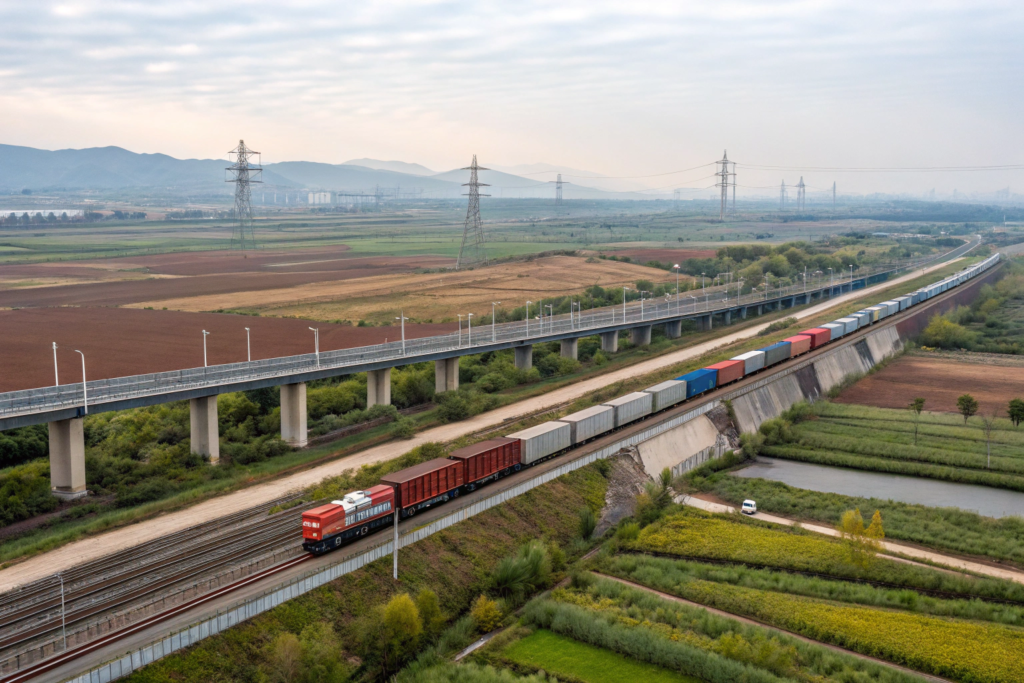
The five major rail hubs for China-Europe Railway Express are Chongqing, Chengdu, Xi’an, Zhengzhou, and Wuhan. Each has a different transit time to Germany based on the distance to the Chinese border and the specific international route used. Chongqing and Chengdu are the westernmost hubs, closest to the Khorgos and Alashankou border crossings into Kazakhstan. From Chongqing, the train reaches the Chinese border in about 2 days, then transits Kazakhstan, Russia, and Belarus before entering Poland at Malaszewicze and continuing to Germany. The total terminal-to-terminal time from Chongqing to Duisburg is the fastest in the network because the Chinese domestic leg is short. Xi’an is centrally located and has become the busiest rail hub. The train from Xi’an takes about 3 days to reach the border, and the total transit to Hamburg or Duisburg averages 15 to 16 days. Zhengzhou and Wuhan are further east, adding an extra 1 to 2 days of domestic transit. The choice of departure hub should be based on your factory location. Trucking from a factory in Yiwu to Chongqing takes 2 days and adds significant cost. Trucking that same factory to Xi’an takes 1 day. You must balance the faster international transit from the western hubs against the longer domestic trucking leg. I map the factory address to the nearest rail hub and calculate the total door-to-terminal time, not just the international rail leg. You can check the official train schedules and transit times published by the China Railway Express Platform which coordinates the various route operators.
What are the two main border gauge-change points and how much time do they add?
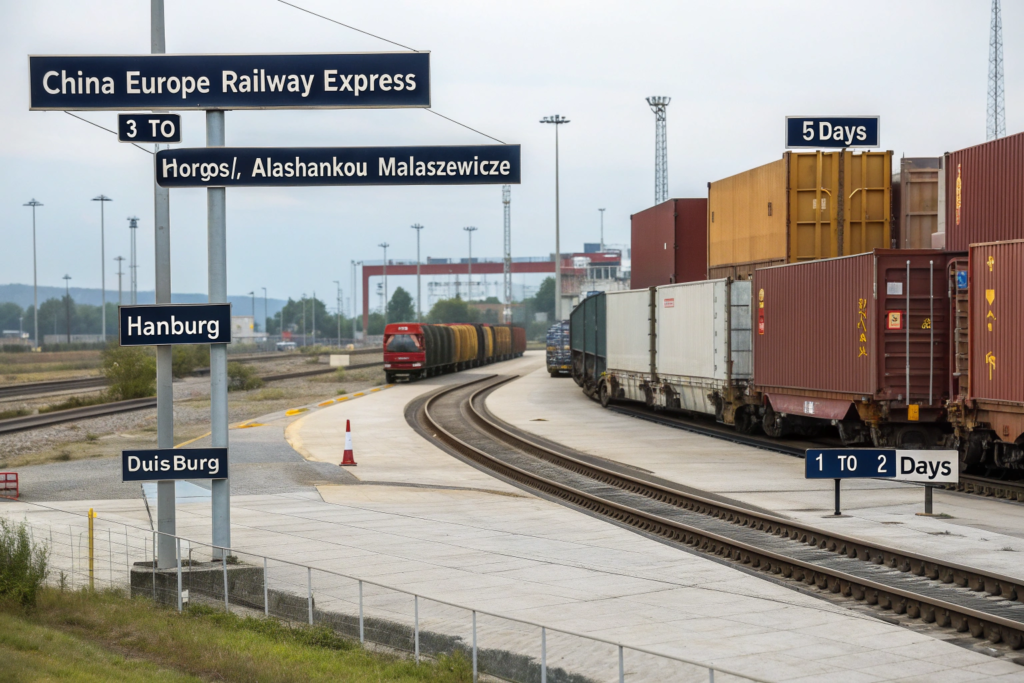
The railway tracks in China and Europe use the standard gauge of 1,435 millimeters. The tracks in the former Soviet Union countries, including Kazakhstan, Russia, and Belarus, use a broad gauge of 1,520 millimeters. A train cannot simply drive from Chinese tracks onto Kazakh tracks. The containers must be lifted off the Chinese train and placed onto a Kazakh train, or the entire railcar bogies must be swapped. This gauge-change operation happens at two major border points on the China-Europe route: Khorgos or Alashankou on the China-Kazakhstan border, and Malaszewicze on the Belarus-Poland border. Each gauge change takes a minimum of 4 to 6 hours for a full train under optimal conditions. However, if the transshipment yard is congested with multiple trains arriving simultaneously, the dwell time can stretch to 24 or even 48 hours. The Malaszewicze crossing is the most notorious bottleneck because almost all trains entering the European Union pass through this single yard. During peak season, the dwell time at Malaszewicze can reach 3 to 5 days. This is the single biggest variable in your transit time. I track the current border congestion status through my operational partners in Kazakhstan and Poland and route my clients’ shipments to the less congested crossing when possible. The OSJD International Rail Transport Corridor coordinates the gauge-change procedures and publishes the standard processing times. When I quote a rail transit time to a client, I include a "border dwell buffer" of 1 to 2 days per crossing in the estimate. If the border clears faster, the shipment arrives early, which is always a welcome surprise.
How Does Rail Freight Transit Time Compare to Ocean and Air Freight?
You are standing in front of a whiteboard trying to decide between ocean, rail, and air for a shipment of clothing from China to your warehouse in Frankfurt. Ocean takes 30 to 35 days and costs $2,500. Air takes 5 to 7 days and costs $8,000. Rail takes 18 to 22 days and costs $4,500. The numbers are in front of you, but the decision is not making itself. The transit time comparison is only one dimension. You must layer on the cost of inventory during transit, the carbon impact if your brand markets sustainability, and the flexibility of the mode to handle last-minute volume changes.
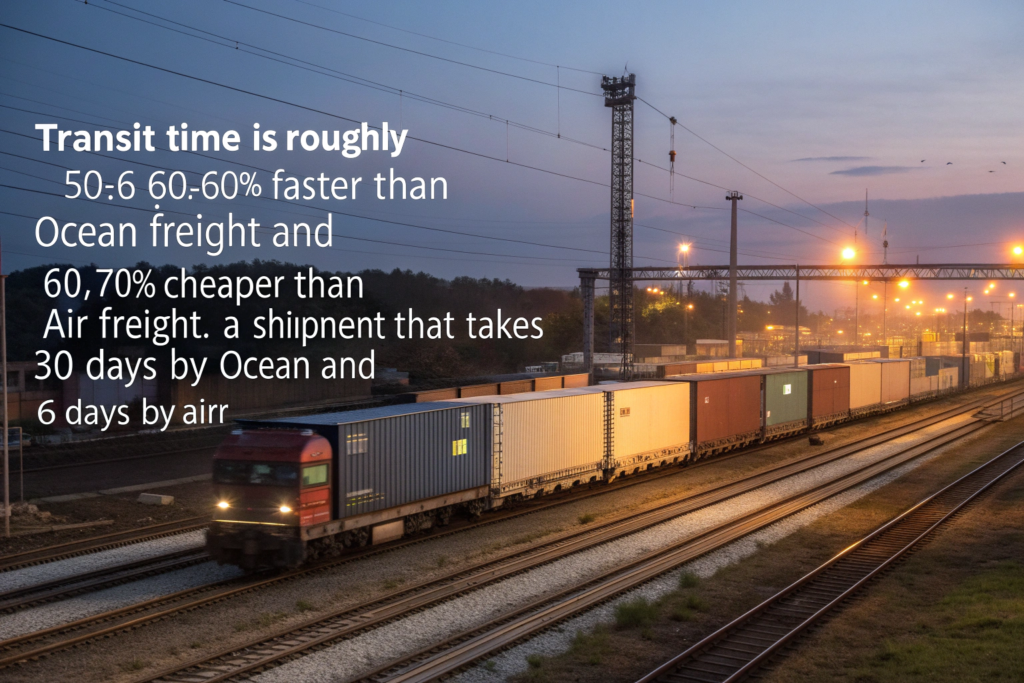
Rail freight from China to Germany occupies a strategic middle ground between ocean and air freight on both time and cost. The transit time is roughly 50-60% faster than ocean freight and 60-70% cheaper than air freight. A shipment that takes 30 days by ocean and 6 days by air takes 18 days by rail. The cost is approximately double the ocean freight rate and one-third to one-half the air freight rate. This positions rail freight as the optimal mode for medium-value, time-sensitive goods that do not justify the extreme premium of air freight but cannot tolerate the slow pace and variability of ocean freight.
I use rail freight extensively for my clients in the clothing, accessories, and electronics sectors. It is the mode that saved many of their businesses during the ocean freight crisis when container rates spiked to $20,000 and transit times bloated to 60 days. Rail became the stability anchor. Let me break down the exact comparison numbers so you can make the mode decision with a calculator, not a gut feeling.
What is the cost-per-day-saved when choosing rail over ocean?
The decision between rail and ocean is a trade-off between freight cost and inventory carrying time. Let’s run the numbers on a real scenario. You are shipping a 40-foot container of consumer electronics from Chengdu to Munich. The cargo value is $80,000. Ocean freight takes 32 days door-to-door and costs $3,200 all-inclusive. Rail freight takes 20 days door-to-door and costs $6,500 all-inclusive. The rail premium is $3,300, but rail saves you 12 days of transit time. Your company’s annual inventory carrying cost is 25%, which means each day your $80,000 of cargo is in transit costs you about $55 in capital cost. Over 12 days, the carrying cost savings are $660. The net rail premium drops to $2,640. Now factor in the sales window. If those electronics are for the holiday season and a 12-day earlier arrival means 12 extra days of full-price sales, the profit from those extra sales days often dwarfs the remaining freight premium. The formula I use with my clients is the Total Landed Cost Formula which adds freight, duty, insurance, and carrying cost into a single number. When you calculate the total landed cost per unit, the difference between rail and ocean often shrinks to a point where rail is the obvious choice for any product with a value above $20 per kilogram. You are not just paying for faster transit; you are buying inventory velocity and sales window protection.
Why is rail freight often more reliable than ocean freight for schedule adherence?
Ocean freight schedule reliability has improved since the pandemic chaos, but it still hovers around 60-70% on-time performance on the Asia-Europe lane. Blank sailings, port congestion, and container roll-overs are weekly occurrences. A vessel scheduled to arrive in 30 days can easily slip to 40 days with no warning. Rail freight operates on fixed schedules that are far less susceptible to the cascading delays that plague ocean shipping. A train departs from Xi’an on a specific day and time. It runs on a dedicated railway corridor managed by the national railway operators of China, Kazakhstan, Russia, Belarus, and Germany. There are no "blank trains" where the operator cancels a departure to manage capacity. The fixed infrastructure of a railway track means the schedule is built around train path slots that are allocated months in advance. Border congestion is the only major variable, and it is a known variable that can be buffered. I track the schedule adherence of the rail operators I use, and the on-time performance for the major routes from Xi’an to Duisburg is above 85%. The Sea-Intelligence Schedule Reliability Report publishes the monthly container shipping schedule reliability figures, and you can see the stark difference between the ocean carrier performance in the 50-70% range and the rail operator performance in the 85% plus range. For a business that sells seasonal goods or manages a lean inventory model, the higher schedule reliability of rail translates directly into lower safety stock requirements and fewer stockout emergencies.
What Are the Key Bottlenecks That Can Delay Your Rail Shipment?
Your rail shipment has a beautiful schedule on paper. Depart Xi’an on Monday, cross Khorgos on Thursday, arrive Duisburg in 14 days. Then Monday comes and the container truck from the factory is stuck in a traffic jam. The container misses the train cut-off by two hours. The next train is on Thursday. You just lost three days before the international journey even started. Bottlenecks are not random acts of god. They are predictable choke points in the rail freight supply chain that you can plan for if you know where they are. The three main bottlenecks are the first-mile trucking and terminal cut-off, the border gauge-change transshipment yards, and the destination terminal capacity in Germany.
The three key bottlenecks that delay China-Europe Railway Express shipments are: the origin terminal cut-off window, where a late-arriving container misses its scheduled train and waits 3 to 5 days for the next departure; the border gauge-change transshipment yards at Khorgos/Alashankou and Malaszewicze, where congestion can add 2 to 5 days of dwell time; and the destination terminal capacity in German hubs like Hamburg and Duisburg, where container availability for truck pickup can be delayed by 1 to 2 days during peak volume periods. Each of these bottlenecks is manageable with proactive planning.
At GeeseCargo, I manage rail shipments with a "bottleneck buffer" in the schedule. I do not promise the fastest theoretical transit time. I promise a realistic transit time that accounts for the known congestion points and gives the client a date they can actually plan their warehouse labor around. Let me walk you through each bottleneck and how to build your rail shipping calendar to absorb these delays.
How does the origin terminal cut-off window affect your departure time?
A rail terminal in Xi’an or Chongqing is not like a bus stop where you can show up five minutes before departure and throw your bag on. The terminal has a strict cut-off window, typically 24 to 48 hours before the scheduled train departure. During this window, the container must be delivered to the terminal, pass through the security scanner, have its customs export declaration filed and accepted, and be positioned in the loading area for the train assembly. If your truck arrives from the factory 30 minutes after the cut-off, the container is not loaded. It sits in the terminal yard until the next available train on that route, which is usually 3 to 5 days later. This delay compounds. A 3-day delay at origin means the container arrives at the border 3 days later, potentially missing the connecting train assembly and adding another 2 days of border dwell time. The total transit time can easily stretch by 7 to 10 days from a single missed cut-off. I work backwards from the train departure date to set a factory pickup date that includes a full day of buffer for trucking delays, a full day for terminal processing, and a final confirmation call with the truck driver when they are one hour from the terminal. The train schedules and terminal cut-off times for each hub are published by the China State Railway Group and the individual terminal operators. I pull these schedules for my clients and mark the critical cut-off date on their production calendar. The factory knows that if production finishes after that date, the shipment moves to the next train, and the delivery promise to the customer shifts by a week.
Why is the Malaszewicze transshipment yard the most critical delay point?
The Malaszewicze yard on the border between Belarus and Poland is the gateway through which the vast majority of China-Europe rail freight enters the European Union. It is a sprawling transshipment complex where containers are transferred from broad-gauge Russian/Belarusian railcars to standard-gauge European railcars. The yard has a finite daily capacity, and during peak season, the number of trains arriving from China exceeds the yard’s processing capacity. Containers back up. A train that arrives at Malaszewicze on Monday might not be processed until Thursday or Friday. The dwell time at Malaszewicze is the single most volatile variable in the entire China-Europe rail transit time. I have seen it swing from 6 hours to 6 days within the same month. I track the Malaszewicze congestion status daily through my rail operations partners in Poland. When the yard is backed up, I explore alternative entry points into the EU, such as the crossing at Brest or the newer route through Kaliningrad to the German Baltic ports, which bypasses the Malaszewicze bottleneck entirely. The PKP Cargo Terminal Schedule provides real-time capacity updates for the Polish rail network. I also use a routing strategy that favors the Dostyk-Alashankou crossing on the China-Kazakhstan border over the more congested Khorgos crossing when the real-time data shows a buildup. A routing decision made at the time of booking based on the current border conditions can save 3 to 5 days on the total transit time. This is not a decision a generic booking platform makes; it requires a forwarder with active operational relationships at the border crossings.
How Can You Optimize Your Door-to-Door Rail Shipping Schedule?
You have accepted that rail transit is 18 to 22 days door-to-terminal. But your goods do not sell from the terminal. They sell from your warehouse in Berlin, and the trucking from the Duisburg terminal to your Berlin warehouse adds another day. Your customer’s purchase order has a delivery deadline. You need to back-schedule from that deadline to determine the exact date the container must depart the Chinese rail hub. This is the discipline of door-to-door rail scheduling. It treats the entire supply chain as a single timeline and holds each segment accountable to its time allocation.
To optimize your door-to-door rail shipping schedule, you back-schedule from the required delivery date at your German warehouse by subtracting the German destination trucking and terminal handling time, the rail transit time with border buffers, the Chinese origin terminal handling and export clearance time, and the factory trucking time. This gives you the "factory ready date," the date by which production must be complete and the goods packed. You then add a one-week buffer for the unpredictable border dwell time and communicate the target train departure to your forwarder as a fixed booking, not a flexible window.
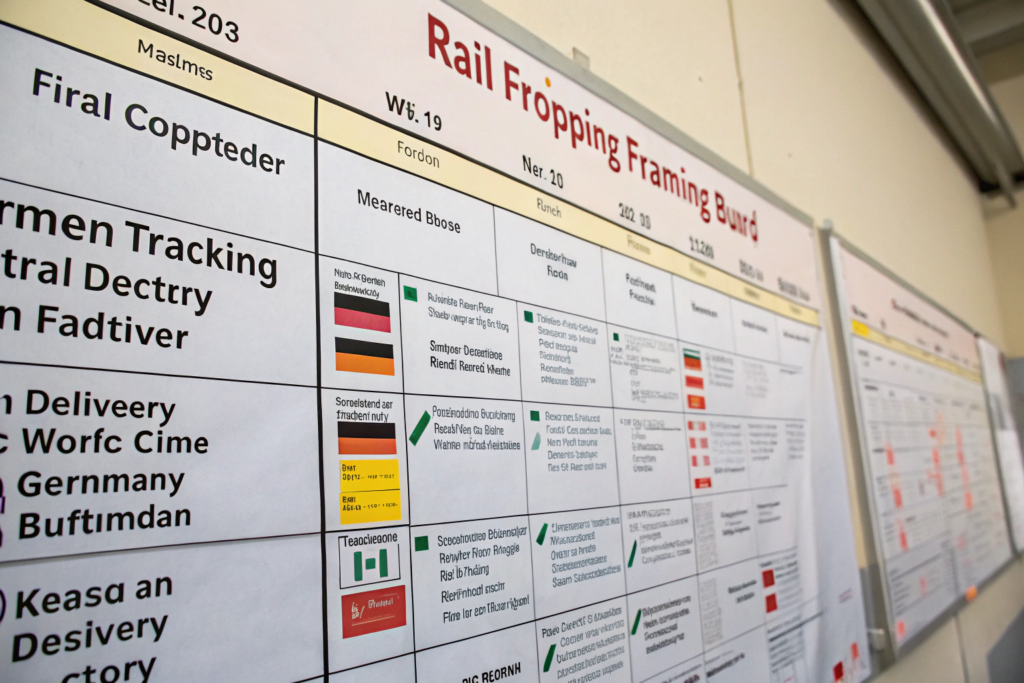
I build a "Rail Delivery Calendar" for every GeeseCargo client who uses the China-Europe Railway Express. The calendar starts with the customer’s required delivery date and works backwards through every step. Let me show you the exact timeline construction and how to build in the right amount of buffer without overshooting and holding unnecessary inventory.
How do you back-schedule from a German delivery deadline to a Chinese factory ready date?
Let us build a real back-schedule. Your customer in Berlin requires delivery on December 1st. German destination trucking from the Duisburg terminal to the Berlin warehouse takes 1 day. You need the container available for pickup at Duisburg by November 30th. Destination terminal handling and customs clearance at Duisburg takes 2 days. The container must arrive at the Duisburg terminal by November 28th. The rail transit time from Xi’an to Duisburg, including a 2-day border buffer, is 18 days. The container must depart Xi’an by November 10th. Origin terminal handling and export customs clearance at Xi’an takes 2 days. The container must arrive at the Xi’an terminal by November 8th. Trucking from the factory in Zhengzhou to the Xi’an terminal takes 1 day. The goods must be packed and ready for pickup at the factory by November 7th. This is the factory ready date. If the factory finishes production on November 7th, the shipment hits the December 1st Berlin deadline. If the factory finishes on November 10th, the shipment misses the Xi’an train cut-off and the Berlin delivery slips by at least a week. This back-scheduling exercise takes 15 minutes and it prevents every missed deadline that arises from wishful thinking about transit times. The scheduling tool I use is based on the standard Project Management Critical Path Method applied to logistics. You identify the longest sequence of dependent tasks and calculate the earliest possible finish date. I then share this schedule with the factory, the trucking company, and the rail terminal operator so every party knows their time window.
What is the right buffer to build into your rail transit time estimate?
A buffer is not a sign of poor planning. It is a recognition that international logistics across six countries and two gauge changes will hit a speed bump. The question is how much buffer to add. Too little, and you miss the delivery deadline and damage your customer relationship. Too much, and your goods sit in a warehouse in Germany for two weeks, accruing storage costs and consuming working capital. I use a tiered buffer system based on the season and the route. For a shipment in March (off-peak), I add a 2-day total buffer across the entire door-to-door timeline. For a shipment in October (peak season), I add a 5-day total buffer, with 3 days allocated specifically to the Malaszewicze border crossing. The buffer is not a secret pad that I hide from the client. It is a transparent line item in the schedule called "Contingency Buffer." If the border clears faster and the shipment arrives early, the client has an extra week of inventory availability, which is a profitable outcome. If the border takes the full buffer time, the shipment arrives exactly on the promised date. I recommend my clients use the early arrival to build a small safety stock at the German warehouse, which reduces the pressure on the next rail shipment. You can track the historical border dwell times and seasonal congestion patterns through data published by the Eurasian Rail Alliance Index which provides transparency on the performance of the China-Europe rail corridor. I use this data to adjust the buffer recommendation quarter by quarter, so the buffer reflects the current reality, not a generic rule of thumb.
Conclusion
The China-Europe Railway Express delivers your cargo from major Chinese hubs to Germany in 14 to 20 days of pure rail transit, and 18 to 24 days door-to-terminal. This is not a single, fixed number. It is a range driven by your choice of departure hub, the border crossing you use, and the season you ship in. Chongqing and Chengdu offer the fastest international transit because they are closest to the western border. Xi’an is the busiest hub with the most frequent departures. The Khorgos and Malaszewicze border transshipment yards are the two critical choke points that can add anywhere from 6 hours to 6 days to your transit time, and the Malaszewicze yard is the most volatile.
Rail freight earns its place in your supply chain when ocean is too slow and air is too expensive. It cuts ocean transit time roughly in half and costs roughly half of air freight. The schedule reliability of rail, consistently above 85%, makes it the preferred mode for inventory planners who cannot tolerate the blank sailings and roll-overs of ocean freight. The total landed cost calculation, which includes the inventory carrying cost during transit, often reveals that rail is the financially optimal mode for goods valued above $20 per kilogram.
The key to a successful rail shipment is the back-schedule. You start with the delivery deadline in Germany and subtract every segment of the journey until you reach the factory ready date in China. You add a transparent buffer that matches the current border congestion conditions. You share this schedule with every party in the chain. When the schedule is built on realistic transit times and managed with active border monitoring, the China-Europe Railway Express becomes not just a cheaper alternative to air freight, but a reliable backbone for your European supply chain.
At GeeseCargo, I treat rail freight as a precision logistics tool, not a gamble. I route your cargo based on real-time border data, I schedule your shipment from the delivery date backwards, and I communicate every milestone so you know where your goods are on the New Silk Road. The railway is the present and future of China-Europe trade, and a well-managed rail program is a competitive advantage for any importer serving the German market.