You just signed your first purchase order with a supplier in China. You are excited. Then the supplier sends an email: "Please provide your forwarder’s contact details and your shipping instructions." You stare at the screen. You have no shipping instructions. You do not know what a forwarder’s contact details should look like. You do not know if the goods need to go by sea or by air, what documents you need, or who pays the Chinese truck driver. The excitement turns into a cold sweat.
At GeeseCargo, we guide you through your first import with a structured, seven-step process. We do not hand you a checklist and wish you luck. We assign you a dedicated account manager who walks you through each step. We start with a consultation to understand your product, your timeline, and your budget. Then we handle the supplier coordination, the pickup, the export clearance, the ocean or air freight, the US customs entry, and the final delivery. You move from "I have no idea what I am doing" to "My goods are in my warehouse" with a partner who explains every document, every cost, and every decision in plain English.
Importing for the first time is not about learning the whole logistics industry overnight. It is about following a proven path with a guide who has walked it thousands of times. I built our first-time importer program specifically to remove the fear and confusion from this process. You focus on your product and your sales. We focus on the journey from the factory floor to your front door. Let me walk you through exactly what that journey looks like, step by step.
Step One: How Do You Prepare for Your First Import Consultation with Us?
You reach out to us with an Alibaba link and a message: "I want to ship this. How much?" That is a great start, but to give you an accurate quote and a realistic timeline, we need a little more. This is the planning phase, and it is where we set the foundation for a shipment without surprises.
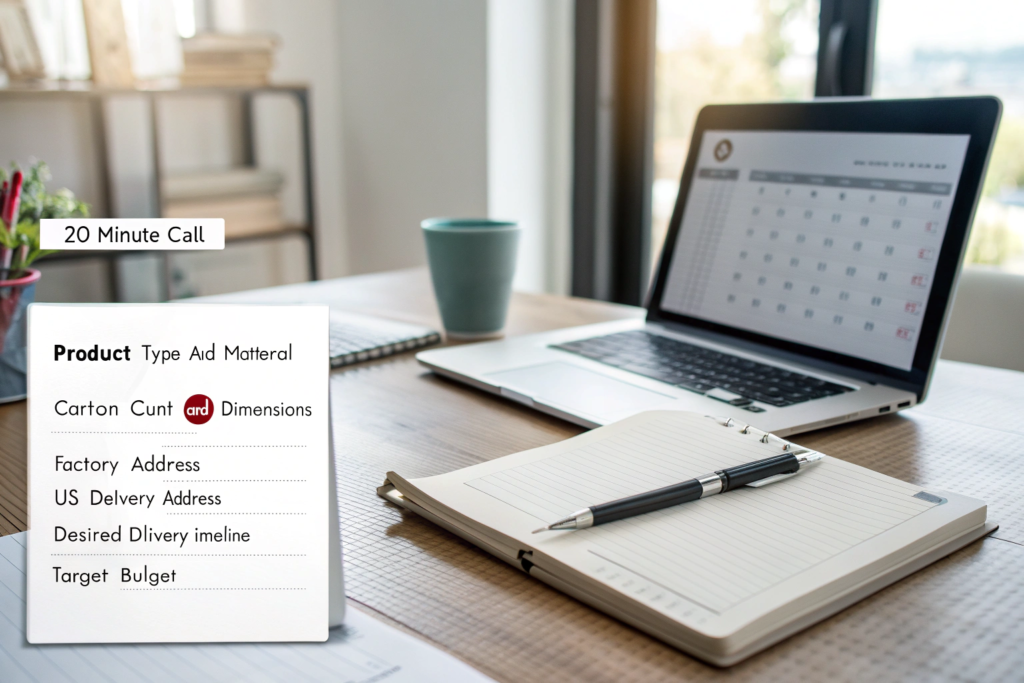
The first import consultation is a 20-minute call or chat where we gather the six pieces of information that determine your freight strategy. We ask for the product type and material, the carton count and dimensions, the factory address, the delivery address in the US, your desired delivery timeline, and your target budget. With these six data points, we build your shipment plan and present you with options. You do not need to have everything perfectly organized. We help you figure out what you do not know yet.
Let me tell you about a first-time importer named Sarah who called me last year. She had found a supplier for handmade resin coasters on Alibaba. She had the product link, the factory WeChat contact, and her home address in Austin, Texas. She did not know the carton dimensions or the weight. She did not know if she needed FDA approval for resin. She was almost apologetic about how little she knew.
I told her to relax. This is what we do. I asked her to send me the supplier’s contact, and I would handle the technical questions directly with the factory. I messaged the supplier on WeChat, asked for the carton dimensions, the gross weight per carton, and the total carton count for her 500-unit order. The supplier replied within an hour with a packing list. I saw the cartons were 40x30x30 cm, 12 kg each, and there were 25 cartons total. The total volume was 0.9 cubic meters. I called Sarah back and explained that her shipment was a small LCL shipment, less than one cubic meter. Air freight would be competitive on cost because the volume was so small, and the transit would be 7 days instead of 25. She chose air freight. Her coasters were on her doorstep 10 days later. She never had to ask the supplier for dimensions or figure out cubic meter calculations. We did that for her. That is how the consultation works. You bring the opportunity. We bring the logistics expertise. Together, we figure out the best plan.
What Information Should You Get from Your Supplier Before Speaking to Us?
You emailed the supplier and said, "I want to buy 500 units." They said, "OK, I will send you the invoice." The invoice has the product name, the unit price, and the total amount. That is all the supplier thinks you need. But the freight forwarder needs the physical details of the shipment, not just the financial details.
We coach you on exactly what to ask the supplier before you even contact us. Send this message to your supplier: "Please provide the packing list for my order, including the number of cartons, the dimensions of each carton in centimeters, the gross weight of each carton in kilograms, and the total volume in cubic meters. Also, please confirm your factory address for pickup and whether the goods will be packed on pallets or as loose cartons." This message takes 30 seconds to copy and paste. The supplier will respond with the data. You forward that data to us, and we have 80% of what we need for an accurate quote. This simple step saves days of back-and-forth emails. We also ask you to confirm the product material and the intended use. A product described as "home decor" could be wood, ceramic, plastic, or textile, and each has a different HTS code and duty rate. The more specific you are, the more accurate our quote and our customs advice will be.
How Do We Help You Choose Between Air Freight and Ocean Freight?
You assume ocean freight is always cheaper and air freight is always faster. That is generally true, but the breakpoint depends on your shipment size and urgency. For very small shipments, air freight can be cheaper than ocean LCL because ocean LCL has high minimum charges.
We present you with both options with real numbers. For a shipment of 0.5 cubic meters and 50 kg, the air freight door-to-door might cost $350 and take 7 days. The ocean LCL might cost $280 and take 30 days. Is saving $70 worth waiting an extra 23 days? For some products, yes. For a seasonal item or a product you are eager to start selling, the speed is worth the premium. For a shipment of 15 cubic meters, the ocean FCL option might cost $3,500 while air freight would cost $12,000. The ocean option is the clear winner. We show you the side-by-side comparison with the transit time, the cost, and the pros and cons of each. We do not push you to the more expensive option. We give you the data and let you decide based on your business priorities. This decision support is part of the consultation. You do not need to understand freight rate structures to make a smart choice. We translate the options into simple trade-offs.
Step Two: How Do We Coordinate the Factory Pickup in China?
You have paid your supplier, and the goods are ready. The supplier says, "Send the truck." You do not know any trucking companies in China. You do not know the pickup procedures, the loading requirements, or the export documentation needed at the factory gate. You are stuck at the very first physical step.
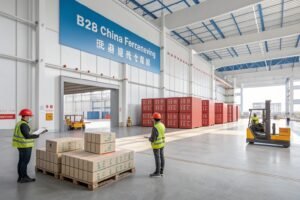
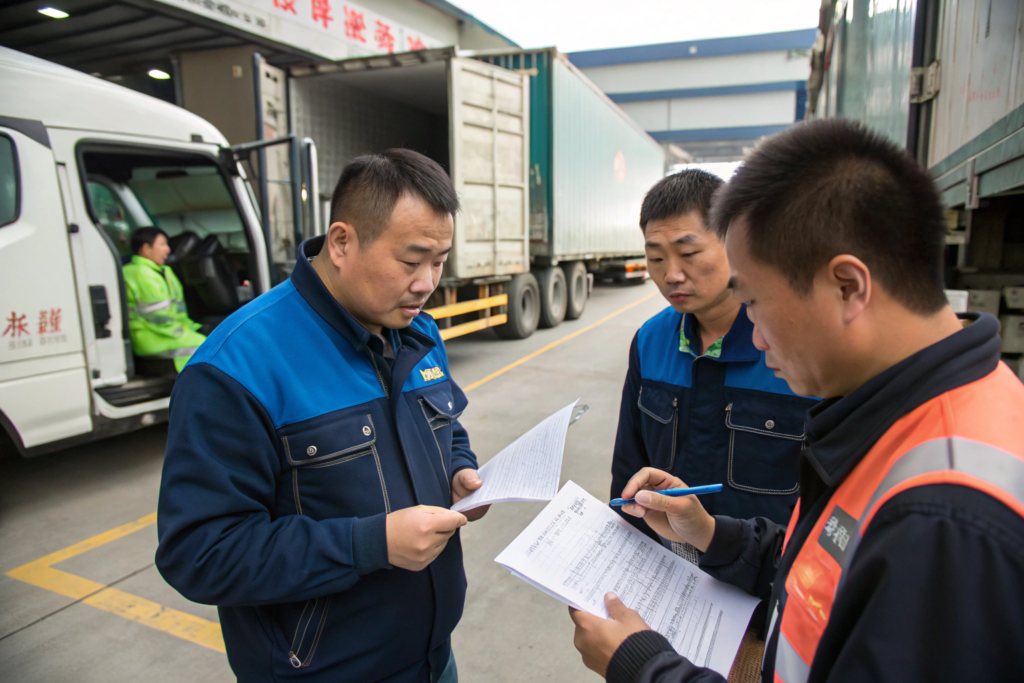
We coordinate the factory pickup for you. We contact the supplier directly, confirm the pickup address and the cargo readiness, and dispatch our contracted trucker. We provide the trucker with the pickup reference number and the loading instructions. The trucker arrives at the factory, counts the cartons, checks for external damage, and issues a pickup receipt. The goods enter our custody at the factory gate. You do not hire a Chinese trucking company. You do not negotiate a rate. You do not communicate with the driver. We handle the entire pickup process in the local language.
The factory pickup is where many first-time importers run into their first real obstacle. The supplier might be in a remote industrial zone that is not accessible to large trucks. The supplier might have specific loading dock hours. The supplier might demand that the trucker provides a specific type of vehicle or a specific document. These are local coordination issues that require a local presence.
Our operations team in Shenzhen speaks Mandarin and Cantonese natively. They call the factory contact and confirm the pickup in the local language. They verify the address because Chinese factory addresses can be notoriously imprecise in English translation. They send the trucker with a printed pickup order that has our company chop and the shipment reference number. The trucker loads the cartons, counts them, and signs a pickup sheet. If the cartons are visibly damaged or wet, the trucker photographs them and notes it on the receipt. This documentation protects you if the supplier claims the goods were in perfect condition when they left. The goods are then transported to our consolidation warehouse. You receive an email notification: "Your goods have been picked up from the factory and are in transit to our warehouse. ETA: 2 days." You did not have to make a single phone call to China.
What Happens If the Supplier Says the Goods Are Ready, But They Are Not?
You schedule the pickup for Monday. The trucker arrives. The factory says, "Sorry, packing not finished. Come back Wednesday." The trucker charges you a dry run fee. Your pickup is delayed, and your vessel booking is at risk.
We confirm the readiness three times. We call the factory one week before the scheduled pickup and ask: "Will the goods be 100% packed and ready by the pickup date?" We call again 48 hours before. We call a final time 24 hours before. If the factory says yes at each checkpoint, the pickup proceeds. If the factory admits a delay at any checkpoint, we reschedule the trucker before the trucker is dispatched. We do not send a truck to a factory that is not confirmed ready. This triple-confirmation process avoids dry run fees and keeps your shipment on schedule. If a supplier is consistently unreliable with readiness confirmations, we flag them in our system. Next time, we recommend you either build a readiness buffer into the timeline or consider a different supplier.
How Do We Handle the Chinese Export Declaration?
You think the goods just get on a truck and go to the port. But China requires an export customs declaration for every shipment leaving the country. The Chinese customs system needs the product name, the HS code, the value, and the exporter’s registration details. Your supplier might not have export rights.
We file the Chinese export declaration on your behalf. If the supplier has export rights, we use their registration. If they do not, we use our own export license. The export declaration is filed electronically through the China Customs EDI system. We list the product description in Chinese, the HS code, the quantity, and the value in USD. The system processes the declaration and issues a release. This step must be completed before the container is loaded onto the vessel. A missing export declaration can delay the container and cause it to miss the sailing. We handle this entirely. You do not provide any documents for Chinese customs. We use the packing list and the commercial invoice that you and the supplier provided. The Chinese export clearance is a silent step in our process. It happens behind the scenes, and you only hear about it if there is an issue. No news from us on export clearance is good news.
Step Three: How Do We Consolidate and Load Your Goods?
Your goods arrive at our warehouse. They are 25 loose cartons of resin coasters, each with a shipping mark written in marker. They look vulnerable. You imagine them getting lost in a sea of identical brown boxes at a massive port terminal.
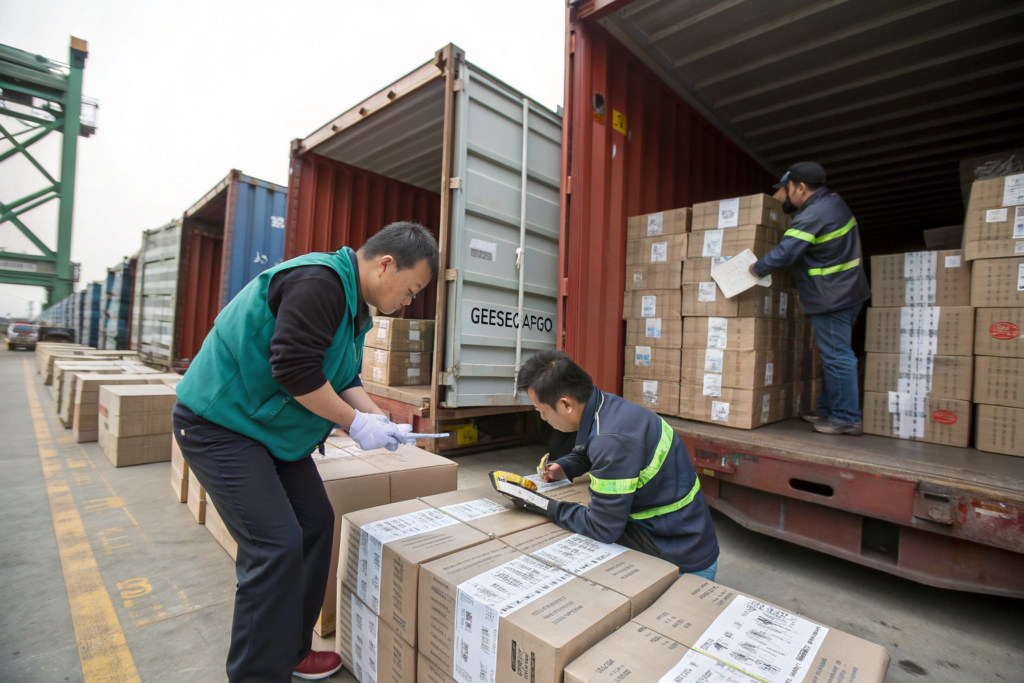
We receive your goods into our consolidation warehouse and immediately label and inventory them. Each carton gets a GeeseCargo barcode label that links it to your shipment in our digital system. We check the carton count and the external condition. We then consolidate your LCL shipment with other compatible cargo into a shared container, or we load your FCL container exclusively with your goods. The container is loaded according to a load plan that maximizes space and stability. You are not just a loose carton in a chaotic system. You are a tracked, managed shipment from the moment it enters our warehouse.
The consolidation warehouse is where your shipment transforms from a collection of individual cartons into a coherent freight unit. For LCL shipments, we group your cartons with other shipments destined for the same US region. Your 25 cartons of coasters might share a container with someone’s 10 cartons of gift boxes and another importer’s 5 pallets of kitchenware. Each importer’s goods are physically separated inside the container with clear markings. Our system tracks which cartons belong to which shipment.
For FCL shipments, the entire container is yours. We load it according to a load plan that we prepare in advance. Heavy cartons go on the bottom. Light cartons go on top. The cartons are stacked in interlocking patterns for stability. Void spaces are filled with airbags to prevent shifting during the ocean voyage. We photograph the loaded container before the doors are closed. You receive the load photos in your shipment update. You can see your goods inside the container, properly packed and ready for the ocean journey. This visual confirmation is particularly reassuring for a first-time importer. You see your investment being treated with care.
What Is the Difference Between LCL and FCL for a First Shipment?
Your supplier tells you that you have 3 cubic meters of goods. You read online that FCL is faster and safer. You ask for an FCL quote. We quote you $3,500 for a 20-foot container. You are shocked because 3 cubic meters is a tiny fraction of a 33-cubic-meter container. You are paying for a lot of empty space.
We explain the LCL and FCL decision in simple terms. LCL means you share a container with other importers and pay only for your space. FCL means you rent the whole container, regardless of how full it is. The breakpoint is usually around 15 cubic meters. Below 15 cubic meters, LCL is more cost-effective. Above 15 cubic meters, FCL becomes competitive on a per-unit basis and is faster because it skips the CFS deconsolidation step at the destination. For your 3-cubic-meter first shipment, LCL is the correct choice. We put you in an LCL consolidation with a transparent all-in price. You do not pay for empty space. You do not wait for a full container to fill. You simply pay for the cubic meters you occupy. We explain this without making you feel foolish for asking about FCL. Every first-time importer asks this question. We are happy to answer it.
How Do We Ensure Your Cartons Are Not Lost or Mixed Up?
You have a recurring nightmare. Your cartons get mixed up with another importer’s cartons inside a shared container. Their goods are delivered to you. Your goods are delivered to them. You both receive the wrong products, and it takes weeks to sort out.
We use a strict barcode-based tracking system to prevent this. When your cartons arrive at our warehouse, each carton receives a unique GeeseCargo barcode label. This label is linked in our system to your shipment reference number and your delivery address. When we load the container, we scan each carton as it enters the container door. The system records exactly which carton is in which container. When the container arrives at the destination CFS for deconsolidation, the warehouse workers scan each carton as it is unloaded. The system tells them which carton belongs to which importer and which delivery truck it should go on. A carton intended for your shipment cannot end up on the wrong truck because the barcode scan would flag a mismatch. This scan-verification loop from origin to destination is how we achieve near-zero mis-shipment rates. Your cartons are digitally tethered to your shipment ID throughout the journey.
Step Four: How Do We Book the Vessel and Manage the Ocean Transit?
The goods are in the container, and the container is at the port. You imagine it just gets put on the next available ship. But the port has dozens of vessels departing daily to different US ports. Which one is yours? When does it leave? What happens while it is at sea?
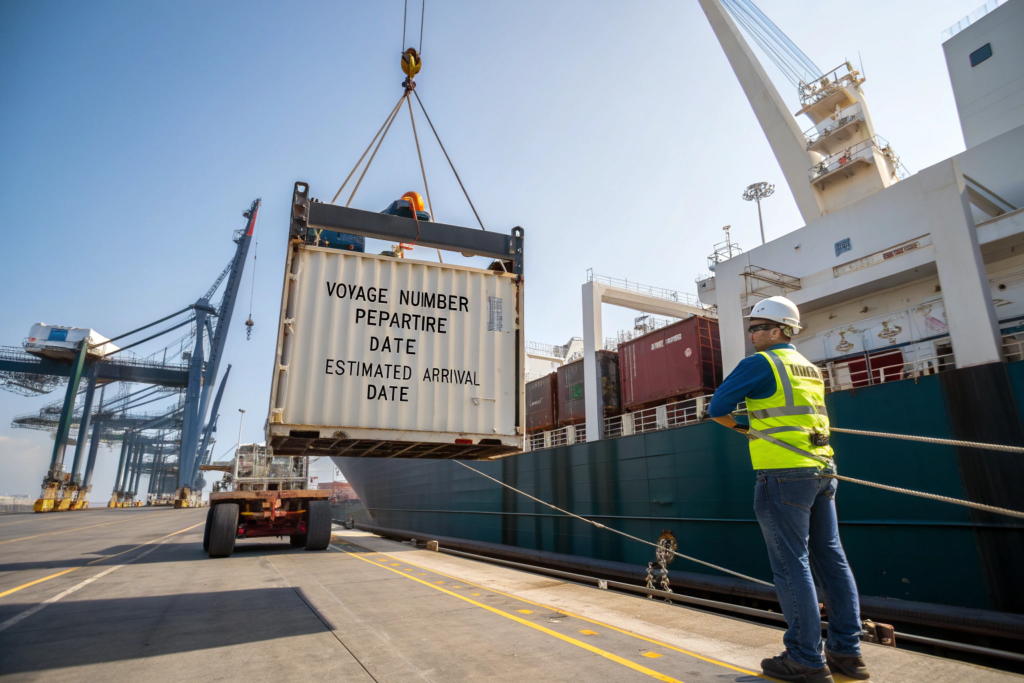
We book your container onto a specific vessel on a specific sailing date. We send you the vessel name, the voyage number, the departure date, and the estimated arrival date. You can track the vessel’s real-time position on a marine traffic website using the vessel name we provide. During the transit, we file the US customs entry and the ISF filing. You receive a mid-transit update from us confirming the paperwork is filed and the vessel is on schedule. You are not in a blackout period. You know exactly where your goods are.
The ocean transit is the longest single leg of the journey, usually 12 to 18 days from a major Chinese port to a major US West Coast port. It is also the leg where first-time importers feel the most anxiety because the goods are physically inaccessible. You cannot touch them, see them, or control them. They are inside a metal box on a ship in the middle of the Pacific Ocean.
We manage this anxiety with proactive communication. The day the vessel departs, you receive a departure notification email. The email includes the vessel name, the voyage number, the bill of lading number, and a link to the vessel tracking page on MarineTraffic.com. You can click the link and see a map with a little ship icon moving across the ocean. It is strangely satisfying. A week into the transit, you receive a mid-transit update. We confirm that the ISF is accepted, the customs entry is filed, and the vessel is on schedule. We also give you an updated ETA based on the vessel’s actual speed and position. If there is a delay, such as a port congestion in Busan or a weather deviation, we tell you immediately. You are never wondering what is happening. You are informed at every stage.
What Documents Do We File While the Ship Is at Sea?
You imagine that nothing happens during the ocean transit. The goods are just sitting there. But this is actually the busiest time for the paperwork that clears your goods into the United States.
We file two critical documents during the transit. The first is the Importer Security Filing (ISF), also known as the 10+2 filing. This must be filed with US Customs at least 24 hours before the vessel departs the foreign port. We file it 48 to 72 hours before departure to provide a safety margin. The ISF contains ten data elements from the importer, including the seller, buyer, importer of record, consignee, manufacturer, ship-to party, country of origin, and HTS code. We pull all of this from your commercial invoice and our own records. The second document is the US Customs Entry (CBP Form 3461 for immediate delivery or the entry summary CBP Form 7501). We file this while the vessel is at sea so that by the time the vessel docks, the entry is already processed and conditionally released. This pre-filing is what allows your container to be discharged and immediately available for pickup, bypassing the days of waiting that occur when the entry is filed after arrival.
How Do We Keep You Updated During the Ocean Transit?
Your previous experience with mail-order packages is that you get a tracking number and you refresh the page obsessively. You expect the same with your container. But container tracking is different from parcel tracking. The updates are less frequent but more meaningful.
We send you scheduled milestone updates, not just a tracking link. The updates arrive at your email inbox on key dates: "Vessel Departed," "Mid-Transit Status Check," "Vessel Approaching Destination Port," "Vessel Arrived at Port," "Container Discharged," "Customs Released," "Out for Delivery." Each email is a short, plain-English status message. You do not need to log into a portal and decipher cryptic status codes. The information is pushed to you. If you do want to dive deeper, you have access to your client portal where you can see the full shipment history, the documents, and the financial breakdown. We also welcome check-in messages. If you wake up at 2 AM worried about your shipment, you can send me a message on WhatsApp. I will see it when I wake up and reply with an update. You are not annoying us. Your anxiety is normal, and we would rather you ask us than worry in silence.
Step Five: How Do We Clear US Customs for Your First Import?
The vessel has arrived at the Port of Los Angeles. You think the goods just drive off the ship and onto a truck. But there is a gate between the port and the highway, and that gate is US Customs and Border Protection. Your goods must be legally admitted into the country.
We clear US customs on your behalf using our in-house customs brokerage. We have already pre-filed the entry while the vessel was at sea. When the vessel docks, the entry is typically already conditionally released. We pay the duties and taxes to CBP using our continuous customs bond. You do not set up a customs account. You do not file a single form with the US government. The clearance is a silent, seamless step in our managed process.
For a first-time importer, US customs is the boogeyman of importing. You have heard horror stories of shipments seized, fines issued, and goods held indefinitely. The reality is that standard consumer goods imported correctly by a licensed broker clear customs smoothly 99% of the time. The problems happen when importers try to cut corners, misclassify goods, or under-declare values.
We do not cut corners. We classify your product under the correct HTS code. We declare the true transaction value that you paid the supplier. We pay the accurate duty rate. We use our continuous customs bond to secure the entry. The CBP automated targeting system reviews the entry data, sees a correctly filed entry from a known, compliant importer, and issues a conditional release. The whole process is digital and often takes minutes. You pay the duty as part of your single invoice from us. We pay CBP directly from our duty account. You receive a copy of the CBP Form 7501 Entry Summary for your records. This document is proof that your goods entered the country legally and that the duties were paid. Keep it with your tax records. It is your import compliance documentation.
What If CBP Selects Your Shipment for Examination?
You receive an update: "Shipment flagged for CBP exam." Your stomach drops. You think this means something is wrong. You think you are in trouble. You imagine your goods being destroyed.
A CBP examination is a normal, random screening process. It is not an accusation of wrongdoing. A percentage of all shipments are examined based on risk algorithms and random selection. We handle the exam for you. We have a local team at the port who liaises with the CBP officers at the Centralized Examination Station. Most exams are non-intrusive X-ray scans that clear within 24 to 48 hours. If a physical tailgate exam is required, our team is present when the container is opened. We ensure the cartons are handled carefully and properly repacked. The exam fee is covered in our quoted price up to a standard amount. We do not surprise you with a bill for a random exam. We update you on the exam status and the expected clearance date. The vast majority of exams result in a release with no issues found. Your shipment is simply one of the statistically selected units in a routine screening program.
How Do We Pay the Import Duty on Your Behalf?
You read that you need to set up a customs account, get a bond, and have cash on deposit to pay duties. You do not know how to do any of that, and you do not want to learn.
Our DDP service includes the duty payment. We act as the Importer of Record using our continuous customs bond. We calculate the duty based on the product’s HTS code and the declared value. We pay the duty directly to CBP through our automated payment system. The duty amount is included in your single invoice from us. You pay us the invoice total before the goods are delivered. We handle the payment to the government. You do not need a customs account, a bond, or a cash deposit with CBP. You simply pay us, and we pay them. This is the simplest way for a first-time importer to handle the duty obligation. You are compliant with the law, and you have none of the administrative burden.
Step Six: How Do We Deliver Your Goods to Your Final Address?
Customs is cleared. The container is released. You think the hard part is over. But now your goods need to get from the port to your doorstep. The port is a massive, secure facility. You cannot just drive in with a rental van. You need a licensed, registered trucker with port access credentials.
We arrange the final delivery to your address. For LCL shipments, we coordinate with the destination CFS to deconsolidate the container and transfer your cartons to our contracted trucker. For FCL shipments, we arrange a drayage trucker to pick up the full container from the port and deliver it directly to your address. We schedule a delivery appointment window and provide you with the ETA. You need to be available to receive the goods and sign the delivery receipt. The journey ends at your door.
The final delivery is the step where you finally see and touch your goods. It is the moment of truth, and we want it to be smooth and drama-free. A few days before the delivery, we call you to confirm the delivery address and any special access requirements. Is your delivery address a residential home with a narrow street? We send a smaller truck with a lift gate. Is it a commercial warehouse with a loading dock? We send a standard 53-foot dry van. Is it a storage unit? We confirm the unit size and the access hours. We do not dispatch a truck blindly to an address that might be inaccessible.
On the delivery day, the trucker calls you an hour before arrival. The truck arrives, and you inspect the cartons for any visible damage. You count the cartons against the packing list. You sign the delivery receipt. If there is any damage, you note it on the delivery receipt before signing. Photograph the damage. We will assist you with an insurance claim if you purchased our cargo insurance. The delivery receipt is the final document in your shipment file. Your goods have traveled from a factory in China to your address in the United States. The first import is complete.
What Does "Final Mile" Mean, and Why Does It Matter?
You see the term "final mile" or "last mile" in logistics articles. You think it is just a buzzword. But it refers to the most expensive and unpredictable leg of the entire journey.
The final mile is the delivery from the destination port or warehouse to your address. It is disproportionately expensive because it involves a dedicated truck, a driver, and direct customer interaction. It is unpredictable because of traffic, parking restrictions, and delivery appointment availability. We manage the final mile carefully because it is the part of the journey you actually witness. If the first 99% of the journey is flawless but the trucker is rude, late, or unprepared, your impression of the entire service is negative. We use vetted, professional trucking partners who understand they are the face of GeeseCargo at the delivery point. They are punctual, courteous, and equipped with the right truck for your delivery. The final mile is not an afterthought in our process. It is a key service point that we control and monitor.
Can You Pick Up Your Goods from the Port Yourself?
You think you can save money by picking up the goods yourself from the port. You have a pickup truck and a friend. You tell us you want to pick up at the port instead of paying for delivery.
We strongly advise against this for a first-time importer. Picking up from a port requires a registered trucking company, a port access pass, an appointment, and an understanding of the terminal procedures. You cannot just drive in. If you try, you will be turned away at the gate. Even if you hire a local trucker yourself, you need to coordinate the pickup with the customs release, the terminal availability, and the per-diem clock on the container. A mistake in any of these areas results in storage charges that quickly exceed the delivery cost. Our managed delivery service includes all of this coordination. It is not expensive, and it guarantees the goods arrive at your address without you navigating the port bureaucracy. Take the delivery service. Focus on being ready to receive your goods, not on learning how to extract them from a marine terminal.
Step Seven: How Do We Close Out Your First Import and Prepare You for the Next One?
The goods are in your hands. You are thrilled. You are already thinking about your next, larger order. But the shipment file is not closed yet. There are final documents to archive, lessons learned to capture, and a debrief to conduct so your second import is even smoother than the first.
We close out your first import with a final documentation package and a debrief call. We send you the complete digital file: the bill of lading, the customs entry summary, the delivery receipt, and the final invoice. We review the shipment with you: what went well, what could improve, and how to optimize your next order. We update your product tariff classification in our system so future shipments are even faster to process. We are not just a one-time service provider. We are building a long-term logistics relationship with you.
The debrief is an important step that many forwarders skip. They deliver the goods and disappear. We believe the learning from your first import is valuable, and we want to capture it. On the debrief call, we discuss the timeline. Did the production take longer than expected? Should we adjust the pickup buffer? Did the customs clearance go smoothly, or was there a documentation question that delayed things? Did the final delivery meet your expectations?
We also discuss your next order. Now that you have done one shipment, you are no longer a first-time importer. You have a baseline. You understand the process. You might be ready to move from LCL to FCL, or from air freight to ocean freight, or from a single supplier to a multi-supplier consolidation. We share our observations. If your cartons were weak and showed crush marks at delivery, we recommend upgrading to double-wall cartons for the next shipment. If your supplier was consistently late, we recommend factoring that into the timeline or considering a backup supplier. This continuous improvement mindset is how we help you grow from a nervous first-time importer into a confident, high-volume importer with a finely tuned supply chain.

What Documents Should You Keep for Your Import Records?
You have a folder full of emails and attachments. You are not sure which documents are important and which are just routine correspondence. You do not want to throw away something critical.
Keep four documents from every import. The Commercial Invoice is your proof of purchase and the basis for customs valuation. The Bill of Lading is your proof of ownership and the carrier’s contract. The CBP Form 7501 Entry Summary is your proof that duties were paid and the goods entered legally. The Delivery Receipt is your proof that the goods were received in the stated condition and quantity. These four documents should be kept for at least seven years in digital or physical form. They are your defense in a customs audit, your support for a product liability claim, and your records for tax purposes. We store all four in your GeeseCargo client portal. You can download them anytime. You do not need to manage a filing cabinet. We are your document archive.
How Do We Help You Optimize Your Second Shipment?
Your first shipment was 500 units, LCL, and took 28 days. You are ready to order 2,000 units. You want to know how to reduce the per-unit cost and the transit time.
We analyze your second shipment with fresh eyes. With 2,000 units, your volume might now be close to the FCL threshold. We quote both LCL and FCL and show you the per-unit cost comparison. FCL will be faster because it skips the CFS step. The per-unit cost might be lower. We also review the packaging. Can the cartons be optimized to fit more units per carton, reducing the overall volume? Can the product be nested or flat-packed to reduce dimensional weight? We review the supplier performance from the first order. Was the supplier on time? Were the goods packed well? We adjust the timeline based on actual performance, not theoretical promises. Your second shipment with us benefits from everything we learned together on the first. It is faster to quote, faster to process, and faster to deliver. The learning curve flattens, and the process becomes routine.
Conclusion
Your first import from China is a rite of passage. It is the moment you stop being someone who thinks about selling a product and become someone who actually does it. It is complicated in its details but simple in its structure: plan, pick up, ship, clear, deliver. You do not need to master all the details. You need a guide who has mastered them and who will walk you through the process step by step.
At GeeseCargo, we have built our entire first-time importer program around the belief that everyone starts somewhere. We were all first-timers once. We remember the confusion, the anxiety, and the relief when a shipment finally arrives safely. We treat your first shipment with the same care and attention we would give our own.
We guide you through the planning consultation, the factory pickup, the consolidation and loading, the ocean booking and transit, the US customs clearance, the final delivery, and the close-out debrief. At each step, you know what is happening, what happens next, and who to call with questions. You are never alone in the dark.
If you have a purchase order in hand and you are ready to take the leap, go to GeeseCargo.com and tell me about your product. We will start with a simple consultation call. No commitment, no pressure. Just a conversation about how to get your goods from the factory to your door. Let’s make your first import a success story you tell other entrepreneurs.