You receive a freight quote for $2,800 to ship a 40-foot container from Shanghai to Los Angeles. You build your product pricing around that number. Six weeks later, the final invoice arrives and the total is $4,600. The extra $1,800 is a wall of line items you never saw coming: a chassis split fee, a port security surcharge, a demurrage charge for three days, and a customs examination fee. Your profit margin on that shipment just evaporated. I have seen this exact scenario play out with countless importers who trusted a single headline rate. The ocean freight or air freight base charge is only the starting point. The real cost is the sum of a dozen individual charges that appear at different stages of the journey, and if you do not ask for an all-inclusive breakdown before the cargo moves, you are writing a blank check.
To calculate the total shipping cost including all fees, you add together the origin local charges in China, the main carriage ocean or air freight, the destination local charges at the US port or airport, the customs clearance and duty fees, and the final trucking delivery to your warehouse. An all-inclusive door-to-door quote should itemize each of these five cost blocks. If your forwarder only gives you a single number without the underlying breakdown, you are exposed to hidden surcharges that will inflate the final bill.
You do not need an accounting degree to get a real shipping cost. You need a checklist and the willingness to ask specific questions before you book. At GeeseCargo, I provide every client with a "Landed Cost Forecast" spreadsheet that maps out every charge from the factory floor to the warehouse dock. Let me walk you through that spreadsheet, line by line, so you can calculate your true shipping cost with confidence and stop losing money to surprise fees.
What Are the Five Cost Blocks That Make Up Your Total Shipping Bill?
You look at a freight invoice and see a dozen cryptic abbreviations: THC, BAF, CAF, PSS, DTHC, CFS. Your eyes glaze over. You pay the bill because you do not know which charges are legitimate and which are padded. The chaos of the invoice is a feature, not a bug. Some less scrupulous operators rely on your confusion to bury inflated fees. The truth is that every single charge on a legitimate freight invoice falls into one of five logical cost blocks. Once you understand these blocks, the invoice transforms from a confusing mess into a simple checklist that you can audit in five minutes.
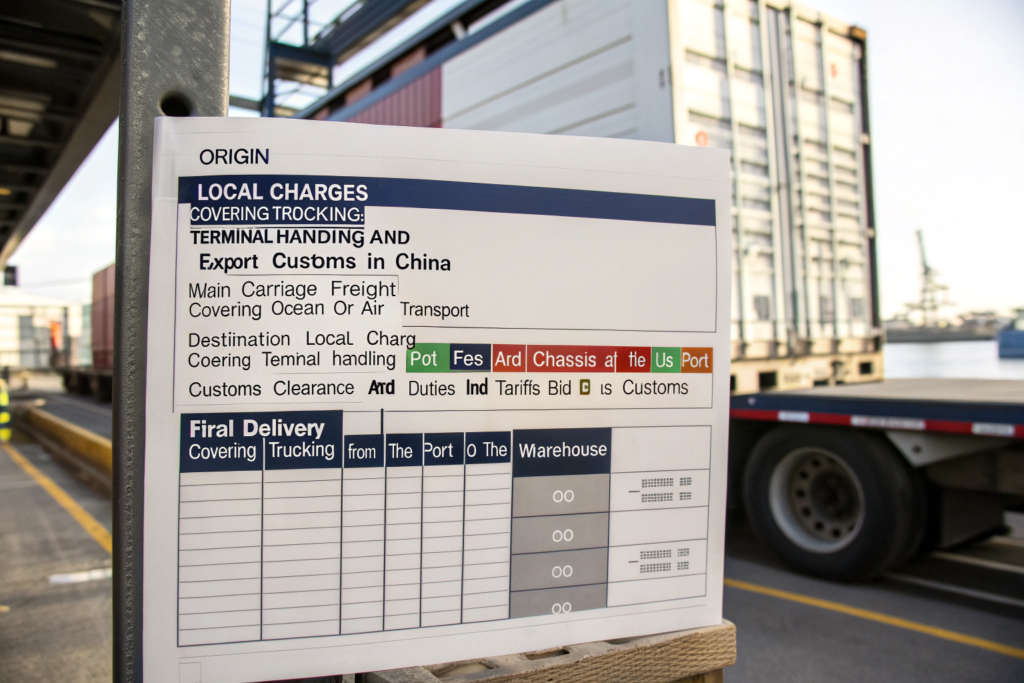
The five cost blocks of a total shipping bill are: Origin Local Charges covering trucking, terminal handling, and export customs in China; Main Carriage Freight covering the ocean or air transport; Destination Local Charges covering terminal handling, port fees, and chassis at the US port; Customs Clearance and Duties covering the customs broker fee, the customs bond, and the import duties and tariffs paid to US Customs; and Final Delivery covering the trucking from the port to your warehouse, including the delivery appointment and unloading. Each block has a standard set of line items.
I train my new clients to think of their shipment as a relay race. The baton passes through five runners. If you only price the middle runner—the ocean freight—you are ignoring the other four. At GeeseCargo, my quotes always show these five blocks in a table with a subtotal for each, so you can see exactly where your money is going. Let us break down each block in detail so you can read your next invoice like a logistics auditor.
How do origin local charges in China add up before the vessel departs?
The origin block is the first place your money goes, and it catches many first-time importers off guard. They assume the factory’s truck to the port is included in the product price. It is not, unless you are buying on DDP terms. The origin local charges start with the domestic trucking from the factory to the port container freight station or terminal. This cost depends on the distance between the factory and the port. A factory in Yiwu trucking to Ningbo port is cheap; a factory in inland Chongqing trucking to Shanghai is expensive. Next comes the Terminal Handling Charge, or THC, which is the fee the port terminal charges to receive the container, inspect it, and load it onto the vessel. You also pay a Bill of Lading Fee for the issuance of the shipping document, a VGM or Verified Gross Mass submission fee for the weight certification, and a Security Fee for the container screening. If the shipment requires export customs clearance in China, you pay a customs declaration fee. The total origin local charges for a 40-foot container from a major Chinese port typically range from $400 to $800, depending on the port and the specific services required. You can verify the standard THC rates for major Chinese ports by checking the official tariff published by the terminal operator, such as the Shanghai International Port Group Tariff. A professional forwarder will list every one of these origin charges as a separate line item on the quote. If the forwarder rolls them into a vague "Origin Handling Fee" without detail, ask for the breakdown. Transparency at the origin is the first test of a trustworthy logistics partner.
What destination local charges appear when the cargo arrives in the US?
The destination block is where the most painful surprises hide. The vessel arrives at the Port of Los Angeles, and the port terminal charges a Destination Terminal Handling Charge to discharge the container from the ship. Then you pay a Pier Pass fee or a Traffic Mitigation Fee, which is a surcharge for moving containers during daytime hours at congested ports. The container needs a chassis to be trucked out of the port. If the ocean carrier does not provide a chassis, you pay a Chassis Usage Fee or a Chassis Split Fee, which can add $50 to $150 per day. If the container sits in the terminal beyond the free time, you pay demurrage to the carrier. If it sits at the trucker’s yard beyond the free time, you pay detention to the carrier. These are two different fees for two different delays, and a container that arrives on a Friday and cannot be picked up until Monday can accrue three days of demurrage through no fault of your own. You must ask your forwarder before booking: "What is the free time on demurrage and detention for this ocean carrier, and what is the daily rate after the free time expires?" The standard US West Coast tariff for these charges is published by the Port of Los Angeles Tariff and the individual ocean carrier. I provide my clients with a destination cost estimate that includes the first five days of chassis and the standard terminal handling fee. I also flag the demurrage and detention free time window in bold on the booking confirmation so the warehouse team knows exactly when they must receive the container.
How Do Customs Duties and Tariffs Factor Into the Total Cost?
You have calculated the freight, the trucking, and the port fees. You think you have the total number. Then the customs broker sends you a bill for $2,300 in import duties and a $150 customs bond fee. You forgot the tax man. The US government treats your imported goods as a revenue source, and the duty rate on your specific product is a hard cost that cannot be negotiated away. Ignoring duties and tariffs in your landed cost calculation is like pricing a restaurant menu without accounting for the cost of ingredients. It is the single largest missing line item on amateur freight budgets.
Customs duties and tariffs are calculated by multiplying the US Harmonized Tariff Schedule duty rate percentage by the commercial invoice value of your goods, plus any additional Section 301 tariffs that apply to Chinese-origin products. On top of the duty payment, you must also account for the customs broker fee for filing the entry, and the customs bond fee that guarantees the duty payment to CBP. For a typical shipment of clothing and accessories from China, the total customs and duty burden can range from 8% to 32% of the product value, completely transforming your landed cost calculation.
I never let a client book a shipment without first running an HTS classification and duty estimate. It is a non-negotiable step in my quoting process at GeeseCargo. A $10,000 shipment of accessories with a 25% duty rate carries a $2,500 tax bill. If you did not build that $2,500 into your retail price, you just sold your product at a loss. Let me show you exactly how the duty calculation works and how to get the right HTS code before the container leaves China.
How do you find the correct HTS code and duty rate for your product?
The HTS code, or Harmonized Tariff Schedule code, is a 10-digit number that classifies your product for US Customs. The first six digits are global; the last four are specific to the United States. A single digit difference can swing your duty rate by 10 percentage points. For example, a women’s cotton knitted shirt has a different HTS code and duty rate than a women’s cotton woven shirt. You cannot guess the code. You must look it up using the official HTS Search Tool maintained by the US International Trade Commission. I start by typing a plain-English description of the product—say, "polyester fleece blanket"—and then drill down through the chapter headings until I find the exact subheading that matches the material composition and manufacturing method. The tool shows the base duty rate, which for most consumer goods from China ranges from free to 20%. Then you must check whether the product is subject to the additional Section 301 China tariffs. Many clothing items, accessories, and consumer goods are covered under the Section 301 lists and carry an additional 7.5% or 25% tariff on top of the base rate. The Office of the United States Trade Representative publishes the current Section 301 Tariff Lists with the exact HTS codes affected. I add the base rate and the Section 301 rate together to get the total applicable duty percentage. I then multiply that percentage by the commercial invoice value of the goods to get the estimated duty payment. This is a hard, non-negotiable cost that must be included in your total shipping cost calculation.
What is a customs bond and why is it a mandatory shipping cost?
A customs bond is a financial guarantee purchased from a surety company that ensures US Customs and Border Protection gets paid the duties you owe, even if your business defaults. Every commercial import shipment valued over $2,500 requires a customs bond. You have two choices: a single-entry bond that covers one shipment, or a continuous bond that covers all your shipments for a year. A single-entry bond costs about $60-$90 per shipment. A continuous bond costs $250-$500 per year, depending on your total duty volume, and is the obvious choice if you import more than three times a year. The bond fee is a line item that appears on your customs broker’s invoice. It is separate from the duty payment itself. The bond also covers any penalties, liquidated damages, or additional duties assessed by CBP after the entry is filed. Without a bond, your goods will not clear customs and will sit in a bonded warehouse racking up storage fees. You can read the full bond requirements on the official CBP Customs Bond Information page. I ensure every GeeseCargo client has a continuous bond in place before their first shipment lands. It is a one-time annual cost that removes a repetitive fee and speeds up every customs clearance.
What Accessorial Charges Are Hiding in Your Freight Invoice?
You managed the five cost blocks. You calculated the duties. You think the number is solid. Then the final invoice shows a $350 "Bunker Adjustment Factor" surcharge, a $120 "Congestion Surcharge," and a $75 "Documentation Revision Fee" because the factory changed the carton count after the booking. These accessorial charges are the landmines buried in the fine print of the carrier’s tariff. They are not fixed; they float with fuel prices, port congestion levels, and operational mistakes. A forwarder who does not explain these floating surcharges before booking is setting you up for invoice shock.
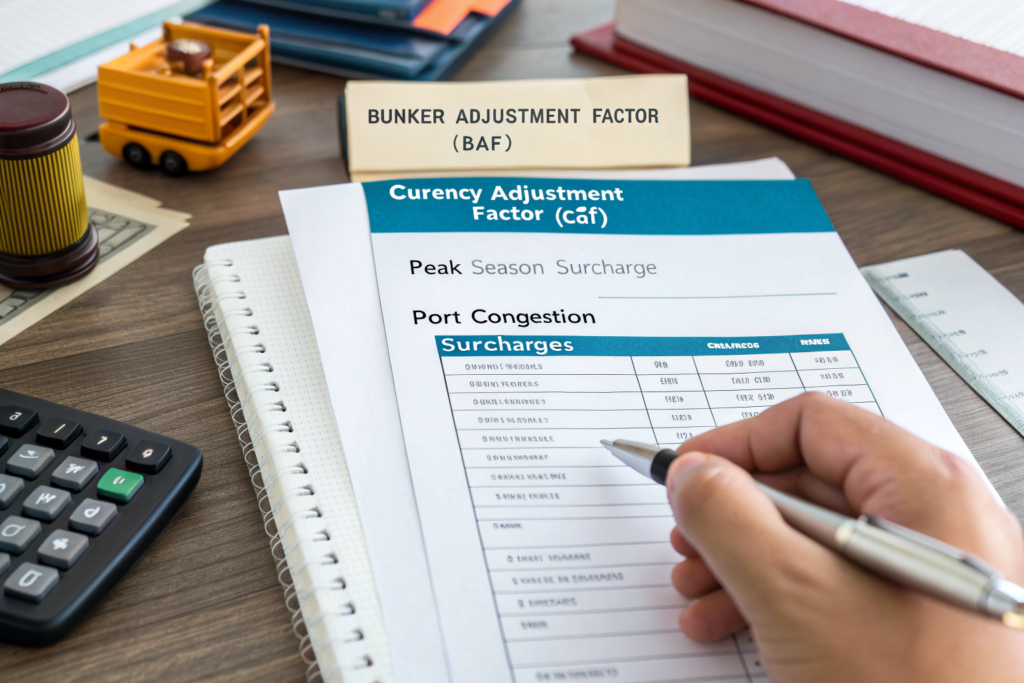
Accessorial charges are the variable surcharges that ocean carriers and terminals impose on top of the base freight rate. The most common ones include the Bunker Adjustment Factor (BAF) tied to fuel prices, the Currency Adjustment Factor (CAF) tied to exchange rate fluctuations, the Peak Season Surcharge (PSS) applied during high-demand months, Port Congestion Surcharges when terminals are backlogged, and administrative fees for documentation amendments. A complete total shipping cost calculation must include the maximum possible value of each floating surcharge at the time of booking.
I insist on a "validity period" clause in every quote I issue at GeeseCargo. The quote states that the rates are valid for 30 days and lists exactly which surcharges are fixed and which are floating. If the floating surcharges spike, I communicate the change before the container loads. Let me show you how to identify these surcharges and negotiate them down before they become a surprise deduction from your profit.
How do fuel and currency surcharges fluctuate month to month?
The Bunker Adjustment Factor, or BAF, is the ocean carrier’s mechanism for passing fuel cost volatility to you. When the price of marine bunker fuel goes up, the BAF goes up. When fuel drops, the BAF drops. It is calculated as a percentage of the base freight or as a fixed dollar amount per container. The BAF changes monthly or quarterly based on a published fuel price index. You cannot control the price of oil, but you can ask your forwarder what the current BAF is and what index they use to calculate it. The Currency Adjustment Factor, or CAF, applies when the payment currency fluctuates against the carrier’s operating cost currency. Since most ocean freight is quoted in US dollars, and many carriers have costs in euros or Chinese yuan, a strong dollar reduces the CAF and a weak dollar increases it. These are legitimate pass-through costs, but they must be disclosed. A forwarder who quotes you a "base freight" without mentioning the BAF is hiding the real cost. I always quote the all-in rate that includes the current BAF, and I note that the BAF component is subject to adjustment if the fuel index moves more than 5% before the sailing date. You can track the marine fuel price trends independently using a public index such as the Ship & Bunker World Fuel Index to verify whether the BAF your forwarder is charging aligns with the market.
How do you avoid paying unnecessary documentation and amendment fees?
Documentation fees are the nickel-and-dime charges that add up fast. A carrier might charge $50 for a Bill of Lading amendment if you correct the consignee address after the original submission. A terminal might charge a "mis-declaration fee" if the VGM weight submitted by the factory differs from the terminal’s scale weight by more than a threshold. An express release fee applies if you need the original bill of lading released electronically instead of physically. These fees are avoidable with accurate preparation. I send my clients a "Document Lock" checklist 48 hours before the vessel cut-off. The checklist asks: Is the commercial invoice final? Are the carton count and weight correct? Is the consignee address exactly as it appears on the business license? Any change after this point incurs a fee. The industry standard for amendment fees is published by individual carriers, and a good forwarder absorbs the occasional small amendment as a customer service gesture. However, a factory that consistently provides incorrect packing lists will generate a string of amendment fees that erode the shipment’s profitability. The Ocean Carrier Bill of Lading Terms from BIMCO outline the standard amendment clauses. I also recommend that my clients use a standard packing list template in Excel that locks the cell formulas for the carton dimensions and weight. This prevents the factory from using manual calculations that introduce errors. A clean packing list from the start eliminates 90% of amendment fees.
How Can a Door-to-Door DDP Quote Eliminate Hidden Cost Surprises?
You have run the calculations. You have mapped every origin charge, every destination fee, every duty payment, and every accessorial surcharge. Your spreadsheet is 22 rows deep, and you still are not 100% confident you caught everything. There is a simpler way. A Delivered Duty Paid quote, or DDP, is a single door-to-door price that rolls every single cost into one number. The forwarder takes the risk of the floating surcharges, the destination delays, and the customs clearance. You know the exact landed cost before the container leaves the factory. For importers who value certainty over micromanagement, DDP is the tool that transforms freight from a variable gamble into a fixed cost of goods sold.
A door-to-door DDP quote eliminates hidden cost surprises by transferring the risk of surcharge fluctuations, customs examinations, and destination delays from you to the freight forwarder. The forwarder guarantees a single all-inclusive price that covers every cost block: origin handling, ocean or air freight, destination handling, customs duties and clearance, and final trucking. If any surcharge spikes or a customs exam adds a storage fee, the forwarder absorbs that cost within the fixed DDP price. You receive one invoice with one number, and that number is the total landed cost.
I built GeeseCargo’s DDP service specifically for business owners who want to focus on selling products, not auditing freight invoices. My DDP quote includes everything from the factory loading dock to your warehouse receiving door. If the fuel surcharge jumps mid-month, that is my problem, not yours. Let me explain exactly how a real DDP quote is structured and how to verify that your forwarder is giving you a genuine all-inclusive price.
What does a genuine DDP quote include that a standard freight quote does not?
A standard freight quote usually stops at the port or airport. It covers the ocean or air freight and maybe the destination terminal handling. It leaves you holding the bag for the customs clearance, the duties, the customs examination fees, the trucking, and any demurrage or storage charges that arise. A genuine DDP quote wraps all of these post-port costs into the upfront price. Specifically, it includes the import customs broker fee, the continuous customs bond allocation, the estimated duties and tariffs based on your HTS code, the destination terminal handling charge, the chassis fee for trucking, the delivery trucking to your final warehouse with fuel surcharge, and a contingency buffer for any minor customs examination or port delay fees. When I issue a DDP quote at GeeseCargo, I list every one of these components in the breakdown and then present the single all-inclusive price at the bottom. The key language in a DDP agreement is the Incoterms definition. The official ICC Incoterms 2020 DDP Definition states that the seller bears all costs and risks of bringing the goods to the named destination and clearing import customs. If a forwarder offers a "DDP" price but then sends you a separate invoice for the duties, they are misusing the term. A genuine DDP includes the duties in the quoted price.
How do you verify that a DDP quote is competitive and honest?
A DDP quote is a bundled price, and a bundled price can hide inflated costs. The only way to verify competitiveness is to request a breakdown of the DDP into its cost block components and compare those components to the market rates. I provide my DDP clients with an internal cost sheet that shows the ocean freight component, the origin charges component, the duty component, and the destination delivery component. Even though the client pays the single bundled price, they can see that the individual line items align with the current market rates. You can benchmark the ocean freight component against a public freight rate index like the Freightos Baltic Index to see if the forwarder is embedding an unreasonable margin. The real value of a DDP quote is not just the bundling; it is the risk transfer. A competitive DDP quote might be slightly higher than your raw cost calculation because the forwarder is pricing in the risk of a demurrage event or a customs exam. That premium is the insurance you are buying. For an importer who has been burned by a $1,200 surprise demurrage bill, paying an extra $150 in the DDP premium for complete peace of mind is a profitable trade. I advise my clients to get DDP quotes from three forwarders, request the component breakdown from each, and compare not just the final number but the ocean carrier used, the free time days offered, and the estimated duty calculation. The cheapest DDP quote often uses the slowest carrier with the least free time, which increases the risk of a delay that the forwarder’s cheap price did not properly cover.
Conclusion
Calculating the total shipping cost is not about finding the lowest headline freight rate. It is about building a complete picture of every dollar that leaves your bank account between the factory floor and your warehouse shelf. That picture has five cost blocks. The origin local charges in China cover trucking, terminal handling, and export clearance. The main carriage freight covers the ocean or air transport. The destination local charges at the US port cover terminal handling, chassis usage, and the demurrage clock that starts ticking the moment the vessel arrives. The customs duties and tariffs are calculated from your HTS code and the Section 301 China tariff list, and they are non-negotiable. The final delivery trucking covers the last mile to your door. Accessorial surcharges like the BAF fuel adjustment and peak season fees float on top of these blocks and must be disclosed with a validity window.
The most effective way to eliminate surprise costs is to demand transparency before you book. Ask for an all-inclusive quote with a line-item breakdown. Verify the HTS code and duty rate yourself. Confirm the free time on demurrage and detention at the destination port. If you want to completely outsource the cost risk, a door-to-door DDP quote from a forwarder you trust converts a 22-row spreadsheet into a single predictable number. You pay a small premium for the risk transfer, and you gain the ability to price your products with confidence.
At GeeseCargo, I believe that a shipping invoice should never be a surprise. It should be the execution of a plan that we built together before the container was even booked. You should know your landed cost per unit down to the penny. That is the foundation of a profitable import business, and that is the standard I deliver to every client.