When one of our clients expanded from the US to Europe, they discovered their $280,000 shipment was delayed for three weeks due to unfamiliar EU customs procedures that differed dramatically from what they knew. As founder of GeeseCargo with extensive experience in both markets, I've learned that understanding these differences isn't just academic—it's essential for successful international expansion and avoiding costly delays.
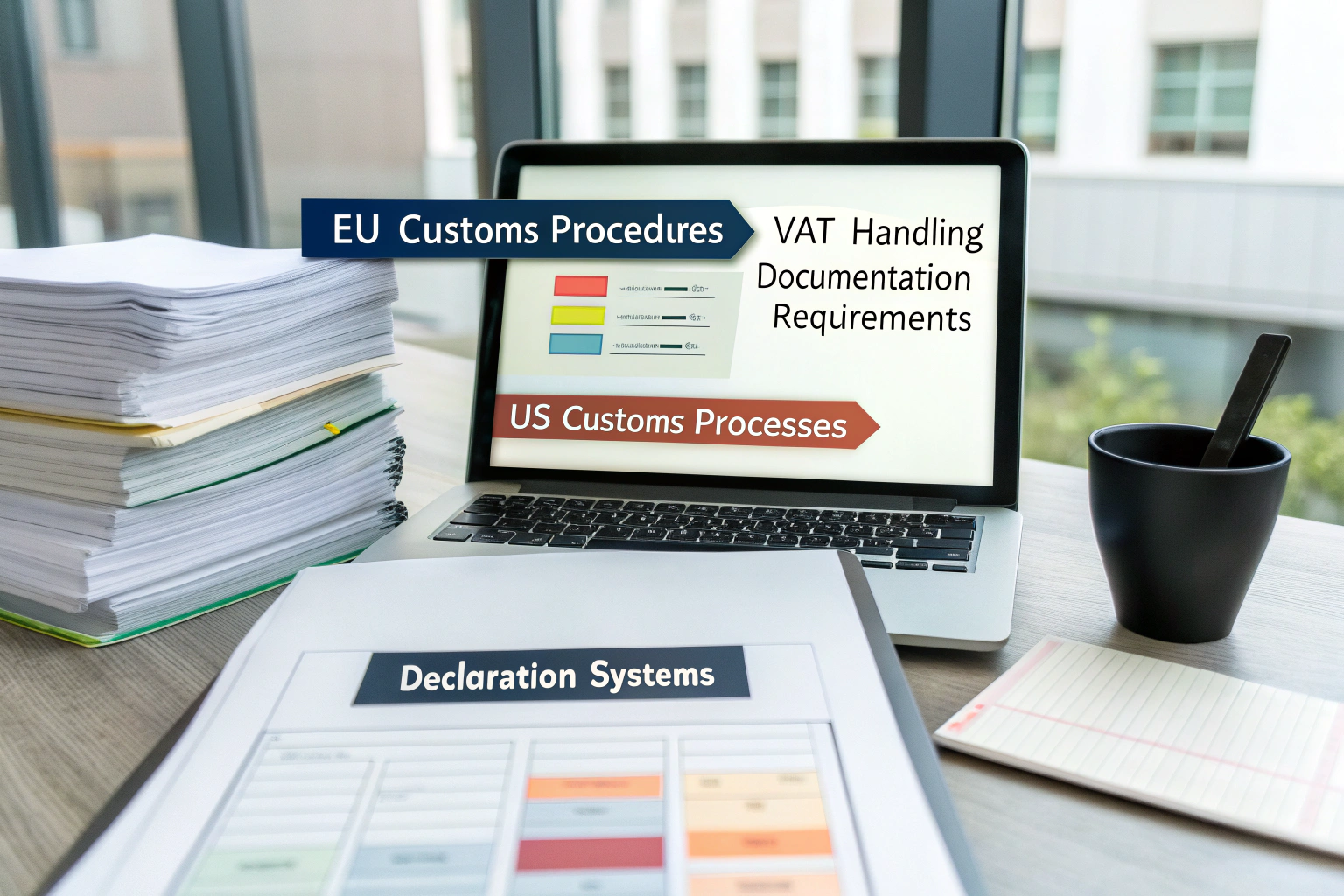
European customs procedures differ from US processes in declaration systems, VAT handling, documentation requirements, and risk management approaches. The EU uses a unified customs union with standardized procedures across member states, while the US employs a centralized system with more uniform national requirements. Key differences include the EU's Import Control System (ICS) versus US Automated Commercial Environment (ACE), and VAT collection versus US duty payment structures.
Navigating these differences requires understanding both the procedural variations and the underlying philosophical approaches to customs management. Companies that successfully adapt their processes to each market's requirements typically experience 40-60% fewer customs delays and achieve 20-35% lower compliance costs.
What Are the Fundamental Structural Differences?
The foundational structures of EU and US customs systems reflect different historical developments and administrative philosophies that shape daily operations.

How Does the EU's Customs Union Differ from the US System?
Single customs territory across 27 member states enables one-time declaration for EU entry. Once goods clear customs in any EU member state, they generally move freely throughout the union without additional customs formalities, though some regulatory controls still apply.
National administration with EU-wide standards creates procedural variations. While EU regulations standardize procedures, individual member states implement them differently, requiring country-specific knowledge despite the unified framework.
VAT harmonization with national rate variations means consistent principles but different applications. All EU countries use Value Added Tax systems, but rates, exemptions, and procedures vary significantly between member states.
What Makes the US System More Centrally Managed?
Single federal authority (CBP) provides uniform national procedures. US Customs and Border Protection operates consistently across all US ports of entry, with minimal variation between different states or ports.
Duty payment based on country of origin follows consistent rules nationwide. The same tariff classification, valuation rules, and duty rates apply regardless of which US port handles the shipment.
Partner government agency requirements are centralized through ACE. While multiple agencies regulate imports (FDA, USDA, etc.), their requirements are integrated into a single automated system with standardized processes.
How Do Declaration Processes and Timing Differ?
The sequence, timing, and methodology for customs declarations represent one of the most operationally significant differences between the two systems.

What Are the Key Differences in Pre-Arrival Declarations?
EU's Entry Summary Declaration (ENS) requires submission before departure to EU. The ENS must be filed at the first port of entry in the EU, typically 24-48 hours before loading at non-EU ports, with strict data quality requirements.
US Importer Security Filing (ISF) has different timing and content requirements. The 10+2 ISF must be submitted 24 hours before vessel loading for ocean shipments, but the data elements and validation processes differ from ENS.
Risk assessment timing varies significantly between the systems. EU customs conduct risk assessment before vessel departure, while US CBP performs assessment during transit, creating different amendment and correction procedures.
How Do Import Declaration Processes Compare?
EU's Single Administrative Document (SAD) standardizes declarations across member states. The SAD contains 54 boxes of information and serves as the unified customs declaration, though electronic submission has largely replaced paper forms.
US Electronic Manifest systems require carrier-specific filings. While ACE provides a unified platform, different transportation modes have distinct manifest requirements and submission timelines.
Post-summary correction procedures differ in timing and flexibility. The EU allows broader post-clearance amendments in many cases, while the US has more restrictive timeframes for correcting certain types of errors.
How Do Tax and Duty Collection Systems Differ?
The revenue collection mechanisms and structures represent another major area of differentiation with significant financial implications.
What Makes VAT Fundamentally Different from US Duties?
VAT applies to the total landed cost plus duty in the EU. The Value Added Tax is calculated on the cumulative value including product cost, transportation, insurance, and any import duties, typically ranging from 17-27% across member states.
US duties are calculated only on transaction value of goods. The US generally bases duty calculation solely on the price paid for the goods, with some adjustments for assists and royalties, but excluding most other costs.
VAT recovery mechanisms create cash flow considerations. Businesses can typically recover VAT paid on imports, but the process requires proper registration and documentation, creating different financial planning needs.
How Do Payment Processes and Timing Differ?
EU VAT payment timing varies by member state and importer status. Some countries require immediate payment, while others allow deferred payment for authorized traders, with significant differences in cash flow impact.
US duty payment typically occurs within 10 days of entry. The US generally provides a shorter payment window but more uniform procedures across all ports of entry and importer types.
Security requirements differ for deferred payments. The EU's customs debt security requirements for deferred VAT payment differ from US bonding requirements, creating different financial guarantee considerations.
What Are the Key Documentation Differences?
While both systems require extensive documentation, the specific forms, certificates, and supporting documents differ significantly.
Which Unique Documents Are Required in Each System?
EU requires additional certificates for specific product categories. Products like electronics, toys, and machinery often need CE marking documentation, conformity declarations, and specific technical documentation not required in the US.
US has unique partner government agency requirements. The US requires specific forms like FDA prior notice, USDA permits, and CPSC certificates that have no direct EU equivalents.
Proof of origin documentation has different acceptance criteria. While both systems prefer certificates of origin, the EU has more formalized requirements for preferential origin claims under various trade agreements.
How Do Commercial Invoice Requirements Differ?
VAT identification number requirements are unique to the EU. Commercial invoices for EU imports must include both supplier and customer VAT numbers, with specific formatting requirements that don't apply to US shipments.
US customs valuation declarations have specific requirements. The US requires more detailed breakdown of assists, royalties, and buying commissions on commercial invoices than typically required for EU imports.
Language requirements create additional preparation needs. While the US accepts English documentation exclusively, EU member states may require translations or specific language elements for certain procedures.
How Do Compliance and Risk Management Approaches Differ?
The philosophical approaches to compliance, enforcement, and risk management reflect different regulatory cultures and priorities.

What Are the Key Differences in Risk Assessment?
EU uses more decentralized risk assessment with member state variations. While the EU has unified risk criteria, individual customs authorities implement them differently based on national priorities and resources.
US employs more centralized, data-driven risk assessment. CBP uses advanced analytics and unified targeting criteria across all ports, creating more consistent risk assessment nationwide.
Post-clearance audit frequency and focus differs between systems. The EU conducts more frequent but often less intensive post-clearance verifications, while US focuses on fewer but more comprehensive audits.
How Do Enforcement and Penalty Systems Compare?
EU penalty systems vary significantly by member state. Penalty amounts, assessment procedures, and mitigation opportunities differ dramatically between EU countries, requiring localized compliance strategies.
US has more uniform penalty assessment nationwide. While CBP officers have some discretion, penalty structures and mitigation procedures are largely standardized across US ports of entry.
Voluntary disclosure programs have different structures and benefits. The US formal prior disclosure process offers specific penalty mitigation, while EU member states have varied approaches to voluntary compliance corrections.
What Are the Practical Implications for Shippers?
Understanding these differences enables development of tailored processes that optimize operations in each market while maintaining overall supply chain efficiency.

How Should Import Processes Be Adapted for Each Market?
EU processes require more advance planning for VAT and ENS compliance. The earlier filing deadlines and VAT considerations necessitate starting customs processes sooner than for equivalent US shipments.
US processes demand tighter integration with partner government agencies. The extensive PGA requirements mean engaging with multiple regulatory bodies beyond just customs authorities.
Classification and valuation approaches may need adjustment. While principles are similar, practical application differences may require different approaches to tariff classification and customs valuation in each market.
What System and Resource Implications Should Companies Consider?
IT systems must accommodate different data requirements and submission timelines. The varying data elements, submission deadlines, and validation rules require flexible systems capable of handling both processes.
Staff expertise needs differentiation between markets. The procedural differences are significant enough that specialized knowledge for each customs system typically delivers better results than generalized customs expertise.
Broker management approaches may differ between regions. The variation in customs broker licensing, capabilities, and practices between EU countries and the US may warrant different partnership strategies.
Conclusion
The differences between European and US customs procedures extend beyond simple paperwork variations to reflect fundamentally different approaches to trade regulation, revenue collection, and risk management. Companies that recognize and adapt to these differences typically experience significantly smoother market entry, lower compliance costs, and fewer operational disruptions.
At GeeseCargo, we've helped hundreds of clients navigate both systems successfully, with the most effective approaches being those that respect each system's unique requirements while maintaining overall process consistency. The key lies in understanding the philosophical underpinnings of each system rather than just memorizing procedural checklists.
Begin your preparation by conducting a thorough gap analysis of your current processes against both systems' requirements, then developing tailored procedures for each market. Remember that success in international trade requires both global thinking and local execution—understanding these customs differences represents a crucial component of that local execution excellence.