You have found a winning product, negotiated a great price with a factory in Shenzhen, and created your Amazon listing. Then you open a spreadsheet to calculate your profit margin and freeze. The freight quotes you are getting are all over the place. One forwarder sends a single number, another sends a PDF with fifteen line items, and a third ghosts you for a week before replying. You cannot price your product competitively if you do not know your true landed cost to the Amazon fulfillment center. I have been moving goods for Amazon sellers for years, and I know that the quoting process is the first test of whether a forwarder actually understands FBA or is just guessing.
You get accurate FBA shipping quotes from China to Amazon USA by providing your forwarder with the exact delivery FBA warehouse address, the carton dimensions and weight, the ready date at the factory, and the Amazon shipment ID for labeling. A professional freight forwarder will then offer you a choice between sea freight LCL, a full container load, or fast air freight into Amazon, with a complete door-to-FBA breakdown that includes the origin trucking, customs clearance, the destination truck to Amazon, and the critical Amazon palletization and delivery appointment fee.
You want a clear answer, not a guessing game. The FBA delivery process has strict rules that a generic freight forwarder simply does not know. You need a partner who treats the Amazon Seller Central requirements as the baseline, not an afterthought. Let me walk you through exactly what information you need to prepare, what a real FBA quote must include, and how to spot a forwarder who is going to get your shipment refused at the Amazon dock.
What Information Do I Need to Provide to Get an Accurate FBA Quote?
You send a message to a forwarder saying, "I have 500 units of a kitchen gadget, what is the shipping cost to Amazon?" The forwarder comes back with a number that sounds cheap. You book it. Three weeks later, you get hit with an extra bill for palletization, a missed delivery appointment fee from Amazon, and a long-haul trucking surcharge you never saw coming. That cheap initial quote was not accurate because you did not speak the same language as the forwarder. An accurate FBA quote starts with you providing the exact technical data that Amazon itself requires.
To get an accurate FBA shipping quote from China to Amazon USA, you must provide the precise FBA warehouse address including the FC code, the final packed carton count with the exact dimensions and gross weight of each carton, the factory pickup address in China, and the confirmed Amazon shipment plan name. Without these four exact data points, any quote you receive is a rough estimate and is likely to change in ways that hurt your bottom line.
I treat every quote request like a pre-shipment audit. The more detail you give me, the more precise my number will be. I have seen too many sellers lose their launch momentum because they budgeted for an estimate and then ran out of cash when the real logistics bill arrived. Let us go deeper into why these specific data points matter and how you can gather them from your factory without any confusion.
Why is the exact FBA warehouse FC code essential for accurate trucking costs?
Amazon has over a hundred fulfillment centers in the United States, and they are not all near a major container port. You might assume your goods go to Long Beach, California, because that is the closest port to China. Then Amazon assigns your inventory to a warehouse in Memphis, Tennessee, or worse, a rural fulfillment center in an inland state. The trucking cost from the Port of Los Angeles to an urban California FC might be $350. The trucking cost to a middle-of-nowhere FC in the Midwest could be $1,800. That is a huge swing in your landed cost per unit. When you give me the specific warehouse code—like ONT8, FTW1, or MEM1—I can plug that into my route planner and give you an exact destination drayage cost. Even within a metro area, the final mile delivery to an Amazon facility involves a strict Amazon Carrier Appointment Request process. The trucker must schedule a specific delivery window, often days in advance. If a forwarder quotes you a generic "US destination handling" fee without knowing the warehouse, they are likely hiding the real cost. I always ask sellers to generate their shipment plan in Seller Central first and share the assigned FC. You can also check the average transit time from the port of entry to the specific FC by analyzing the general Amazon Fulfillment Center Locations map and calculating the mileage. A warehouse located one state over from the port costs you far less in time and money than one across the country.
How do carton weights and dimensions impact the ocean and air freight charge?
Air freight and sea freight do not care about your unit count; they care about volume and weight. You might have 500 units of a lightweight but bulky pillow. Your factory packs them in large cartons that take up a lot of space. The ocean freight cost is based on the cubic meter (CBM) volume, while air freight uses a chargeable weight calculation that compares the actual gross weight against the dimensional weight. If your factory gives you only a rough estimate of the box size, the forwarder’s quote is a guess. When the cargo arrives at the freight terminal, the warehouse measures the cartons with a laser scanner. If the actual CBM is 20% higher than estimated, you get a rate adjustment bill that wipes out your margin. I require my clients to have the factory photograph each carton on a scale with the tape measure visible on the length, width, and height. We input those exact dimensions into our freight calculation tool. This is also critical for the Amazon FBA Packaging and Prep Requirements. If a single carton exceeds the maximum weight of 50 lbs, Amazon will refuse the delivery unless you label it "Team Lift." I catch that problem during the quoting phase and tell the factory to split the heavy carton before they seal it, which saves you a rejected shipment nightmare at the FC dock.
What Is the Difference Between DDP to FBA and EXW Shipping to Amazon?
You are negotiating with a factory in Yiwu. They offer you an EXW price for the goods, and you think you are getting a great deal because it is the lowest factory price. Then you start adding up the costs: the Chinese domestic truck, the export customs broker, the port fees, the ocean freight, the US import duty bond, the customs clearance, the US domestic truck, and the Amazon delivery appointment. You realize you are now managing seven different vendors in two time zones, and any single one of them dropping the ball means your Amazon inventory runs out of stock. The acronym on your purchase order changes everything about your risk and workload.
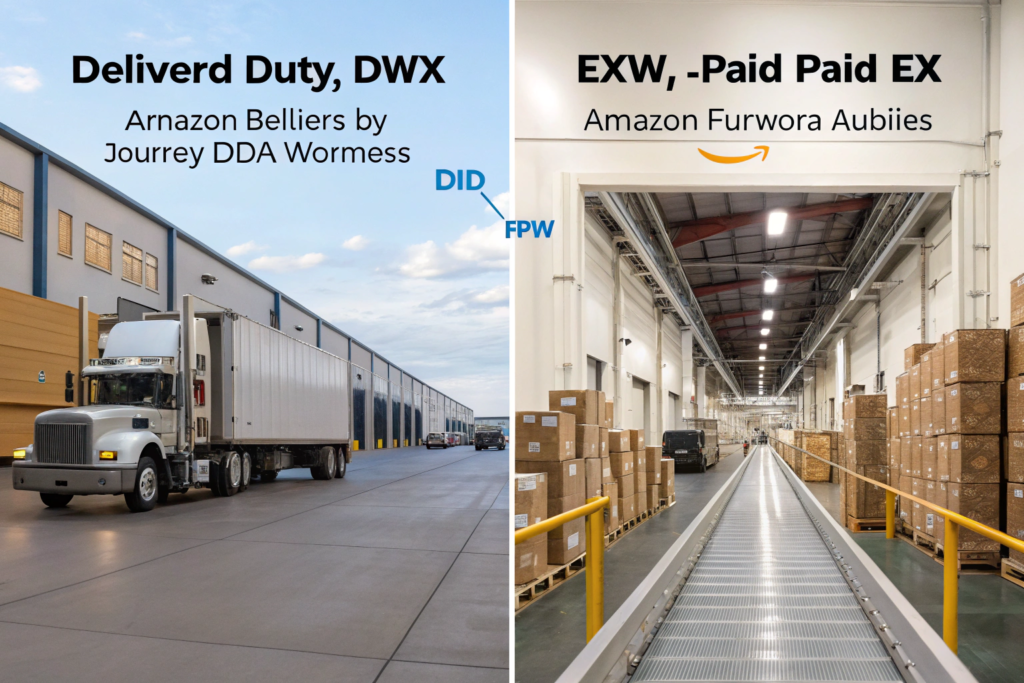
DDP shipping to FBA means the freight forwarder takes full responsibility for the entire door-to-FBA process including all duties and taxes, whereas EXW shipping means you the seller own the logistics chain from the factory door and must coordinate every trucker, customs broker, and carrier yourself. For Amazon sellers without a dedicated logistics department, DDP to FBA converts a fragmented headache into a single, predictable expense with a guaranteed delivery date.
I have watched too many first-time sellers get burned by picking EXW because they thought they were saving money. They usually end up paying more because they lack the buying power to negotiate with individual truckers and customs brokers. My DDP service wraps the entire chain into one fixed price. Let’s break down why this single term changes your entire Amazon cash flow and how to verify you are actually getting a true DDP service, not a fake one.
Why does EXW shipping expose you to hidden Chinese port charges?
When you buy EXW from the factory, you are responsible for the cargo from the moment it leaves the factory gate. You might assume the cost to get it onto the ship is simple: just a truck ride and a port fee. But Chinese export ports have a complex layer of charges: the Terminal Handling Charge, the Security Fee, the Bill of Lading Fee, the VGM (Verified Gross Mass) submission fee, and possibly an escort fee for dangerous or regulated goods. If your goods need export customs inspection, and the container gets flagged for an X-ray scan, you pay the chassis waiting time and the scanning fee directly to the terminal. A single factory trucking service does not include any of this. You get a frantic call from the driver demanding payment before he can drop the box. An experienced DDP forwarder bundles all these Chinese origin charges into the unit price. We also handle the export customs filing using a professional customs broker, not a factory-appointed agent whose only qualification is being the owner’s cousin. I often use a formal China Customs Declaration Form filing process that properly declares your export value, which protects your eligibility for the Chinese export tax rebate that many sellers do not even know they can claim. When you evaluate an EXW versus DDP quote, ask the forwarder to list all the Chinese local charges separately, even if you choose DDP. A transparent partner will show you the cost breakdown from factory to CY (Container Yard).
How does DDP to FBA simplify the US customs entry and duty payment?
The moment your Amazon-bound goods hit US soil, you have a legal obligation. US Customs and Border Protection wants a customs entry filed by the "Importer of Record." Under EXW or FOB terms, you are the importer, and you must post a customs bond. If you are a small seller importing three times a year, buying a single-entry bond every time is expensive and inefficient. A DDP forwarder acts as the Importer of Record using their continuous bond, which covers an unlimited number of entries. This speeds up the clearance because the CBP Customs Entry process with a continuous bond is pre-approved. The true DDP benefit is the duty payment. Amazon has no mechanism to pay import duties on your behalf when the truck arrives. If your freight forwarder drops the ball and says "the duty is your problem," the truck stops at the border, and your goods are sent to a bonded warehouse to accrue storage fees. A professional DDP service pre-pays the duties and taxes before the vessel even arrives using an automated payment system. I also ensure your goods are classified under the correct HTS code. For private-label clothing, the difference between a generic shirt and a performance shirt can be a tariff swing that impacts your profitability. I cross-reference your product against the official HTS Search Tool to find the most accurate legal duty rate, which protects you from a CBP audit down the line.
Why Is Amazon Palletization and Labeling Crucial for FBA Shipments?
You ship the goods perfectly. They arrive at the Amazon FC on time. You wait for the "Checked In" status in Seller Central and instead you see "Refused – Palletization Non-Compliance." The truck driver is told to take the entire shipment back. You are now paying for the return trucking, storage at a commercial yard, re-palletization by a third-party warehouse, and a new delivery appointment slot that is booked out for two weeks. During that time, your listing is out of stock, your sales rank drops to zero, and your competitor takes the Buy Box. Amazon’s receiving dock is not a suggestion box; it is a rigid automated system.
Palletization and labeling are crucial for FBA shipments because Amazon will flatly refuse your delivery if the pallets are not built to the precise GMA B-grade or higher standard, stacked within the 72-inch height limit including the pallet, wrapped correctly, and labeled with the unique FBA pallet labels placed on all four sides. One missing label or an unstable pallet stack triggers an instant rejection that can kill your product launch momentum and cost you thousands of dollars in non-compliance fees.
When I build a pallet for an Amazon shipment, I treat it like I am packing a parachute. The rules are black and white, and the penalty for failure is absolute. You cannot sweet-talk an Amazon dock manager. They scan the pallet, the system beeps red, and the shipment goes back on the truck. Let’s get into the specifics of building an Amazon-proof pallet and fixing the labeling errors that trip up most self-shippers.
What are the exact Amazon pallet specifications that prevent a refused delivery?
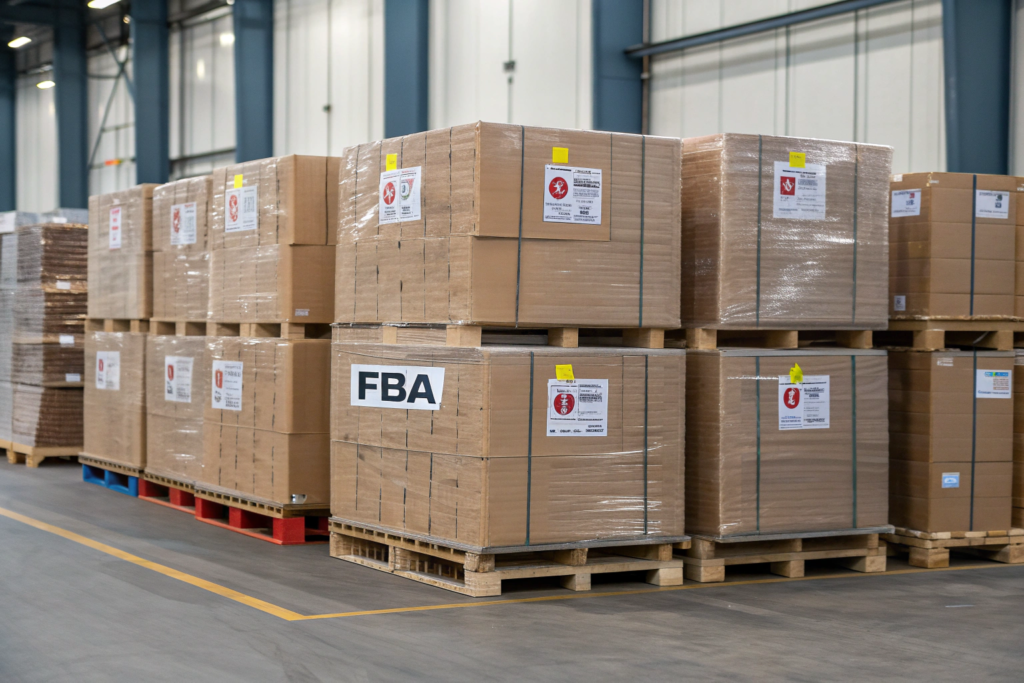
Your pallet must be a standard 40×48-inch four-way access pallet. It cannot be a cheap, thin "lightweight" export pallet because those snap under the weight of stacked cartons during truck transport. Amazon requires GMA Grade B or higher pallets. The total height from the floor to the top of the highest carton cannot exceed 72 inches. Double-stacking pallets is strictly forbidden unless you are using a specialized pallet racking system that Amazon does not allow for standard inbound freight. The cartons must not overhang the pallet edge by more than one inch. If the boxes bulge over the side, the automated conveyor system at the FC can jam. The entire load must be wrapped in clear plastic stretch wrap with the words "DO NOT BREAK DOWN" printed on the wrap. A crucial compliance point is the physical condition of the pallet. A broken board, a protruding nail, or a water-stained base will get the shipment rejected. I source pallets at the US destination port that meet the strict Amazon Pallet Requirements for inbound shipments. At my consolidation warehouse in California, we often have to re-palletize goods that arrived from China on substandard pallets built by the factory. We swap the broken pallet for a new GMA standard one, re-stack the cartons so the heaviest boxes are on the bottom, and apply the correct wrapping tension so the load does not shift on a truck turn. This re-palletization service costs a small fee per pallet but saves you from a catastrophic rejection.
How do you generate and apply the Amazon FBA shipment labels correctly?
The box label and the pallet label are two different things, and Amazon’s system treats them independently. Each individual carton must carry the unique FBA box ID label, which you download from Seller Central as a PDF. The barcode must be scannable and printed clearly on a white label; do not use a yellow thermal label that fades after a few days. On top of the box labels, each pallet requires four FBA pallet labels, one placed squarely in the center of each of the four sides of the stretch wrap. The most common failure I see is a pallet with a single pallet label placed on top of the stack, which the dock scanner ignores completely. You generate these pallet labels after Amazon accepts your "Shipment Plan." The labels must include the SCAC code of the carrier, the shipment ID, and the Fulfillment Center destination. If you print a lower-resolution image, the laser scanner rejects the barcode. I run a scan-test on every label batch using a handheld barcode verifier before the pallet leaves our warehouse. The full guide on the label generation process is in the FBA Shipment Creation Workflow instructions. Another hidden rule is the box content configuration. You must tell Amazon whether each carton contains a single SKU or multiple SKUs, and the label must match that configuration. If the box label says "Single SKU" and the Amazon unpacker finds a mixed assortment, your inventory gets segregated into a "problem solve" queue that takes weeks to untangle. I double-check that the factory packing list matches the digital shipment plan exactly, carton by carton.
What Are the Best Shipping Methods for Amazon FBA Restocking in 2026?
You launched your product, and it is selling faster than you projected. You check your inventory dashboard and see a red warning: "12 days of cover remaining." If you do not get a restock shipment into the FC within the next three weeks, you go out of stock and the algorithm buries your listing. Your immediate instinct is to air-freight everything, regardless of cost. But if you air-freight a low-margin, heavy product, you just locked in a quarter of negative profit. Choosing the wrong restocking mode can save your listing and kill your business at the same time.
The best shipping methods for Amazon FBA restocking in 2026 are a hybrid strategy: using express air freight for the immediate 15-20% of your inventory to cover the sales velocity during the critical out-of-stock window, while the remaining 80% moves via a fast sea freight LCL or a premium full container service. This split approach ensures you never lose the Buy Box, and your overall blended landed cost remains profitable.
I have designed restocking strategies for clothing brands and gift wholesalers that turn their logistics into a competitive weapon. When your competitor runs out of stock for a month, your product stays live and climbs the organic rank. A smart restock is not about picking the cheapest freight; it is about protecting your sales velocity. Let us map out the timelines and costs so you can build your own restocking calendar with confidence.
How do you use express air freight to avoid Amazon FBA stockout penalties?
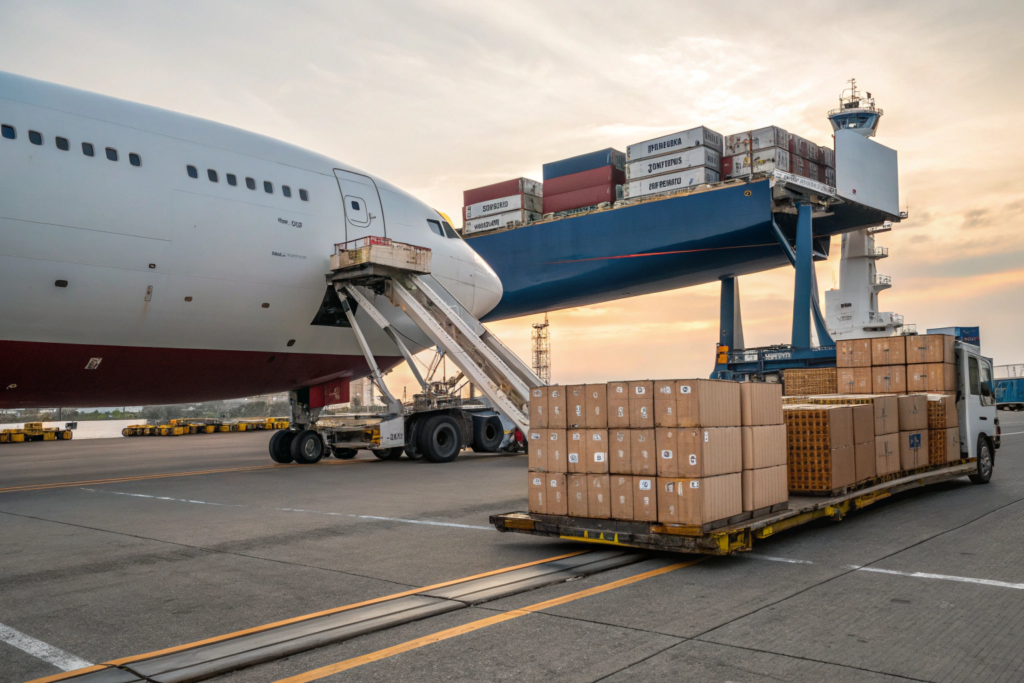
When your inventory is critically low, you are fighting the Amazon storage limit and the long-term storage fees. Express air freight from China to the US takes 5-8 days door-to-FBA. You pay a premium rate per kilogram, but you save the sales rank that took you six months to build. I use a special air freight consolidation service that books space on passenger and cargo flights out of Hong Kong, Shanghai, and Shenzhen directly into major US hubs like LAX, JFK, and ORD. We clear customs mid-flight using an electronic filing, so when the plane lands, the pallets move directly to a bonded truck that has a pre-scheduled Amazon delivery appointment. The key to not overpaying on air freight is the "chargeable weight" calculation. If your goods are bulky clothing items, the dimensional weight might be higher than the actual weight. I advise my clients to vacuum-pack apparel into compressed bags for air shipments, which reduces the cubic volume drastically and cuts the freight charge by up to 30%. You also need to match the air freight timeline with the Amazon Restock Inventory Guidelines. Amazon’s "Available" date is not the delivery date; it is the date the goods are scanned and stowed. I add a 3-day buffer to the air freight ETA to account for the FC receiving queue. A shipment arriving on a Monday might not be available for sale until Thursday. Plan your trigger point accordingly, and reorder when you have more days of cover than the transit time plus the receiving buffer.
When should you use a Full Container Load (FCL) versus LCL for quarterly restocks?
If you are selling on Amazon, your business grows in steps. At first, you ship maybe 5 cubic meters every six weeks. LCL sea freight is the right choice. You pay only for the space you use inside a shared container. The transit time from Shanghai to Los Angeles is roughly 14-16 days, plus trucking and Amazon check-in. Your total restock pipeline is about 25 days. But when you scale to ordering 20 or 30 cubic meters every month, LCL becomes a drag. You pay a high per-unit rate, and your goods sit in a consolidation warehouse in China waiting for other people’s cargo to fill a box. An FCL 40-foot container gives you a sealed unit that moves on your schedule, not the consolidator’s schedule. The per-unit cost drops dramatically. I often move a high-volume clothing client from LCL to FCL once they hit the 15 CBM threshold on a single restock order. The security of a sealed FCL also reduces the risk of lost cartons that are common when a shared LCL box is deconsolidated. The schedule for FCL is more rigid because you are booking a vessel slot directly with the Ocean Carrier Schedules from main carriers. You need to have your factory finish production three days before the vessel cut-off date. I synchronize the factory’s production finish date with the sailing schedule so that the container is stuffed and returned to the terminal within the same day, avoiding any waiting fees at the yard. For a quarterly restock strategy, I recommend shipping the bulk FCL at the start of the quarter and keeping a buffer stock at a 3PL warehouse near the Amazon FC instead of paying Amazon’s high Q4 storage fees. You then feed the inventory into Amazon weekly using the 3PL’s LTL service, which keeps your IPI score healthy and your storage costs low.
Conclusion
Getting an accurate FBA shipping quote from China to Amazon USA is not about finding the cheapest number on a spreadsheet. It is about finding a freight forwarder who understands that Amazon is a distinct destination with its own set of strict delivery rules. You start by preparing the right data: the exact FC code, the correct carton dimensions, and your confirmed Amazon Shipment ID. Without this, any quote you receive is just a placeholder, and the real cost will hit your wallet later in the form of surcharges and penalties.
The difference between DDP and EXW determines whether you are a product entrepreneur or an unpaid logistics coordinator. A true DDP to FBA service wraps the entire chaotic chain into a single predictable cost, letting you focus on your PPC campaigns and product reviews instead of fighting with a trucking dispatcher in Los Angeles. And when you build your pallets, you must treat the Amazon specifications like a law, not a suggestion. A rejected pallet does not just cost you money; it costs you the sales velocity that is the lifeblood of any Amazon business.
When it comes time to restock, I always advise sellers to think in a hybrid model. Air freight is your emergency insurance policy for the Buy Box; sea freight is your profit engine. Combining both in a planned, calendar-driven strategy ensures that you never see that red "Out of Stock" banner on your listing. Your freight forwarder should be helping you plan those reorder points, not just moving boxes.
At GeeseCargo, I built my FBA shipping service around the reality of Seller Central, not generic freight theory. Every label scan, pallet wrap, and duty payment is handled with the knowledge that your product ranking is on the line. A great logistics partner does not just deliver your goods; they deliver peace of mind that your business engine keeps running.