You placed your order with the supplier six weeks ago. The goods were finished three weeks ago. You were told the shipment would take "about a month." You are now refreshing the tracking page daily, wondering why "about a month" has turned into day 38 with no delivery in sight. Your retail buyer is asking for an in-stock date, and you cannot give them one because your own understanding of the timeline is fuzzy. You feel like sea freight time is a mystery that even your forwarder cannot explain clearly.
Sea freight from China to the USA is not a single duration. The total door-to-door time depends on the specific ports, the service level, and the inland destination. A shipment from Shanghai to Los Angeles using express FCL service typically takes 18 to 22 days door-to-door. A shipment from a secondary Chinese port to a US East Coast destination using economy LCL service can take 35 to 45 days. The ocean transit itself is only one part of the total timeline. The pre-sailing, customs, and delivery stages add 6 to 15 days depending on the service. At GeeseCargo, we provide a detailed milestone timeline for every shipment so you know exactly what to expect at each stage.
The vague "about a month" answer is not good enough for your business planning. You need a breakdown of where the time goes, what factors can shorten or lengthen it, and how to choose the service level that matches your inventory needs. Let me break down the full timeline stage by stage and show you the realistic durations for the most common China-to-USA shipping lanes.
What Are the Stages of a Sea Freight Shipment Timeline?
You think "sea freight time" means the time the ship spends on the water. That is the longest single stage, but it is only about half of the total door-to-door time. The other half is consumed by pre-sailing operations at the origin and post-arrival operations at the destination.
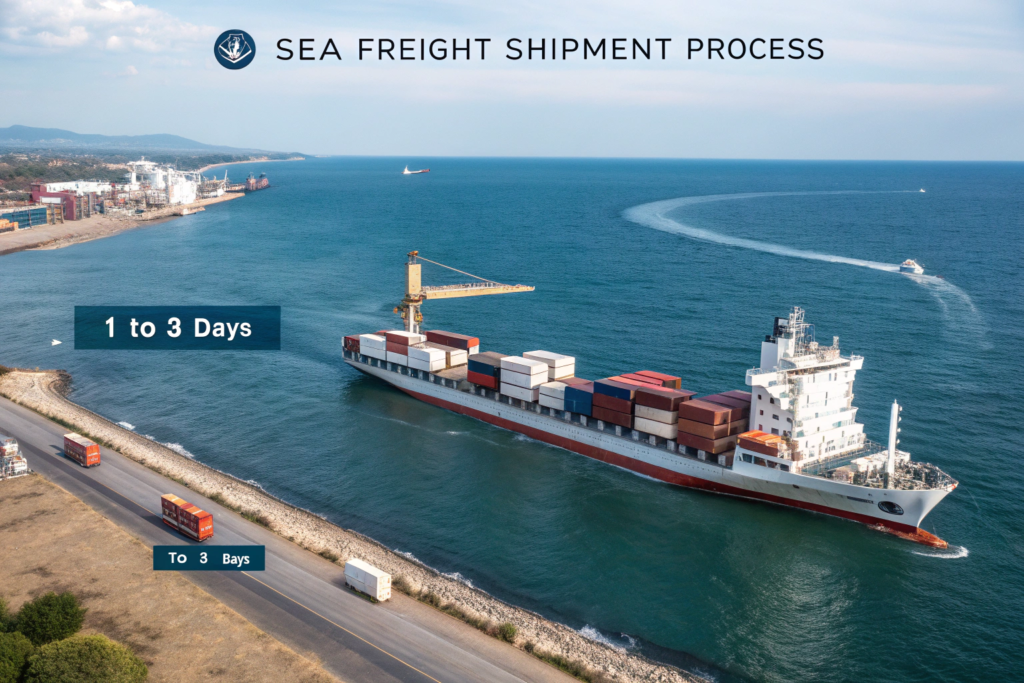
A complete sea freight shipment has six stages. Stage one is the origin pickup and consolidation, taking 1 to 3 days. Stage two is Chinese export customs clearance and port handling, taking 1 to 3 days. Stage three is the ocean transit, taking 12 to 35 days depending on the destination. Stage four is US import customs clearance, taking 1 to 3 days if no exam, or 3 to 7 days with an exam. Stage five is the destination port handling and deconsolidation for LCL, taking 1 to 4 days. Stage six is the final delivery to your warehouse, taking 1 to 5 days depending on distance. The total is the sum of these six stages.
Let me walk through each stage with the realistic time ranges.
Stage one begins when your goods are ready at the factory. We schedule the pickup and transport the goods to our consolidation warehouse or directly to the port. If you are shipping FCL, this is typically one day for pickup and one day for container loading. If LCL, there is an additional one to two days of consolidation waiting time while we build a full container. Total for stage one is one to three days.
Stage two covers the Chinese export process. The container is delivered to the port terminal. The export customs declaration is filed electronically. The terminal processes the container and loads it onto the vessel. This stage is typically one to two days, but can stretch to three days if there is a documentation issue or terminal congestion.
Stage three is the ocean transit, the sailing time from the Chinese port to the US port. This is the stage with the widest range. The physical sailing time from Shanghai to Los Angeles is 12 to 14 days. Shanghai to New York via the Panama Canal is 25 to 30 days. A secondary Chinese port adds one to three days for the feeder vessel to the main transshipment hub. I will break down these transit times by destination in the next section.
Stage four is US customs clearance. We file the entry while the vessel is at sea. When the vessel docks, most shipments are conditionally released within 24 hours. If CBP selects the container for an X-ray exam, add two to three days. A physical tailgate exam adds three to five days. An intensive exam adds five to seven days. Exams are not the norm, but they happen to a percentage of shipments.
Stage five is the destination port handling. For FCL, the container is discharged from the vessel and available for pickup within one to two days. For LCL, the container goes to a CFS for deconsolidation, adding two to four days.
Stage six is the final delivery. A local delivery within 50 miles of the port takes one day. A regional delivery to a warehouse 200 to 500 miles away takes one to two days. A long-haul delivery to the Midwest or East Coast via truck takes three to five days. Rail intermodal to the Midwest takes five to eight days.
Add these stages together. An express FCL from Shanghai to a Los Angeles local warehouse: 1 plus 1 plus 12 plus 1 plus 1 plus 1 equals 17 days best case, 22 days with minor delays. An economy LCL from a secondary Chinese port to a Chicago warehouse: 3 plus 3 plus 28 plus 3 plus 4 plus 5 equals 46 days.
Why Is the Pre-Sailing Stage Often Longer Than Expected?
Your factory says the goods are ready. You tell us to pick up. The pickup happens the next day. But then the shipment sits for three days before the vessel sails. You do not understand what takes three days between pickup and sailing.
The pre-sailing stage includes the trucking to the port, which can take a full day if the factory is far from the port. It includes the terminal receiving window. Most terminals only accept containers during a specific window before the vessel departure, typically two to four days before sailing. If the container is delivered too early, it waits. If it is delivered too late, it misses the cut-off and rolls to the next vessel. We time the pickup to match the terminal receiving window, but a one-to-two-day wait at the terminal is normal.
How Does the Destination Stage Vary by Service Level?
You choose LCL to save money. The transit time quoted was 28 days. The actual time is 35 days. The extra week was the destination CFS deconsolidation and the delivery scheduling. You did not account for the LCL-specific destination delays.
LCL adds two to four days at the destination CFS. The shared container must be unloaded, each importer’s cartons must be sorted and staged, and the individual deliveries must be scheduled. FCL skips this entirely. The container is picked up directly from the terminal and delivered to your warehouse. For shipments close to the FCL breakpoint, the time savings of FCL is often worth the marginal cost increase.
What Are the Ocean Transit Times for Major China-to-USA Routes?
You are shipping from Shenzhen to Miami. You search for the transit time and find "Shenzhen to Los Angeles: 14 days." But you are not shipping to Los Angeles. You are shipping to Miami. The Los Angeles transit time is irrelevant to your shipment.
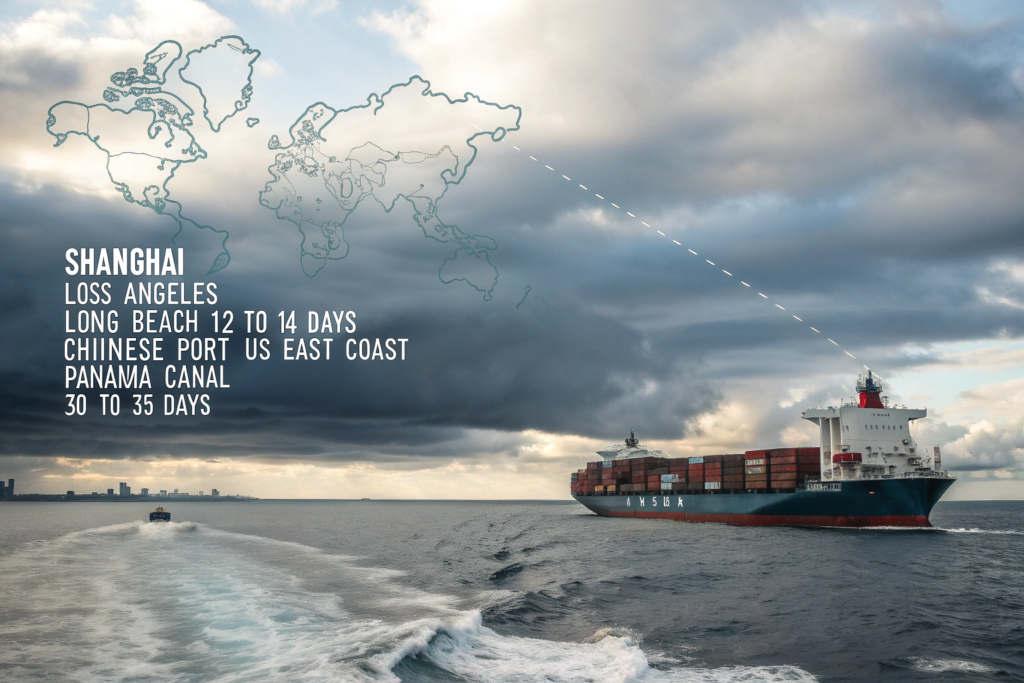
Ocean transit times vary significantly by port pair. The fastest major route is Shanghai to Los Angeles or Long Beach at 12 to 14 days. The slowest common route is a secondary Chinese port to a US East Coast port via the Panama Canal at 30 to 35 days. The transit time for a specific port pair depends on the sailing distance, the number of intermediate port calls, the vessel speed, and whether the container transships at a hub port. Here are the typical transit times for the most common China-to-USA routes.
| Origin Port | Destination Port | Typical Ocean Transit | Notes |
|---|---|---|---|
| Shanghai | Los Angeles / Long Beach | 12 – 14 days | Fastest direct service |
| Ningbo | Los Angeles / Long Beach | 13 – 15 days | Similar to Shanghai |
| Shenzhen (Yantian) | Los Angeles / Long Beach | 13 – 15 days | Major South China hub |
| Shanghai | Seattle / Tacoma | 12 – 14 days | Pacific Northwest is slightly shorter |
| Shanghai | New York / New Jersey | 25 – 30 days | Via Panama Canal |
| Shenzhen | New York / New Jersey | 27 – 32 days | Via Panama Canal |
| Shanghai | Savannah | 26 – 30 days | Major Southeast US gateway |
| Shanghai | Houston | 24 – 28 days | Via Panama Canal to Gulf Coast |
| Secondary port (Xiamen, Qingdao) | Los Angeles | 15 – 18 days | Includes feeder to hub |
| Secondary port | US East Coast | 32 – 38 days | Feeder plus Panama transit |
The transit times above are for the ocean leg only, from the vessel departure at the origin port to the vessel arrival at the destination port. Add the pre-sailing and post-arrival stages to get the total door-to-door time.
The fastest route is Shanghai to Los Angeles. The ports are major hubs with frequent direct sailings. Multiple carrier alliances operate on this route, offering several departures per week. The sailing distance is approximately 5,700 nautical miles. A container vessel cruising at 18 to 20 knots covers this distance in 12 to 14 days.
The slowest route for a major port pair is a secondary Chinese port to a US East Coast port. The container first moves on a feeder vessel from the secondary port to a hub like Shanghai or Busan. The feeder adds two to four days. The main vessel then transits the Pacific, passes through the Panama Canal, and sails to the East Coast port. The Panama Canal transit itself takes approximately one day, but the waiting time for a transit slot can add another day or more.
How Do Transshipments Add Time to the Journey?
Your factory is in Xiamen. The vessel does not sail directly to Los Angeles. It sails to Shanghai first, where your container is transferred to a larger vessel. This transfer is a transshipment.
Transshipments add time in two ways. First, the feeder vessel sailing time from the origin port to the hub port. Second, the waiting time at the hub port for the connecting vessel. A well-timed transshipment adds two to three days. A poorly timed one, where the feeder arrives just after the main vessel departs, can add a week. We monitor transshipment connections and select sailings with reasonable connection times.
What About the Pacific Northwest Route?
You are shipping to Chicago. The default route is Los Angeles entry plus rail to Chicago. But the Seattle or Tacoma entry plus rail to Chicago is a viable alternative.
The Pacific Northwest ports are one to two days closer to China by sea than Los Angeles. The rail transit from Seattle to Chicago is shorter than from Los Angeles to Chicago. For Chicago and Midwest destinations, the Pacific Northwest routing can be one to three days faster overall than the Los Angeles routing. The cost difference varies. Our system compares both and recommends the best option.
How Do Different Service Levels Affect the Total Door-to-Door Time?
You need the shipment fast. You choose "ocean freight" thinking all ocean services are the same speed. Then you discover there is express FCL, standard FCL, and economy LCL, with very different total transit times.
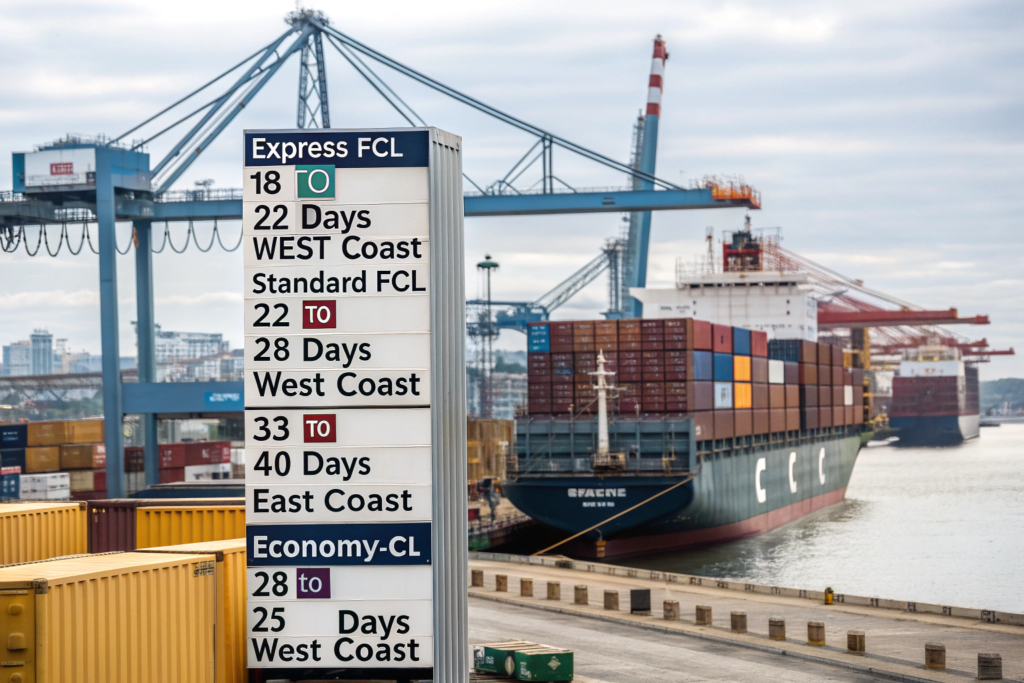
Our three ocean service levels offer different door-to-door transit times. Express FCL is our fastest ocean service, with total door-to-door times of 18 to 22 days to the West Coast and 30 to 35 days to the East Coast. Standard FCL is 22 to 28 days to the West Coast and 33 to 40 days to the East Coast. Economy LCL is 28 to 35 days to the West Coast and 38 to 50 days to the East Coast. The differences come from the pre-sailing consolidation waiting time, the vessel priority, and the destination handling speed.
Express FCL minimizes waiting time at every stage. The container is picked up and delivered directly to the port on a tight schedule. It is booked on a vessel with priority loading, meaning it is one of the last containers loaded and one of the first discharged. At the destination, we use an off-pier chassis pickup, meaning the container is placed directly onto a chassis and picked up immediately, bypassing the terminal stack. These small optimizations at each stage compound into a 5-to-10-day reduction in total transit time compared to economy LCL.
Standard FCL is the middle tier. The container is not on a priority loading program, so it may wait a day or two at the origin terminal and a day or two in the destination terminal stack. The total time is a few days longer than express FCL.
Economy LCL is the slowest tier because of the consolidation and deconsolidation steps. At the origin, your goods wait one to three days for a full container to build. At the destination, the container waits one to two days for CFS deconsolidation, and your cartons wait another one to two days for the delivery truck to be scheduled. These four to seven days of LCL-specific waiting are the trade-off for the lower cost.
What Is the Fastest Possible Door-to-Door Ocean Time?
You have an urgent restock need. You cannot afford air freight, but you need the fastest possible ocean service. What is the absolute minimum door-to-door time?
The fastest realistically achievable door-to-door ocean time from China to the US West Coast is 16 to 18 days. This requires express FCL service from a major port like Shanghai to Los Angeles, with no customs exam, no port congestion, and a local delivery within 50 miles. Day one is pickup. Day two is port delivery and export clearance. Day three is vessel loading and departure. Days four through sixteen are ocean transit. Day seventeen is arrival, discharge, and customs release. Day eighteen is delivery. This is the best-case scenario. We have achieved it, but it requires everything to go perfectly. For planning purposes, budget 20 to 22 days for express FCL to the West Coast.
How Much Time Can You Save by Choosing Express Over Economy?
You are comparing express FCL at $3,800 and economy LCL at $2,200. The cost difference is clear. The time difference is less clear from the quotes you received.
Express FCL to the West Coast is 18 to 22 days. Economy LCL is 28 to 35 days. The express service saves you 8 to 13 days. For a shipment of 2,000 units with a retail value of $40 per unit, 10 extra days of sales at 10 units per day is $4,000 in revenue. The express FCL premium of $1,600 is recovered by the extra sales. This is the time-value-of-inventory calculation that we help you make.
What External Factors Can Delay Your Sea Freight Shipment?
You have a confirmed delivery date. You plan your warehouse labor, your marketing campaign, and your retail buyer communication around that date. Then the shipment is delayed by a week due to a factor you never saw coming. You feel blindsided.
The most common external factors that delay sea freight shipments are port congestion at origin or destination, vessel schedule changes including port call omissions, customs examinations, severe weather, labor actions, and peak season capacity crunches. We monitor all these factors proactively and update your ETA in real time. You know about delays as soon as they become likely, not after they have already consumed your buffer.
Port congestion is the most frequent delay cause. When too many vessels arrive at a port simultaneously, they anchor offshore and wait for berths. In severe congestion events, the wait can be three to seven days. The Port of Los Angeles and Long Beach experienced this acutely in 2021-2022. While conditions have improved, congestion remains a periodic risk. Our predictive ETA system monitors anchorage queues and adjusts your ETA before the carrier issues an official delay notice.
Vessel schedule changes are the second most common cause. A carrier may omit a scheduled port call to recover schedule delays elsewhere. If your container is booked on a vessel that omits your origin or destination port, it will be rolled to the next available vessel, adding 7 to 14 days. We monitor carrier schedule announcements and rebook immediately when an omission affects your shipment.
Customs examinations are the third factor. An X-ray exam adds two to three days. A physical exam adds three to five days. An intensive exam adds five to seven days. Exams are not predictable at the individual shipment level, but we know the risk factors and can advise on the probability.
How Do We Predict and Communicate Delays?
Your forwarder emails you three days after a delay occurs. You have already missed a delivery appointment and paid a dry run fee. The communication failure is as costly as the delay itself.
Our predictive ETA engine detects delays before the official carrier notification. Port congestion is detected by monitoring anchorage vessel counts. Weather delays are detected by monitoring National Hurricane Center and Joint Typhoon Warning Center advisories. Labor disruptions are detected by monitoring news feeds and union negotiation updates. When a delay is predicted, your dashboard ETA updates, you receive a notification, and your account manager reaches out with the details and the mitigation plan.
What Can You Do When a Delay Threatens Your Deadline?
Your shipment is delayed by five days. Your launch date is in ten days. The original plan was delivery in seven days. The delay puts the delivery two days before launch, leaving no time for quality inspection and repackaging.
Contact your account manager immediately. We can explore several options. We can expedite the destination drayage by booking a hot-shot truck for faster delivery. We can split the delivery, sending a partial load by expedited truck and the remainder by standard truck. We can arrange for the warehouse to receive the goods after hours or on a weekend. The earlier you tell us about the deadline pressure, the more options we have to recover time.
Conclusion
Sea freight from China to the USA is a journey with predictable stages and realistic time ranges. The total door-to-door time to the West Coast is 18 to 35 days depending on the service level. To the East Coast, it is 30 to 50 days. The ocean transit itself is 12 to 35 days depending on the specific ports. The pre-sailing and post-arrival stages add 6 to 15 days.
The key to managing your inventory timeline is not to memorize these ranges but to use a forwarder who provides a detailed, milestone-based timeline for your specific shipment, monitors the progress in real time, and communicates delays proactively. At GeeseCargo, our platform shows you the planned versus actual timeline for every milestone. You see exactly where your shipment is, what has been completed, and what is coming next. You are never in the dark.
If you want to know the exact transit time for your specific origin, destination, and shipment size, go to GeeseCargo.com and use the instant quote tool. The tool returns the door-to-door transit time along with the cost. You can also contact me directly with your shipment details, and I will provide a customized timeline breakdown. Stop guessing. Start planning with real data.