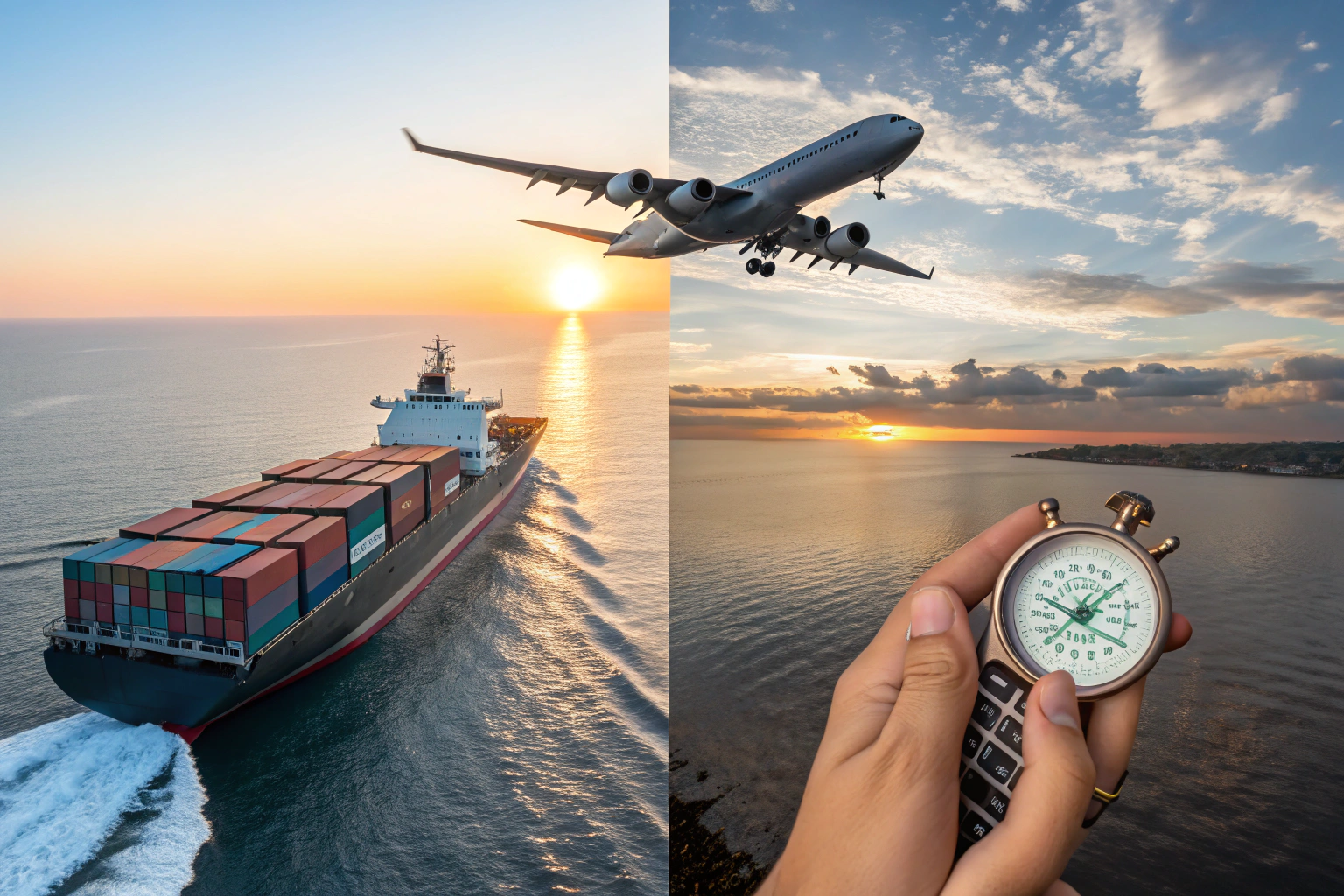
I got a text from Ron at 11 p.m. on a Wednesday. His biggest retail buyer had just changed a promotion date. A line of fashion accessories that was supposed to launch in six weeks was now launching in two weeks. Ron had 500 kilograms of product ready at his factory in Guangzhou. Ocean freight was out of the question. The goods would arrive three weeks after the promotion started. He needed them in his warehouse in Dallas in ten days. He had never used air freight before. He was worried about the cost. He was worried about the process. He texted me one line: "Can you make this work?" I replied with one word: "Yes." Five days later, the goods were in Dallas, the promotion launched on time, and Ron learned something important. Air freight is not a cost. It is a tool. And when you use the right tool for the right job, it pays for itself.
GeeseCargo recommends air freight over ocean freight when the speed-to-market advantage preserves a sale, when the product value-to-weight ratio makes the freight premium negligible against the inventory carrying cost, when small production runs or samples need rapid delivery, and when an ocean shipment would miss a contractual deadline and risk chargebacks or lost retail contracts.
Air freight is not just "fast ocean." It is a fundamentally different logistics mode with its own cost drivers, its own operational rules, and its own strategic use cases. At GeeseCargo, we do not push air freight to pad our revenue. We recommend it when the math and the business situation support it. And we run the math with you, transparently, so you can make an informed decision. Let me walk you through the specific scenarios where air freight is not just the faster option, but the smarter option.
What Is the Cost Difference Between Air Freight and Ocean Freight, and When Does It Not Matter?
Let me address the elephant in the room immediately. Air freight is more expensive than ocean freight on a per-kilogram basis. There is no getting around that. The air freight rate from China to the U.S. is roughly four to eight times the ocean freight rate, depending on the product density and the current market. A product that costs $2 per kilogram to ship by ocean might cost $8 to $12 per kilogram by air. If you stop your analysis there, you will never use air freight. But you should not stop your analysis there.
The per-kilogram cost of air freight is four to eight times higher than ocean freight, but this cost difference becomes irrelevant to the total business case when the inventory carrying cost savings, the margin preservation from faster sales, and the avoidance of retail penalty costs are fully calculated into the total cost of the shipping decision.
The total cost of shipping is not the freight invoice. It is the impact of the shipping decision on your entire profit and loss statement. I run a total cost model for clients considering air freight. The model has several lines. Line one is the freight cost, which is higher for air. Line two is the duty cost, which is the same percentage but higher in absolute dollars because the freight cost is included in the customs value. Line three is the inventory carrying cost. Goods on an ocean vessel are inventory at sea. You paid the factory. You have not sold the goods. Your capital is tied up. At a cost of capital of 8% to 12% per year, a $100,000 shipment sitting on a boat for 35 days costs you $750 to $1,150 in lost capital use. The same goods arriving in 5 days by air cost you $100 to $150. The air freight premium is offset by $650 to $1,000 in inventory cost savings. Line four is margin preservation. If the goods are seasonal or trendy, a 30-day earlier arrival can mean selling at full price instead of a 30% markdown. On a $100,000 retail value shipment, that is $30,000 in preserved margin. The air freight premium is a rounding error compared to that number. When you run the total cost model, air freight often wins for the right products.

How does product value density affect the air versus ocean decision?
Value density is the ratio of a product’s value to its weight and volume. A product with high value density, like premium electronics or designer handbags, carries a lot of financial value in a small, light package. A product with low value density, like basic ceramic mugs, has low value spread across heavy, bulky cartons.
Air freight is charged on chargeable weight, which is the greater of actual weight and dimensional weight. The freight cost per unit is driven by the physical characteristics of the product, not its value. A $200 handbag and a $10 handbag that weigh the same and take up the same space cost the same to ship by air. The freight cost as a percentage of the product’s value is therefore much lower for the expensive handbag. For the $200 handbag, a $5 air freight cost is 2.5% of the product value. For the $10 handbag, that same $5 is 50% of the product value. High-value-density products are natural candidates for air freight because the freight cost is a small fraction of the product cost, and the inventory and obsolescence risks are higher. We help our clients calculate the freight cost as a percentage of product value for their specific SKUs. When that percentage is in the low single digits, air freight is a serious option.
When does air freight actually become cheaper than ocean freight on a total landed cost basis?
This is the holy grail question, and the answer is yes, for certain product profiles, air freight is genuinely cheaper than ocean freight when you calculate all costs.
This happens when the product has very high value density, high tariff exposure, and high inventory risk. Consider a shipment of premium fashion accessories with an FOB value of $200,000 and a weight of 400 kilograms. Ocean freight and associated costs might total $8,000. Air freight might total $20,000. The air freight premium is $12,000. But the duty on the ocean freight component adds $2,000. Inventory carrying cost on $200,000 for 30 extra days at 10% annual cost adds $1,644. But the real equalizer is the market risk. If these are seasonal accessories that lose 50% of their retail value if they arrive late, that is a $100,000 risk. Even a 20% probability of a late ocean arrival makes the expected loss $20,000. The air freight premium is $12,000. The expected loss from ocean delay is $20,000. Air freight is the cheaper option. We do not present this as a theoretical exercise. We build this model with real numbers for real shipments.
In What Scenarios Does Air Freight Deliver a Better Business Outcome?
Ron’s 11 p.m. text was a classic scenario. A retail promotion date changed, and the cost of missing the date was not just the lost sales of that promotion. It was the damaged relationship with the buyer. Buyers at major retail chains have long memories. If your goods are late, you lose credibility. You lose future orders. You lose shelf space to competitors who deliver on time. That cost is impossible to quantify precisely on a spreadsheet, but every experienced importer knows it is real and it is large.
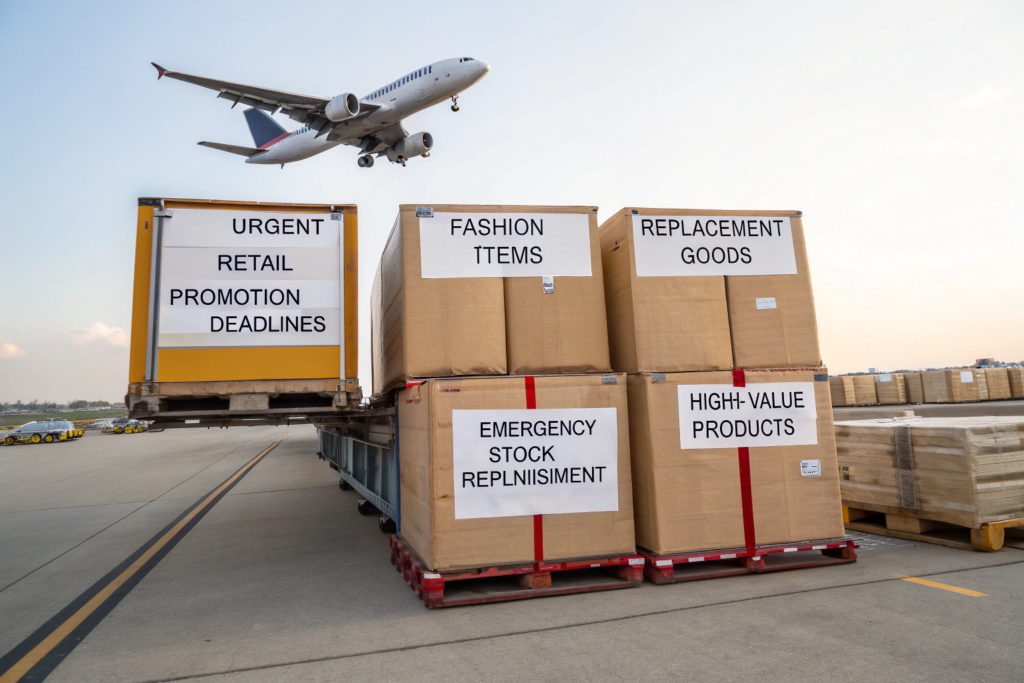
Air freight delivers a better business outcome than ocean freight in scenarios involving urgent retail promotion deadlines, fashion and trend-driven products with short selling windows, replacement of defective goods to preserve a buyer relationship, high-value product launches where being first-to-market commands a price premium, and emergency stock replenishment to avoid stockouts on best-selling items.
The retail promotion deadline is the most common air freight trigger I see. A buyer issues a purchase order with a firm delivery window. If the goods arrive outside that window, the order is cancelled, or worse, the goods are accepted with a chargeback penalty that wipes out the margin. Ocean freight is too slow and too variable for these hard deadlines. Air freight, with its 3 to 7-day door-to-door timeline, hits the window reliably. The fashion and trend-driven product scenario is a close second. A fast-fashion item has a selling window measured in weeks, not months. If the goods spend four weeks on a boat, the trend may have passed before they hit the rack. Air freight compresses the supply chain so the product arrives while the trend is still hot. The defective goods replacement scenario is one that importers often overlook. If a factory ships a container of goods with a quality defect, and your buyer is waiting, a replacement order by ocean will take another month. The buyer will not wait. They will cancel. Air freight saves the relationship by getting the replacement goods there in a week.
How do you calculate the cost of missing a retail delivery window?
The hard costs of a missed window are chargebacks, markdowns, and order cancellations. A typical retail chargeback for a late delivery is 2% to 5% of the invoice value. A markdown to clear seasonal goods that arrive late can be 30% to 50% of the retail price.
The soft costs are harder to quantify but potentially larger. A buyer who loses trust in your delivery reliability will reduce your order volume, shift shelf space to a more reliable competitor, or drop you entirely. The lifetime value of a retail buyer relationship is enormous. An air freight shipment that costs $10,000 more than ocean is a cheap insurance premium against losing a $500,000 annual account. We help our clients frame the air freight decision in terms of relationship protection, not just freight cost. When you see the freight premium as an insurance premium on your buyer relationship, the decision often becomes clear.
What role does air freight play in new product launches and market testing?
When you are launching a new product, speed to market can mean the difference between being the first mover and being a follower. The first brand on the shelf captures the early adopters and sets the price anchor.
Air freight allows you to get initial inventory to market in days, not weeks, after production. You can test the market response with a small air shipment before committing to a large ocean production run. If the product sells, you have validation and you have sales momentum while the ocean shipment is in transit. If it does not sell, you limited your exposure to a small air freight cost rather than a full container of inventory. This "test and scale" model is one of the smartest uses of air freight. We have clients who launch every new product with an air shipment of 500 to 1,000 units. Based on the initial sales data, they adjust the ocean production quantity. The air freight cost is a market research investment that pays for itself in avoided inventory mistakes.
How Does GeeseCargo’s Air Freight Service Handle the Operational Details?
When Ron agreed to his first air freight shipment, he had operational questions. How does the factory get the goods to the airport? What documents are needed? How does customs clearance work for air cargo? Is the process different from ocean? He was comfortable with ocean freight because he had done it a hundred times. Air freight felt unfamiliar and intimidating. I walked him through the process step by step, and I will do the same for you here.
GeeseCargo’s air freight service handles the complete operational chain from factory pickup in China, through air carrier booking and consolidation, to U.S. customs clearance and final delivery, using the same documentation standards and the same customer-facing team that manages our ocean freight, so the client experience is seamless regardless of mode.
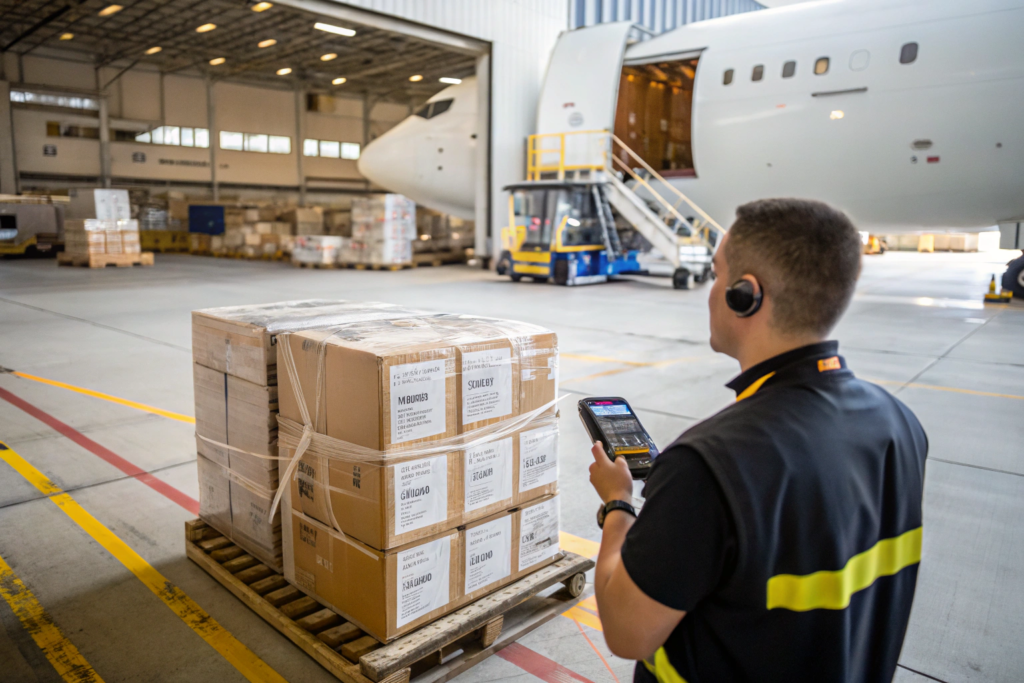
The process begins the same way as ocean freight. The factory finishes production. We send a truck to pick up the goods and bring them to our air freight hub near the departure airport. At the hub, we receive the cargo, verify the carton count and condition against the packing list, and prepare the air waybill. The air waybill is the equivalent of the ocean bill of lading. It is the contract of carriage with the airline. We file the electronic export information with Chinese customs. We book the air cargo space with our contracted carrier. We have block space agreements with major air carriers, which means we have guaranteed capacity and negotiated rates. The cargo is palletized, weighed, and handed to the airline. It flies. Upon arrival in the U.S., our customs brokerage team files the entry, the same team that handles our ocean entries. The goods clear customs, usually within hours. We arrange the final delivery to the destination warehouse. The client receives the same tracking updates and the same communication they receive on ocean shipments.
What are the different air freight service levels and which one is right for you?
Air freight is not a single product. There are multiple service levels with different speed and cost profiles. The right choice depends on the urgency of your shipment.
Express service uses the integrated networks of carriers like FedEx, UPS, or DHL. It is the fastest option, with door-to-door delivery in 2 to 4 days. It is also the most expensive. This is the service for true emergencies, when every day counts. Consolidated air freight uses wholesale cargo carriers. We combine shipments from multiple clients to fill a pallet or a container position. The transit time is 5 to 7 days door-to-door. The cost is 30% to 50% lower than express. This is the service for most business-critical but not same-week emergency shipments. Economy air freight uses lower-priority cargo space on passenger or freighter aircraft. Transit time is 6 to 10 days. The cost is the lowest air option. This is the service for shipments that need to be faster than ocean but are not urgent enough to justify the premium of consolidated or express air. We present all three options with the cost and transit time for each. The client chooses based on their budget and their deadline.
How does the air waybill differ from an ocean bill of lading?
The air waybill is a non-negotiable document, meaning it does not convey title to the goods. The ocean bill of lading can be negotiable, serving as a document of title that can be bought, sold, or used as collateral.
In practice, this means the release process is simpler for air freight. There is no original bill of lading to endorse and courier to the destination. The air waybill is an electronic document. The goods are released to the consignee named on the air waybill upon arrival and customs clearance. This simplifies the process and eliminates the risk of a lost or delayed original document holding up the cargo release. It is one of the operational reasons air freight is inherently faster than ocean, beyond just the speed of the aircraft.
How to Decide If Air Freight Is Worth the Premium for Your Specific Product?
I have given you the scenarios and the cost models. Now let me give you a practical decision framework. When a client asks me whether to use air freight for a specific shipment, I do not answer with a gut feeling. I run through a checklist of questions. The answers determine the recommendation. This is the same checklist I used with Ron when he texted me at 11 p.m., and it is the checklist my team uses every day.
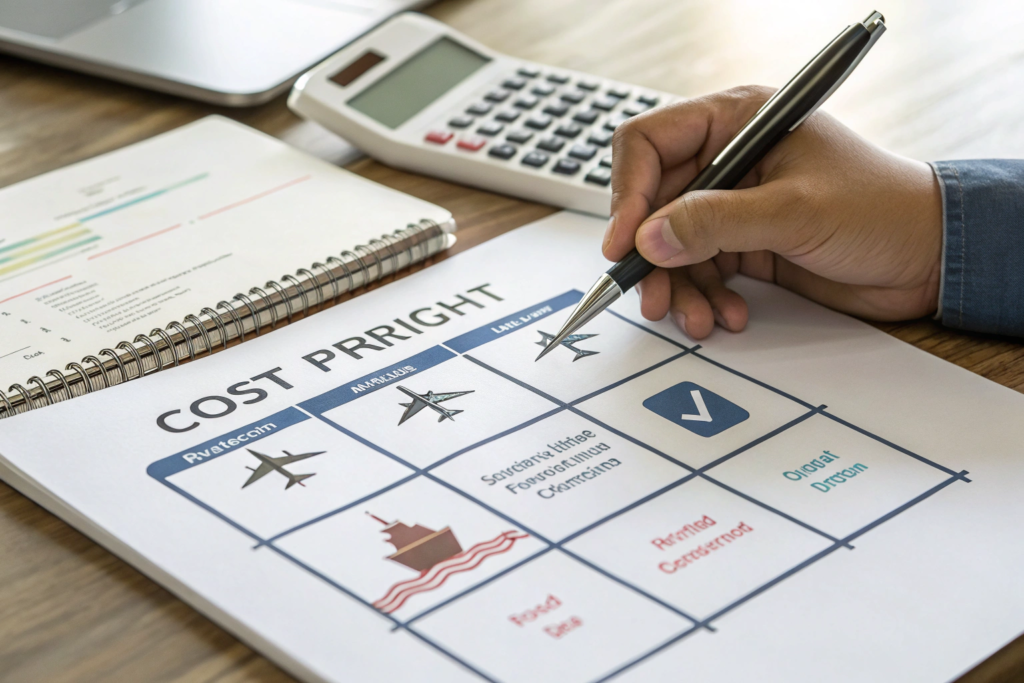
To decide if air freight is worth the premium, answer four questions: What is the product’s value per kilogram and the air freight cost as a percentage of that value? What is the financial cost of a delayed delivery, including retail penalties and lost margin? What is the inventory carrying cost of a 35-day ocean transit versus a 5-day air transit? And can the shipment be consolidated with other orders to reduce the per-unit air freight cost?
Question one is the value density test. Calculate your product’s FOB value per kilogram. If it is above $50 per kilogram, air freight is almost certainly worth evaluating. If it is below $10 per kilogram, air freight will be difficult to justify unless the delay cost is extreme. Question two is the delay cost test. What happens if the goods arrive 30 days late? Quantify it. A retail chargeback percentage. A markdown estimate. A lost sale. Put a dollar number on it. Question three is the inventory cost test. Multiply your shipment value by your cost of capital, divide by 12 for one month of carrying cost. Question four is the consolidation test. Can you combine this shipment with another order to fill an air pallet and get a better rate? We actively look for consolidation opportunities across our client base. If two clients both have air-worthy shipments ready at the same time from the same region, we can combine them and offer both a lower rate. The answers to these four questions make the air versus ocean decision almost mechanical. The data drives the decision.
How do seasonal products change the air freight calculation?
Seasonal products have a hard expiration date. A Halloween decoration has zero value on November 1. A Christmas gift item has heavily discounted value on December 26. The cost of delay is not a percentage. It is total.
For strictly seasonal products, air freight should be budgeted as a risk mitigation tool from the start of the season. We recommend that importers of seasonal goods plan their production schedule to allow for ocean freight under normal circumstances, but reserve air freight capacity as a backstop for the final production run. If the factory is on time, the goods go by ocean. If the factory runs late, the goods go by air. The air freight premium is a contingency cost that is only incurred when needed. This requires having an air freight relationship and capacity in place before the crisis. We establish this for our seasonal clients. We have the carrier agreements, and we have the pricing pre-negotiated. When the call comes, we execute.
Can you use a hybrid Sea-Air solution to balance cost and speed?
Yes. Sea-Air is a multimodal solution where goods travel part of the journey by ocean and part by air. It offers a middle ground between the low cost of ocean and the high speed of air.
A typical Sea-Air routing moves the cargo by ocean from China to a hub like South Korea, Vancouver, or Los Angeles, then transfers it to air freight for the final leg to the destination. The ocean leg takes 8 to 12 days. The air leg takes 1 to 3 days. Total transit is 12 to 18 days. The cost is 40% to 60% less than full air freight. Sea-Air is an excellent option when the shipment deadline is too tight for ocean but not urgent enough to justify the full air premium. It is also useful when air freight capacity is constrained and rates are spiking. We offer Sea-Air as a standard product and help clients evaluate it alongside pure ocean and pure air.
Conclusion
Ron’s 500-kilogram air freight shipment of fashion accessories arrived in Dallas five days after his late-night text. The promotion launched on time. The goods sold through at full price. The air freight premium was $8,000 over what ocean would have cost. The promotion generated $120,000 in revenue at a 55% margin. The air freight premium was 6% of the revenue and 12% of the gross margin. Ron told me later that he had been resisting air freight for years because he could not get past the per-kilogram rate. Once he saw it as a percentage of the business outcome, rather than a cost line, the decision became easy.
Air freight is not for every shipment. It is not for every product. But for the right shipment and the right product, it is not an expense. It is a profit-maximizing, relationship-protecting, market-winning strategic tool. At GeeseCargo, we do not oversell air freight. We analyze it with you, transparently and honestly. We present the ocean option, the air option, and the Sea-Air option, with the costs and the transit times and the business implications of each. You make the decision based on your business needs. We execute it flawlessly.
If you have a shipment that might be a candidate for air freight, or if you want to set up air freight as a contingency option for your seasonal program, reach out to me. Send me the product details and the timeline requirement. I will run the total cost model and give you a clear recommendation. No pressure. No upselling. Just the data and the logistics expertise you need to make a smart decision. That is what a professional, reliable freight forwarder delivers.