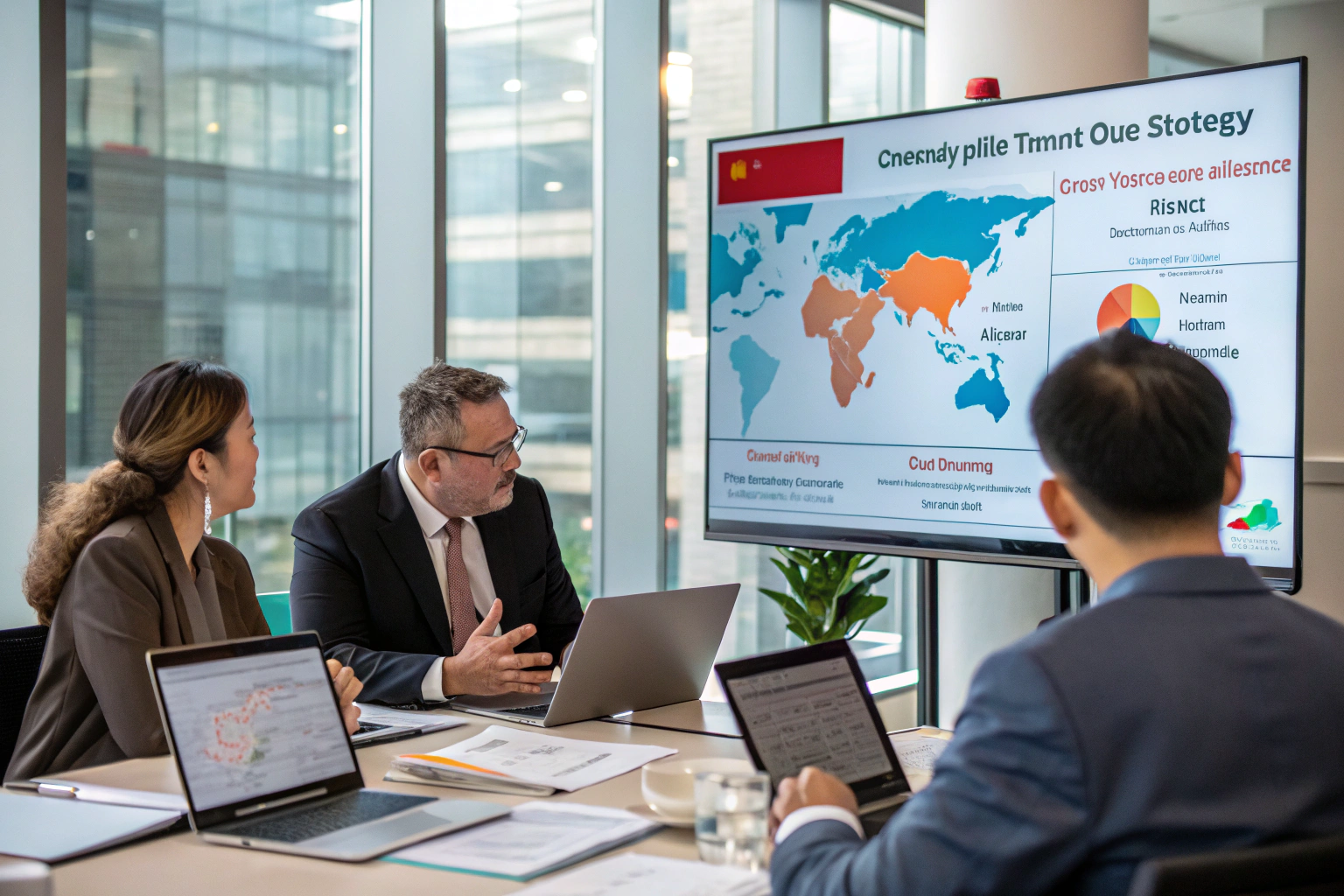
I sat across from Ron in a coffee shop near his warehouse about a year ago. He had just received notice that a new round of Section 301 tariff reviews was targeting several categories of his apparel line. His margins were already thin. Another 10% duty increase would push two of his best-selling products into the red. He stirred his coffee and asked a question I had been expecting for months. "Geese, is it time to start looking outside China? And if I do, can you still handle my logistics, or do I need to find someone else?" I put my cup down and smiled. "Ron, it is time to start looking. And no, you do not need to find someone else. This is exactly what we do."
Diversifying your sourcing through a China Plus One strategy means maintaining your primary, proven Chinese supplier base while developing secondary production capacity in alternative countries like Vietnam, India, Bangladesh, or Mexico, and GeeseCargo supports this transition with integrated logistics solutions that span multiple origins, consolidated shipping options, and consistent customs clearance regardless of where your goods are made.
The China Plus One strategy is not about abandoning China. It is about building a safety valve. China remains the world’s most complete manufacturing ecosystem. Its speed, scale, and supplier density are unmatched. But the trade policy environment, rising labor costs, and the lesson of supply chain fragility that we all learned in recent years have made single-country sourcing a risk that fewer importers can afford. At GeeseCargo, we have been building the infrastructure to support multi-country sourcing for years. Let me explain why diversification matters now, how to think about it strategically, and how we make it logistically seamless.
What Is a China Plus One Strategy and Why Are Importers Adopting It Now?
The term "China Plus One" has been circulating in boardrooms and trade publications for years. But it has moved from a theoretical concept to an operational reality for many importers in the last eighteen months. The "China" part means you keep your core Chinese supplier relationships. You do not burn bridges. You do not abandon factories that have served you well. The "Plus One" part means you identify and develop one or more alternative sourcing countries for a portion of your production volume. The goal is not replacement. The goal is optionality.
A China Plus One strategy is a supply chain diversification approach where importers maintain their established Chinese manufacturing base while developing a secondary production location in an alternative country, adopted now primarily due to persistent Section 301 tariff exposure on Chinese goods, the desire to reduce reliance on a single geopolitical entity, and the maturation of manufacturing capabilities in Southeast Asia and South Asia.
The drivers are multiple and reinforcing. The tariff driver is the most immediate. Section 301 tariffs on Chinese goods remain in place with no clear end in sight. The UFLPA has created a new compliance burden that disproportionately affects China-origin textiles. The political rhetoric from both major U.S. parties is hawkish on China trade. This is not a temporary storm that you can wait out. It is a climate shift. The second driver is risk management. The pandemic showed that a single-country supply chain is a single point of failure. A localized lockdown, a port closure, an energy shortage, can stop your entire business. Having production in two countries means a problem in one does not stop you from shipping product. The third driver is cost. Labor costs in coastal China have risen significantly. Countries like Vietnam, India, and Bangladesh offer lower labor costs for labor-intensive products like apparel and simple accessories. The equation has shifted. A few years ago, the cost and quality advantages of China outweighed the tariff penalty. For many products today, the math has flipped.
How do you decide which products to move to a Plus One country?
You do not move everything. You move strategically. The products that benefit most from Plus One sourcing are those with high Section 301 tariff exposure, high labor content, and relatively simple manufacturing requirements.
Start with a product-level analysis. List your top-selling products by volume and by tariff burden. For each product, calculate the total landed cost from China, including the current tariff. Then get a quote from a qualified factory in a Plus One country. The quote must include the ex-factory price, the ocean or air freight to the U.S., and the applicable duty rate from that country. Many Southeast Asian and South Asian countries have normal trade relations duty rates with the U.S. that are lower than the Section 301-inflated China rates. Some even have preferential duty rates under programs like the Generalized System of Preferences. The landed cost comparison tells you whether the shift makes financial sense. We help our clients run these comparisons using actual freight rates from our network. We do not use generic industry averages. We use the rates we can deliver.
What are the leading Plus One countries for apparel and gift imports?
Vietnam is the leading alternative for apparel, footwear, and many consumer goods. Its manufacturing sector has matured rapidly, and it has favorable trade relations with the U.S. India is strong for textiles, home goods, and certain gift categories. Bangladesh is a powerhouse for basic garments and volume-driven apparel. Mexico has emerged as a nearshoring option for products where speed to U.S. market is critical.
Each country has a different profile. Vietnam offers quality and consistency that approaches China for many categories, but at a higher cost than Bangladesh. India offers massive scale and raw material access, but infrastructure and logistics can be more complex. Bangladesh offers the lowest labor costs, but lead times are longer and minimum order quantities can be higher. Mexico offers speed and tariff advantages under the USMCA, but the supplier ecosystem for consumer goods is less developed than Asia. The right Plus One country depends on your specific product, volume, and customer requirements. We help our clients evaluate the tradeoffs. We do not push one country. We present the data and let your business strategy decide.
What Are the Logistics Challenges of Multi-Country Sourcing and How Do You Solve Them?
When I told Ron that we could handle his Vietnam logistics alongside his China logistics, he was skeptical. He had spent years building a smooth process with his Chinese factories. The forwarder picked up from three factories in Guangdong, consolidated at a warehouse in Shenzhen, and loaded a container to Long Beach. It was a well-oiled machine. Adding a factory in Vietnam felt like throwing a wrench into that machine. Where would the goods consolidate? Would he need separate containers? Would the customs clearance be different? His concerns were valid. Multi-country logistics is more complex than single-country logistics. But complexity is manageable with the right systems.
The main logistics challenges of multi-country sourcing include coordinating separate origin pickups, managing longer or less frequent sailing schedules from secondary origins, handling different export documentation requirements, and avoiding the cost inefficiency of shipping partial containers from two different countries, all of which GeeseCargo solves through multi-country consolidation hubs and integrated shipment planning.
The core challenge is consolidation. If you are ordering 40% of your volume from China and 10% from Vietnam, neither volume may fill a container on its own. Shipping two Less than Container Load shipments from two origins doubles your handling costs and your customs clearance work. The solution is a consolidation hub. We operate or partner with consolidation warehouses in the major Plus One countries. Your Vietnam factory ships finished goods to our Vietnam hub. Your China factory ships to our China hub. We then have a decision. We can either ship each origin’s cargo as a separate LCL or FCL shipment, or we can transship one origin’s cargo to the other origin’s hub and combine them into a single container. For example, we can ship the Vietnam cargo to our China hub via short-sea feeder vessel, consolidate it with the China cargo, and ship one full container to the U.S. This is a cost optimization decision that we make based on volumes, transit times, and freight rate differentials.
How does multi-country consolidation actually work?
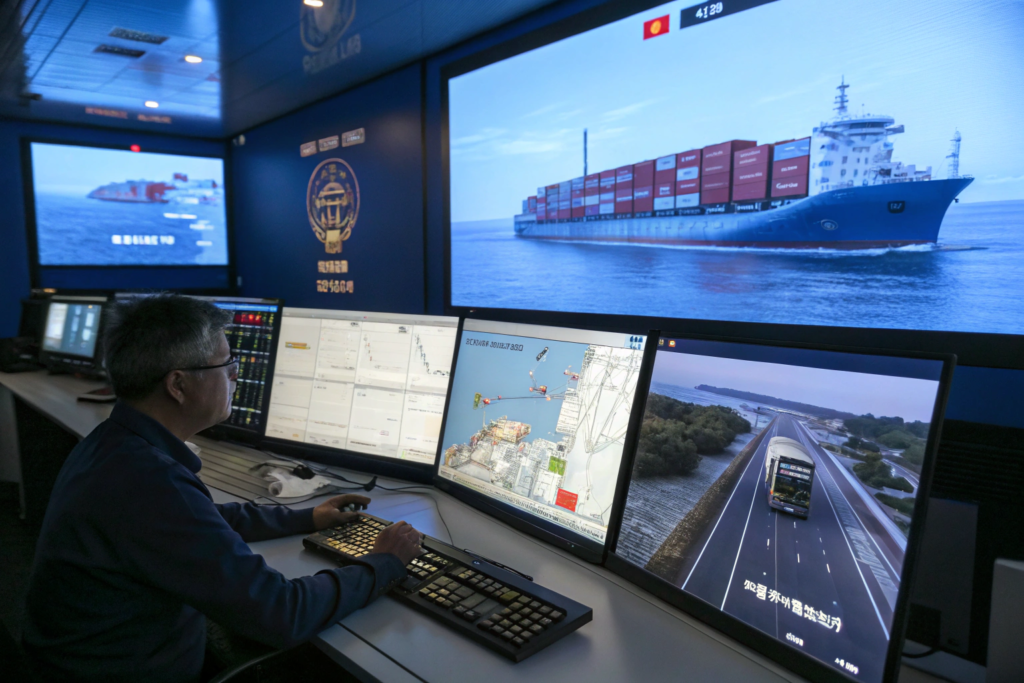
Multi-country consolidation means that goods from different countries are brought together at a single location, combined into one shipment, and cleared through U.S. customs as a single entry.
The consolidation point can be in Asia or in the U.S. The Asia consolidation model works well when the Plus One country is geographically close to China, such as Vietnam or Cambodia. The goods from the secondary country are shipped to our China hub via truck or short-sea vessel. They arrive, are inspected and counted, and are combined with the China-made goods into a single container. One bill of lading. One U.S. customs entry. One delivery to your warehouse. The documentation shows the correct country of origin for each product line, which is critical for customs compliance. The U.S. consolidation model works when the origins are far apart, such as China and India. The goods ship separately to a U.S. Foreign Trade Zone or bonded warehouse. They are consolidated after customs clearance and delivered as a single truckload to your facility. This model defers the consolidation cost but adds U.S. warehousing cost. We analyze the numbers and recommend the optimal consolidation strategy for each client’s mix.
How do you manage export documentation and customs compliance across multiple origins?
Every country has its own export documentation requirements. The commercial invoice format, the export declaration process, and the certificate of origin requirements differ. You cannot apply the China process to Vietnam or India and expect it to work.
We handle this by having trained staff or vetted partner agents in each origin country. They know the local export procedures. They prepare the correct documentation in the correct format. They file the export declarations with the local customs authority. For the U.S. import side, our U.S. customs brokerage team handles the entry regardless of origin. The HTS classification and the Section 301 analysis are different for different countries of origin. Chinese-origin goods face Section 301 tariffs. Vietnamese-origin goods generally do not. But a Vietnamese factory may use Chinese components, which can trigger country of origin marking issues. Our compliance team reviews the supply chain for each Plus One product to ensure the country of origin declaration is legally correct and that the customs entry claims the correct duty rate. Multi-country compliance is more work, but it is work we are equipped and staffed to do.
How Does GeeseCargo’s Network Extend Beyond China for Seamless Freight Services?
When a client asks me whether GeeseCargo can handle logistics from Vietnam or India, the answer is not just yes. The answer is that we have been building these lanes for years in anticipation of this shift. We did not wait for the tariff crisis to start making calls. We have established relationships with carriers, port operators, customs officials, and warehouse partners in all the major alternative sourcing countries. Our network is not a loose collection of random agents. It is a managed, integrated network that operates to the same standards we enforce in China.
GeeseCargo’s network extends beyond China to include fully operational freight lanes from Vietnam, India, Bangladesh, Cambodia, Indonesia, and Mexico, offering ocean freight, air freight, and DDP door-to-door service with the same professional, reliable, and competitive standards our clients experience on our core China routes.
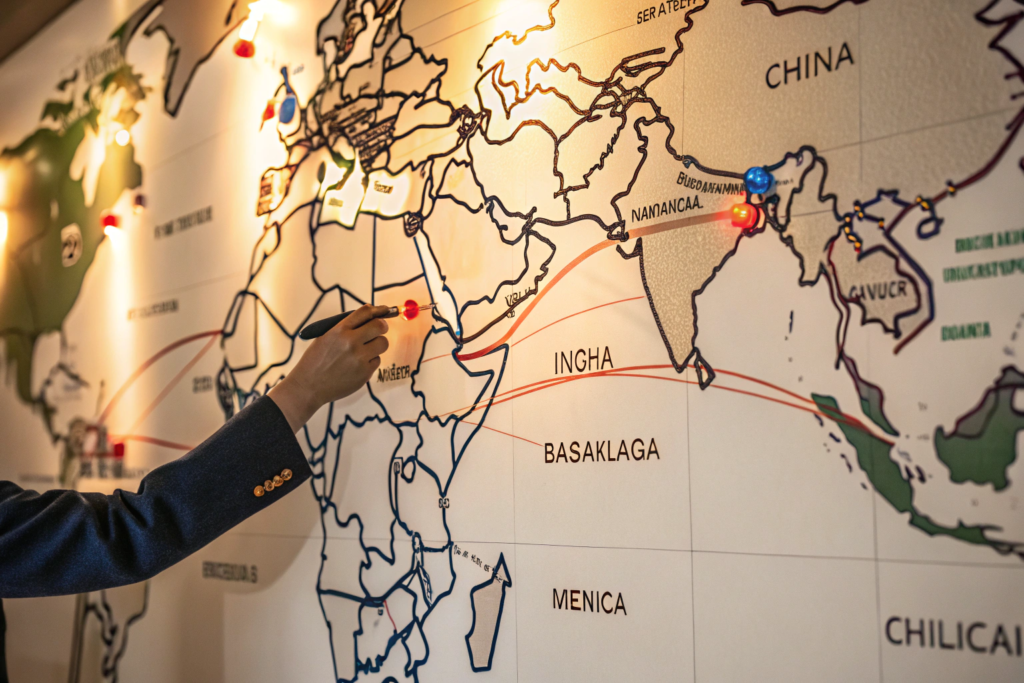
Our Vietnam operations are the most mature. We have a dedicated office in Ho Chi Minh City with staff who manage factory pickups, consolidation, and export documentation. We have contracted ocean rates from the major Vietnamese ports to all major U.S. gateways. Transit times are comparable to China, with excellent service reliability. Our India operations cover the key textile and manufacturing regions. We offer consolidation services from Delhi, Mumbai, and Chennai, with both ocean and air freight options. We have particular expertise in handling the specific documentation requirements for Indian textile exports, including the various export promotion scheme certificates. Our Bangladesh operations focus on the ready-made garment sector. Our Mexico operations are growing rapidly as nearshoring interest accelerates. The common thread across all origins is that you deal with one GeeseCargo team, one point of contact, one set of systems, and one standard of service.
How do you handle freight from Vietnam specifically?
Vietnam is currently the most popular Plus One destination, and we have invested accordingly. Our Ho Chi Minh City team handles the full logistics chain from factory to U.S. port.
The process mirrors our China process for consistency. The factory finishes production. We send a truck to pick up the goods and bring them to our consolidation warehouse. We do a carton count and a basic quality check. We handle the export customs declaration with Vietnamese customs. We load the container and ship to the U.S. The sailing schedules from Vietnam are solid. Direct services to the U.S. West Coast take about 18 to 22 days, comparable to South China. The documentation flows through our digital system just like a China shipment. For our DDP clients, the Vietnam DDP service includes Vietnamese export clearance, ocean freight, U.S. customs clearance with the correct non-301 duty rate, and final delivery. The landed cost is often significantly lower than the equivalent China DDP shipment because the Section 301 tariff is absent.
What are the freight cost and transit time comparisons for alternative origins?
The freight cost from a Plus One country is not always cheaper than China. Sometimes it is higher. The savings come from the duty differential, not the freight differential.
Vietnam ocean freight to the U.S. West Coast is generally competitive with South China rates, sometimes slightly higher due to lower container volume density on the trade lane. Transit time is similar. India ocean freight is more expensive and longer, typically 30 to 40 days to the U.S. West Coast depending on the port. Bangladesh freight costs are higher than China for similar transit times, and the sailing schedules are less frequent. The key is to calculate the total landed cost, not the freight cost in isolation. A product that saves 25% in duty from Vietnam may absorb a 5% higher freight cost and still deliver a 20% net savings. We provide landed cost comparisons for our clients so they can make these decisions with accurate numbers.
How to Plan a Successful China Plus One Transition Without Disrupting Your Business?
The worst way to implement a China Plus One strategy is to panic and move everything at once. I have seen importers do this. They get a bad tariff notice, fire their Chinese supplier, and award the entire volume to a Vietnamese factory they found on Alibaba. The result is usually a quality disaster, missed delivery dates, and a hasty return to the Chinese supplier with an apologetic phone call. A successful transition is gradual, deliberate, and managed with constant feedback loops.
Planning a successful China Plus One transition involves starting with a small trial order, qualifying the new supplier on quality and reliability, gradually shifting volume as the supplier proves capable, and maintaining the China supplier relationship at a reduced but sustainable volume, all while GeeseCargo manages the logistics integration so the transition is invisible to your U.S. customers and warehouse operations.
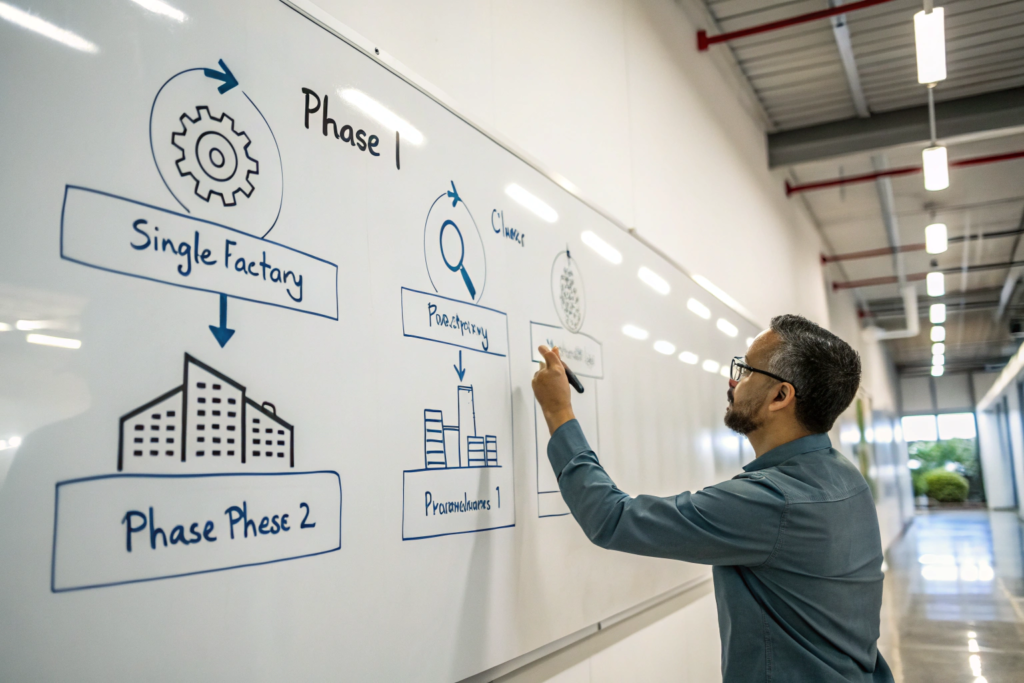
The transition plan should follow a phased timeline. Phase one is supplier identification and qualification. We can help with logistics connections, but the supplier selection is your domain. Visit the factory if possible. Send a quality control inspector. Order samples. Negotiate terms. Phase two is the trial order. Order a small quantity, perhaps 10% of your usual volume for that product. Ship it through our Plus One lane. Evaluate the quality upon arrival. Measure the transit time. Calculate the actual landed cost. Phase three is gradual scaling. If the trial is successful, increase the order to 25% or 30% of volume. Keep the Chinese supplier at 70%. Compare the performance of the two supply chains side by side. Phase four is steady-state diversification. You may settle at 70% China and 30% Plus One, or 50/50, or even 100% Plus One for specific products. The right mix is the one that optimizes your total landed cost and your risk profile. There is no single right answer.
How do you maintain quality control when adding a new sourcing country?
Quality is the biggest risk in any new supplier relationship. A Chinese factory you have worked with for five years knows your standards. A new factory in a new country is starting from zero. You must invest in quality control upfront.
We recommend placing a third-party quality control inspector in the new factory for at least the first three production runs. The inspector checks raw materials, in-process production, and finished goods against your specifications. We can recommend QC partners in the Plus One countries. You should also be prepared for a higher defect rate on the first order and build that into your planning. The second order should be better. By the third order, the factory should be performing to your standard. If it is not, that is a signal that this supplier is not the right Plus One partner. The beauty of the phased transition is that you are not reliant on the new factory. If they fail, your China supplier is still running at volume and can cover the shortfall.
How do you communicate the transition to your U.S. retail buyers?
Your buyers care about price, quality, and delivery. They generally do not care which country the product comes from, provided it is compliant with U.S. law and their own sourcing policies. But you should communicate the change transparently.
Frame the diversification as a risk management and value enhancement initiative, not a desperate cost-cutting move. Tell your buyers: "We are diversifying our production to ensure supply continuity and to mitigate the tariff volatility that has impacted pricing. We have qualified a second factory in Vietnam that meets our quality standards. This change will make our supply chain more resilient and help us maintain stable pricing for you." A buyer who hears that you are reducing single-country risk and protecting price stability is a buyer who is impressed by your supply chain sophistication. At GeeseCargo, we can provide transit time data and supply chain mapping documentation that you can share with your buyers to demonstrate the robustness of your new multi-country network.
Conclusion
Ron finished his coffee that day and made a decision. He would not panic. He would not abandon his Chinese factory that had served him well for a decade. But he would place a small trial order with a Vietnamese factory we had recommended. I connected him with our Ho Chi Minh City team. They handled the logistics for the trial order. The quality was good. The landed cost, including the lower duty rate, was 18% lower than the China equivalent. He scaled that product line to 50% Vietnam over the next year. Today, he sources 60% of his volume from China and 40% from Vietnam, with plans to add India for a specific accessory line. He still talks to his Chinese factory owner regularly. That relationship is intact. But now he has options, and those options have given him pricing stability and negotiating leverage he never had before.
A China Plus One strategy is not about running away from China. It is about running toward resilience. The world has changed. The era of effortless, friction-free single-country sourcing is over. The importers who thrive in the next decade will be those who build flexible, diversified, and professionally managed supply chains. At GeeseCargo, we are ready to be the logistics backbone for that diversified supply chain. We have the network, the customs expertise, and the consolidation infrastructure to make multi-country sourcing as simple as single-country sourcing used to be.
If you have been thinking about diversifying your sourcing but have been held back by the logistics complexity, let us talk. I will personally review your current product mix and tariff exposure, and we will build a Plus One logistics plan tailored to your business. Whether you are ready to place a trial order or just want to understand your options, we are here to guide you. This is the future of importing, and we are already operating in it. Let us take the journey together.