
I was in the middle of a routine call with Ron, my apparel client, when he received an email that changed his whole day. It was from a CBP auditor at the local port. The subject line was "Notification of Compliance Assessment." The auditor wanted to review his entries for the past three years, focusing on classification, valuation, and country of origin for his top-selling garment lines. Ron’s immediate reaction was physical. He stopped talking mid-sentence. Then he said, "Geese, is this as bad as it sounds?" I told him the truth. "No. You are ready. We have been preparing for this since your first shipment with us. Let me walk you through exactly what is going to happen and what we are going to do." Two months later, the audit closed with no penalty, no additional duties, and a letter from CBP confirming his compliance. Ron framed that letter and hung it in his office.
A CBP audit is a formal review by U.S. Customs and Border Protection of an importer’s entries, procedures, and records to verify compliance with customs laws, and GeeseCargo helps you pass by maintaining a complete, organized entry archive, conducting pre-audit readiness reviews, acting as your authorized representative during auditor interviews, and managing the response to any findings to minimize or eliminate penalties.
An audit is not a punishment. It is a verification. CBP selects importers for audit based on risk algorithms, random sampling, or specific compliance concerns. If you import regularly from China, the probability that you will be audited at some point is not zero. It is a normal part of business. The difference between an audit that ends with a handshake and an audit that ends with a penalty is preparation. At GeeseCargo, we do not wait for the audit notice to start preparing. We build audit-ready files from the very first entry. Let me explain how CBP audits work, what triggers them, and how our process ensures that when the auditor calls, you are ready.
What Triggers a CBP Audit and What Types of Audits Exist?
CBP does not audit every importer. It cannot. There are too many entries and too few auditors. Instead, CBP uses a sophisticated risk-based selection system. Your entries flow through algorithms that score them for compliance risk. Factors include the volume and value of your imports, the countries of origin, the product categories, the consistency of your HTS classifications, the declared values compared to industry benchmarks, and your prior compliance history. If your score crosses a threshold, or if you are randomly selected for a statistical sample, you get a notification.
CBP audits are triggered by automated risk assessments that flag importers with unusual classification patterns, undervaluation indicators, high-volume imports from high-risk countries, or industry-specific enforcement initiatives, and the main types include Compliance Assessments, Focused Assessments, Quick Response Audits, and site visits conducted by CBP’s Regulatory Audit and Agency Advisory Services division.
The most common type is a Focused Assessment, or FA. This is a comprehensive audit of a specific aspect of your compliance, such as classification or valuation, conducted at your place of business. CBP auditors will spend several days reviewing your records, interviewing your staff, and examining your procedures. A Compliance Assessment is a broader review of your overall import program. A Quick Response Audit is a targeted, shorter audit triggered by a specific issue, such as a spike in antidumping duty exposure or an allegation from a competitor. There is also the site visit, where CBP visits your warehouse or office to verify that your physical operations match your entry declarations. The type of audit dictates the scope and the intensity. But the preparation principles are the same for all of them. Documentation, consistency, and demonstrable reasonable care are your defenses.
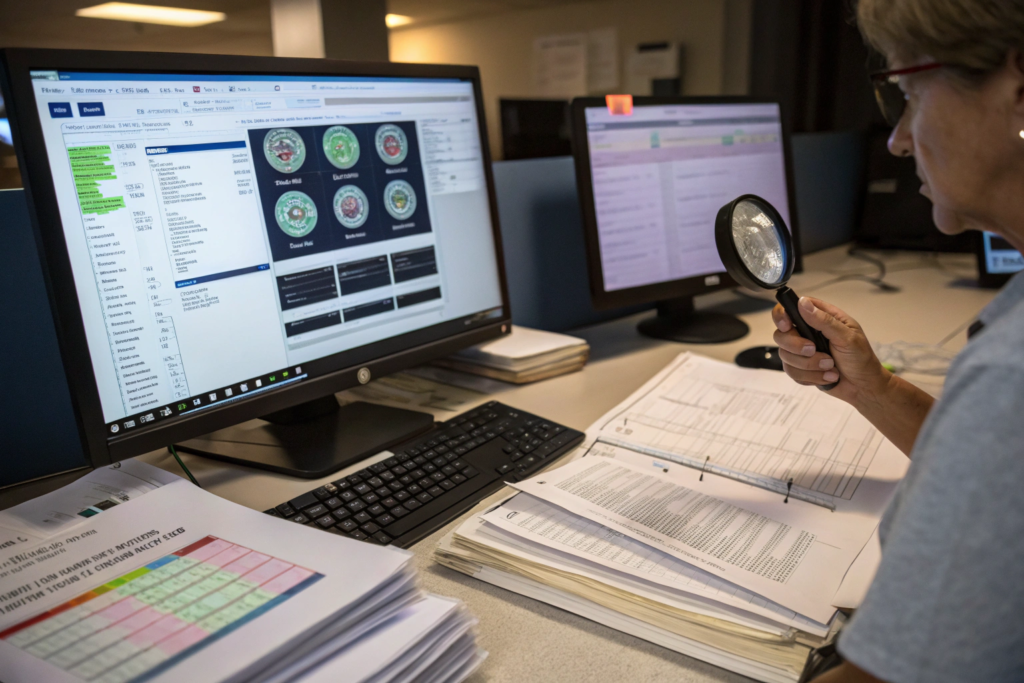
How do CBP’s risk algorithms actually flag an importer?
CBP’s risk algorithms analyze entry data across the entire importer community. They look for anomalies. Your data is compared to the data of other importers in your industry. If your declared values are consistently 30% below the industry average for the same HTS code, that triggers a flag.
The algorithms also look at internal consistency. If you import the same product under three different HTS codes over two years, the system flags the inconsistency. If you switch to a lower-duty code right after a Section 301 tariff increase, the system flags the timing. If your product descriptions are vague while other importers of the same code use detailed descriptions, you stand out. The system is designed to find patterns a human would miss. This is why our approach to classification is so methodical. We do not switch codes without a documented, legally sound reason. We do not accept vague product descriptions. We file entries that are internally consistent and externally comparable to industry norms. A clean data profile is your best defense against being selected for audit in the first place.
What is the difference between a Focused Assessment and a Quick Response Audit?
A Focused Assessment is the deep dive. It involves multiple auditors, several days on-site, a formal entrance conference, a detailed sampling of your entries, and a formal written report at the conclusion. It is the most intensive audit type.
A Quick Response Audit is narrower and faster. It is triggered by a specific, identified risk. CBP may have received information that a particular importer is undervaluing a specific product line. The auditor will come in, review the entries for that product only, and issue findings quickly. Both audit types require you to produce documentation and answer auditor questions. The Focused Assessment carries a higher resource burden because of its scope. We prepare our clients for both. The preparation is similar, but for a Focused Assessment, we spend more time on the mock audit and the procedure review. We make sure the client’s internal controls are documented and that staff are ready to answer process questions, not just entry-level questions.
What Documents and Records Must You Provide During a CBP Compliance Review?
When the audit notification arrives, the first thing the auditor will request is records. The legal requirement is that importers must maintain all records related to a customs entry for five years from the date of entry. This is not a suggestion. It is a regulation. If you cannot produce the records, you fail the audit by default. The records must be organized, complete, and accessible. A box of unsorted receipts is not compliance. It is an invitation for a deeper, more suspicious investigation.
During a CBP compliance review, you must provide the complete entry package for each sampled entry, including the commercial invoice, packing list, bill of lading, CBP Form 7501 Entry Summary, proof of duty payment, the customs bond certificate, any PGA certificates, and supporting documentation for the HTS classification, declared value, and country of origin.
The auditor will select a statistical sample of your entries from the audit period, typically three years. For each selected entry, they will ask for the full document package. This starts with the commercial invoice and packing list. They will want to see the purchase order from you to the supplier and proof of payment, to verify that the declared value matches the actual transaction value. They will want the freight invoices and insurance certificates to verify that the declared value includes all dutiable charges. They will want the HTS classification justification, including any lab test reports for material composition and any CBP binding rulings you have obtained. They will want the country of origin certificates and the factory’s production records if origin is a concern. They will want the CPSC certificates for children’s products, the FDA prior notice for food-contact items, and any other PGA documentation. They will want your internal procedures manual, if you have one, documenting how you ensure compliance. At GeeseCargo, we maintain a digital entry archive for every client that contains every one of these documents, indexed by entry number and date. When an audit hits, we do not search for documents. We pull the electronic file for each sampled entry and produce it within hours.

How does GeeseCargo organize your entry records for audit readiness?
We do not wait for the audit to organize the records. We build the audit file from day one. Every entry we file generates a digital record package that is stored securely and indexed for instant retrieval.
The package includes the filed CBP Form 7501, the commercial invoice as submitted, the packing list, the Importer Security Filing, the bill of lading, the customs release notification, the ACH duty payment confirmation, the bond certificate, and all supporting classification and valuation documentation. The package is stored in a cloud-based system that our clients can access through their portal. If CBP requests records for entry number XYZ, we enter the entry number, and the complete package is on our screen in seconds. We can transmit it electronically to the auditor or print it for an on-site visit. This level of organization communicates professionalism to the auditor. It says, "We take compliance seriously. We have nothing to hide." An auditor who receives organized, complete records on the first request is an auditor who is inclined to close the audit efficiently and favorably.
What happens if you cannot produce the requested records?
Failure to produce records is a violation in itself. CBP can issue a penalty for inadequate recordkeeping. More importantly, if you cannot support a declared value or classification with evidence, CBP will assume the worst and assess duties at the highest applicable rate.
The burden of proof in a customs audit is on the importer. CBP does not have to prove your entry is wrong. You have to prove it is right. If you claim a lower value based on First Sale Rule and you cannot produce the factory’s invoice to the intermediary, CBP will revalue your goods at the price you paid the intermediary and assess back duties on the difference. If you claim a classification based on a specific material content and you cannot produce a lab test report, CBP will reclassify at the highest plausible rate. The absence of records is the presence of liability. We make sure our clients never face this situation. We educate them on the five-year recordkeeping requirement. We provide them with the digital archive. We conduct periodic checks to ensure the records are complete and current.
How Does GeeseCargo’s Pre-Audit Preparation Process Work?
The worst time to prepare for an audit is after you receive the notification. At that point, you are reacting, not preparing. The time to prepare is when there is no audit on the horizon. We encourage all our regular clients to undergo a voluntary pre-audit readiness review at least once a year. This is a structured process where we simulate the audit experience, identify weaknesses, and fix them before CBP ever looks at the file.
GeeseCargo’s pre-audit preparation process involves a voluntary, confidential review of a sample of your entries, a classification and valuation spot-check, an assessment of your internal compliance procedures, and a corrective action plan to address any gaps, all completed well before any CBP audit notification arrives.
The process starts with a random sample of your entries from the past twelve months. We pull the complete digital file for each entry. We review the HTS classification against the product description and supporting documentation. We verify that the declared value matches the commercial invoice and that the invoice matches the payment record. We check that the country of origin is consistent and supported. We review any PGA certificates for currency and correctness. We look for inconsistencies. Did the same product get classified under two different codes on two different entries? Is the product description on the invoice sufficient to support the classification? We document our findings in a memo. If we find an error, we discuss the corrective options with you. This might mean amending unliquidated entries. It might mean filing a prior disclosure for past errors. It might mean updating your internal procedures. The goal is not to catch you doing something wrong. The goal is to find and fix any vulnerabilities before CBP finds them. This is the same principle as a fire drill. You practice when there is no fire so you are ready when there is one.

How do you conduct a self-review of your HTS classifications?
A classification self-review involves pulling a sample of your entries and physically comparing the product against the HTS code you used. You cannot do this from a desk with only the invoice. You need the product specification, and ideally a sample.
We help our clients set up a quarterly self-review process. For each product line, we have a classification file that includes the HTS code, the legal basis for the classification, the material breakdown, and any relevant CBP rulings. Quarterly, we pull a few recent entries for that product and verify that the invoice description matches the classification file. We check that the fiber content, if applicable, matches the test report. We check that the product has not changed without our knowledge. This is a simple, disciplined process that catches errors early. If a factory changed the fabric blend from 60% cotton to 55% cotton and 45% polyester, the classification may have flipped. A self-review catches this before the end of the fiscal year. We document the quarterly review and keep the record. If a CBP auditor later asks, "How do you ensure your classifications stay current?" we can produce a log of quarterly self-reviews.
What does a documented reasonable care procedure look like?
CBP wants to see that you have a system, not just a broker. A documented reasonable care procedure is a written manual that describes how your company ensures customs compliance at every stage of the import process.
The manual should cover vendor setup, product classification, valuation, country of origin determination, PGA compliance, recordkeeping, and audit response. It should assign responsibilities to specific roles within your company. For example, "The Purchasing Manager is responsible for obtaining a detailed material breakdown from the supplier before the purchase order is issued." "The Logistics Coordinator is responsible for providing the commercial invoice to the customs broker and verifying the HTS codes before shipment." We help our clients draft reasonable care procedures that are specific to their business. A small e-commerce company’s procedure will look different from a large distributor’s procedure. The manual does not need to be a hundred pages. It needs to be accurate, followed in practice, and kept current. During an audit, the first thing the auditor will ask for after the entry records is your procedures manual. Having one, and being able to demonstrate that you follow it, is powerful evidence of reasonable care. It can reduce penalties to zero even if an entry error is found, because the error is then a mistake despite a good system, not a result of a missing system.
How Does GeeseCargo Represent You During the Audit Itself?
The audit notification arrives. You call us. We immediately shift from preparation mode to representation mode. The first decision is whether we will attend the audit with you. The answer is almost always yes. You should not face a CBP auditor alone. Not because you have something to hide, but because an audit is a legal proceeding. What you say to the auditor can become evidence. You need someone in the room who speaks the language of customs law and who can manage the flow of information.
GeeseCargo represents you during a CBP audit by acting as your authorized customs broker and advocate, attending all audit conferences and interviews with you, managing the document production and communication with the auditor, and ensuring that your responses are accurate, complete, and protective of your legal interests.
Before the audit entrance conference, we brief you on what to expect. We review the audit scope. We discuss the specific entries that are likely to be sampled. We role-play the auditor’s questions and your answers. The rule for the audit is simple: answer the question asked, nothing more, nothing less. Do not volunteer information. Do not speculate. If you do not know the answer, say "I will need to check our records and get back to you." Never guess. We are in the room to help you follow these rules. During the audit, we sit beside you. We listen to the auditor’s questions and your answers. If a question is unclear, we ask for clarification. If the auditor requests a document, we note it and produce it from our digital archive. We manage the document flow so nothing is provided without a record of what was provided. At the end of each day, we debrief with you. We review what was discussed, what was requested, and what the next steps are. We draft the follow-up correspondence. We are the buffer between you and the government.

What should you say and what should you avoid saying to a CBP auditor?
The auditor is a professional doing a job. They are not your adversary, but they are not your advocate either. They are a fact-finder. Your job is to provide facts, not explanations.
Say: "Here is the commercial invoice for that entry." Avoid: "We usually pay the factory a deposit and then the balance, but sometimes we pay through our Hong Kong office." The first statement provides a document. The second opens a line of inquiry into your payment practices that the auditor may not have been investigating. Say: "The product is 100% cotton knitted fabric." Avoid: "I think it’s cotton. The factory told me it was cotton. It feels like cotton." The first is a verifiable fact. The second is a guess that undermines your credibility. Say: "Our customs broker handles the classification. Here is the classification memo." Avoid: "We let the broker pick whatever code is cheapest." The first demonstrates a professional reliance on a qualified expert. The second admits to a compliance failure. We coach our clients on this communication discipline. The audit is not a conversation. It is a recorded proceeding. Every word matters.
How do you respond to a CBP finding of non-compliance?
The auditor may find an error. A classification is wrong. A value is missing a dutiable charge. A PGA certificate is expired. Do not panic. A finding is not a final penalty. It is the auditor’s preliminary conclusion.
You have the right to respond. We analyze the finding carefully. Is the auditor correct? If yes, we acknowledge the error, correct the entry if possible, and present evidence of reasonable care to argue for penalty mitigation or elimination. If we believe the auditor is incorrect, we prepare a legal response with supporting documentation and CBP rulings. We present this response in writing and request a meeting to discuss it. The audit report is a draft until it is finalized. We have influence over the draft. A well-reasoned, documented response can change the auditor’s conclusion. If the issue cannot be resolved at the auditor level, we escalate to the auditor’s supervisor and, if necessary, to CBP Headquarters through the protest process. The key is to engage substantively. Do not ignore the finding. Do not argue emotionally. Argue with law and with facts.
Conclusion
Ron’s audit closed with a compliance confirmation letter. The auditor reviewed three years of entries, sampled dozens of shipments, and found no material errors. The classification files we had built for his garment line stood up to scrutiny. His commercial invoices were consistent and detailed. His country of origin documentation was complete. The auditor thanked us for the organized files and closed the audit in two months instead of the typical six. Ron still has the framed letter on his wall. He tells his retail buyers about it. It has become a selling point. His supply chain is not just fast and reliable. It is government-verified.
A CBP audit is a test of your import program. If your program is built on a foundation of accurate classification, proper valuation, and organized records, the audit is a validation. If your program is built on guesswork and the cheapest broker you could find, the audit is a reckoning. At GeeseCargo, we build audit-ready import programs from the ground up. We classify your products correctly from the start. We maintain your entry records in an organized, accessible digital archive. We conduct voluntary pre-audit reviews. And if the audit notification comes, we are in the room with you, managing the process and protecting your interests.
If you have never had your import program reviewed for audit readiness, or if you are currently facing a CBP inquiry, reach out to me. I will personally oversee a confidential pre-audit review of your last twelve months of entries. We will identify any issues and fix them before the government finds them. This is what it means to have a professional, reliable freight forwarder and customs broker on your side. Not just shipping boxes, but protecting your business from the risks that come with international trade.