I received a panicked call from a client I will call David a couple of years ago. He was a first-time importer, a distributor who had sourced a single pallet of promotional gift items from a trade show in China. He had arranged shipping through a local agent, and the goods had arrived at the Port of Oakland. The agent had not mentioned anything about a bond. David assumed, reasonably, that the agent had handled everything. When the container arrived, CBP refused to release it. No bond was on file. The entry could not be filed. The container sat on the terminal for six days, racking up $800 in storage charges, while David scrambled to understand what a customs bond was and how to get one. That first shipment, which he had priced carefully for a thin profit, turned into a loss before he ever touched his goods.
An import bond is a financial guarantee required by U.S. Customs and Border Protection that ensures all duties, taxes, and fees will be paid, and GeeseCargo recommends you need one for any formal entry valued over $2,500, for any shipment subject to PGA requirements regardless of value, or if you plan to import regularly and want to avoid the administrative burden and higher cost of purchasing single-entry bonds for every shipment.
The customs bond is one of the most fundamental and most misunderstood parts of importing. It is not insurance for your goods. It is a guarantee to the U.S. government. It says that if you fail to pay your duties, or if you violate a trade law, there is a financial backstop. CBP requires it by law for formal entries. Many new importers do not know it exists until a container is stuck at the port. At GeeseCargo, we make sure our clients understand what a bond is, which type they need, and how to obtain it before their goods ever leave China. Let me walk you through everything you need to know about import bonds and how we help you get bonded and cleared without drama.
What Exactly Is a U.S. Customs Import Bond and How Does It Work?
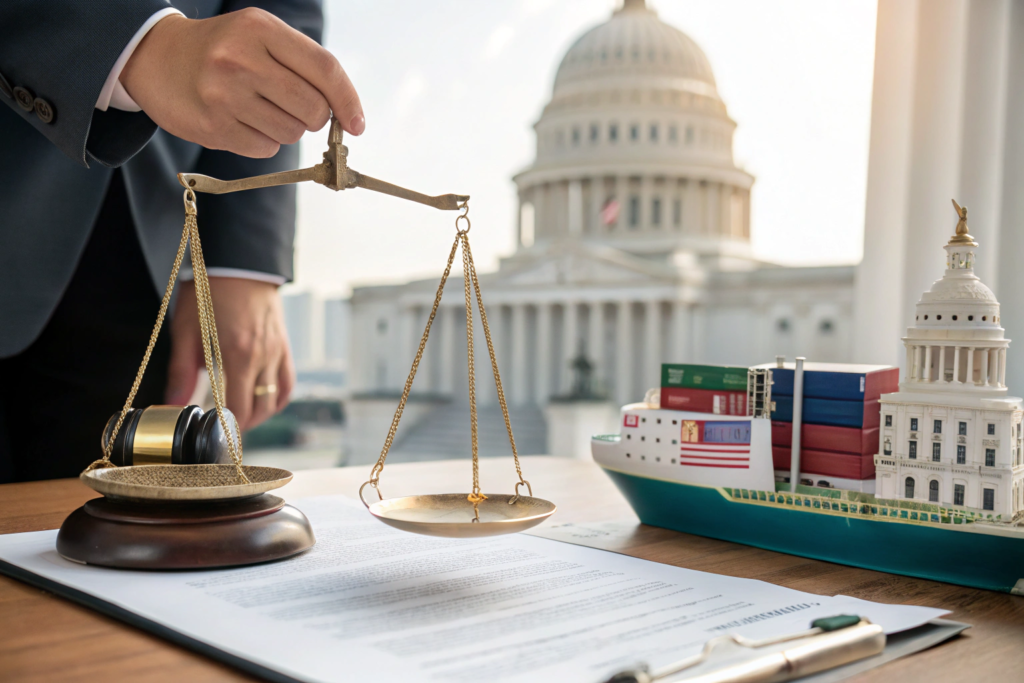
A customs bond is not a payment. It is a contract among three parties. The first party is the importer, called the principal. The second party is the surety company, which issues the bond. The third party is CBP, the beneficiary. The contract says that if the importer fails to pay duties, taxes, or penalties, the surety company will pay CBP and then seek reimbursement from the importer. It is similar to a bail bond in concept. The surety vouches for you, but you are ultimately responsible for the money.
A U.S. Customs import bond is a legally required tripartite financial guarantee among the importer, a CBP-authorized surety company, and U.S. Customs, ensuring that all duties, taxes, fees, and penalties assessed on an import entry are paid in full and on time, and it works as a precondition for CBP to release any formal entry of merchandise into U.S. commerce.
The bond requirement is set by federal regulation. For any shipment of goods valued at $2,500 or more, or for any shipment that requires formal entry for regulatory reasons, a bond must be on file before CBP will release the cargo. The bond amount must be sufficient to cover the potential duties, taxes, and fees. For a single entry bond, the amount is usually set at the total entered value of the goods plus duties and fees. For a continuous bond, the minimum amount is $50,000, or 10% of the total duties, taxes, and fees paid in the previous twelve months, whichever is greater. The bond is filed electronically with CBP through the Automated Commercial Environment, or ACE. When we file an entry on behalf of a client, the ACE system automatically checks that a valid, sufficient bond is on file. If the bond is missing, expired, or under the required amount, the entry is rejected immediately. The cargo stays on the terminal. The clock starts ticking on storage fees.
Who are the three parties in a customs bond agreement?
The three parties have distinct roles and legal obligations. Understanding who does what helps you understand the risk structure.
The principal is you, the importer of record. You are the party who is primarily liable for the duties and for compliance with customs laws. The bond is in your name. The surety is a CBP-authorized insurance company or bonding agency that issues the bond. The surety pre-qualifies you as a financial risk and guarantees your payment to CBP. The surety charges you a premium for this service, which is a small percentage of the bond amount, typically between 0.5% and 3% annually depending on your financial strength and import volume. The obligee is CBP. CBP is the beneficiary of the guarantee. If you default, CBP makes a demand on the surety. The surety pays CBP and then comes after you for reimbursement, plus legal fees and costs. The bond is not a liability shield for the importer. It is a payment mechanism for the government. You are always ultimately responsible for every dollar.
How does a continuous bond differ from a single-entry bond in practice?
A single-entry bond covers exactly one shipment. It is purchased for that specific entry and cannot be used again. A continuous bond covers all shipments by the importer at all U.S. ports for a one-year term, and it auto-renews.
The choice between them is a matter of volume and convenience. If you import once a year, a single-entry bond makes sense. You pay a premium for that one shipment, typically a minimum fee, and you are done. If you import more than twice a year, a continuous bond is almost always cheaper and simpler. With a continuous bond, you pay one annual premium and you never have to think about the bond again for routine entries. The bond is on file in ACE, and every entry you file is automatically covered. You do not need to arrange a new bond for each shipment. You do not risk a shipment arriving on a weekend when the bond desk is closed. The continuous bond also covers you for other CBP obligations, such as FTZ operator bonds or cartman bonds, if structured properly. For our regular clients, we almost always recommend a continuous bond.
When Is an Import Bond Legally Required for Your Shipment from China?
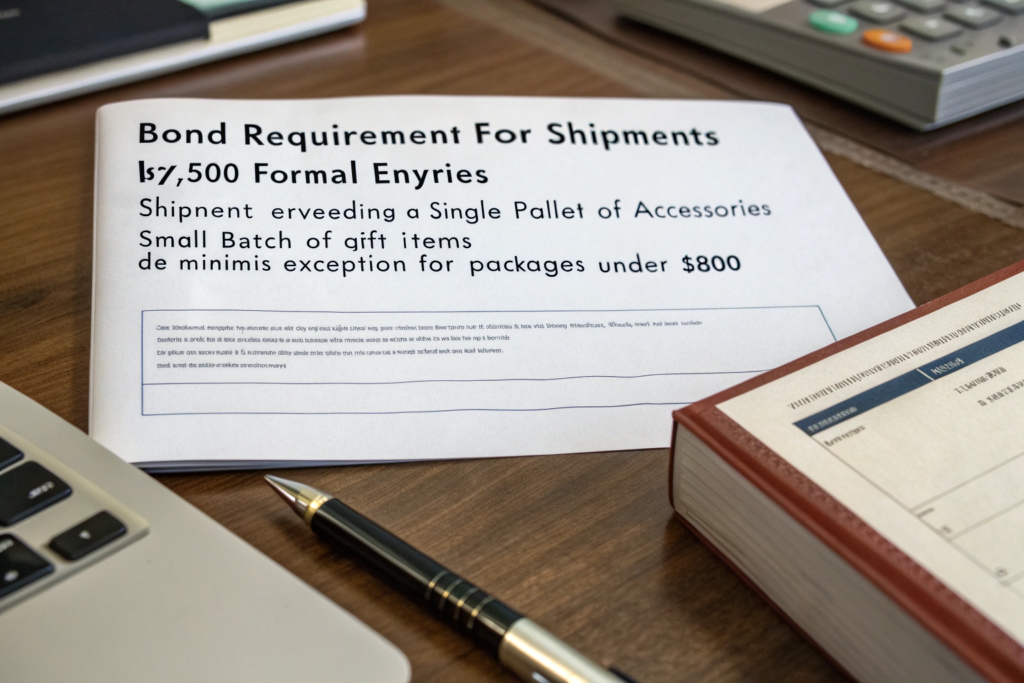
The bond requirement is not a matter of preference. It is a legal trigger. If your shipment meets certain criteria, you must have a bond. Period. There is no negotiation. There is no workaround. The most common trigger is value. If the total value of your goods is $2,500 or more, you must file a formal entry, and a bond is required. This covers virtually all commercial shipments from China. A single pallet of clothing, a few cartons of accessories, a small batch of gift items, these almost always exceed $2,500 in declared value. The de minimis exception that allows duty-free entry for packages under $800 is irrelevant here. That is a separate rule for informal entries. Once you are above $2,500, you are in formal entry territory, and the bond requirement kicks in.
An import bond is legally required for any shipment from China entering the U.S. with a total value of $2,500 or more, for any shipment regardless of value that is subject to Partner Government Agency regulations such as FDA, CPSC, or USDA, and for any goods that CBP determines require a formal entry due to their nature, such as textile articles or goods subject to antidumping duties.
The second trigger is regulatory. Even if your shipment is valued under $2,500, if the goods are subject to regulation by a Partner Government Agency, CBP may require a formal entry and a bond. A shipment of children’s clothing valued at $1,800 may require a bond because CPSC regulates children’s products and CBP wants the enforcement mechanism of the bond behind the entry. Food-contact items, cosmetics, medical devices, and goods subject to antidumping or countervailing duties are all categories where CBP routinely requires formal entry with a bond regardless of value. The third trigger is CBP discretion. If a CBP officer determines that a shipment requires formal entry for any reason, including to protect revenue or enforce trade laws, they can require a bond. This is rare but it happens, especially with textile shipments where transshipment or misclassification is a concern. At GeeseCargo, we review every new client’s shipment against these triggers before booking. We tell you upfront whether a bond is required and which type we recommend.
What happens if you try to import without a required bond?
The entry is rejected. Rejected means rejected. The CBP Automated Commercial Environment will not accept the entry transmission. The cargo cannot be released. It sits on the terminal, and the importer is notified that a bond is required.
This is what happened to David. His agent had not filed a bond. The entry was rejected. The clock started on port storage. Terminal storage fees, called demurrage, accrue daily. For a container, these fees can run $150 to $300 per day after the free time expires. For a pallet, less, but still significant. Meanwhile, the importer scrambles to obtain a bond. A single-entry bond can usually be issued same-day if the importer has the necessary information and funds ready. But that same day is already a day or two after the arrival, and storage fees have started. The stress, the cost, and the delay are all avoidable. We file the bond as part of the pre-shipment process. By the time the vessel leaves China, the bond is already active in ACE. The entry is filed and accepted upon arrival. There is never a moment when the cargo is un-bonded and stuck.
Are there any exceptions to the bond requirement for commercial goods?
The primary exception is the Section 321 de minimis entry, which applies to shipments valued at $800 or less per person per day. These informal entries do not require a bond. The importer is usually the individual consignee.
For commercial importers, this exception is narrow. If you are shipping 100 units of a product to a single distribution center and the total commercial invoice value is $5,000, you cannot split it into seven $714 shipments to avoid the bond. CBP calls this a "split shipment" or "disaggregation" scheme and it is illegal. They will consolidate the shipments for valuation purposes and assess penalties. The only legitimate use of the de minimis exception for commercial goods is true small-parcel e-commerce where each individual order is genuinely a separate transaction with a separate end consumer. If you are a business importing inventory, you need a bond. Do not try to game the system. The penalties are severe, and CBP’s data analytics are excellent at detecting patterns.
What Are the Different Types of Customs Bonds and Which One Fits Your Business?
Choosing the right bond type is a straightforward financial decision once you understand the options. There are two main categories of import bonds: single-entry bonds, also called single transaction bonds, and continuous bonds. There are also several specialized subcategories for specific activities like operating a Foreign Trade Zone, running a cartage operation, or acting as a customs broker. For most importers, the decision is between single-entry and continuous. I make this decision with clients based on a simple calculation of volume and cost.
The main types of customs bonds are the single-entry bond, which covers one shipment and costs a minimum fee per use, and the continuous bond, which covers all shipments for one year and is the most cost-effective and operationally efficient choice for importers who ship more than twice annually.
A single-entry bond premium is calculated on the bond amount, which is typically the entered value plus duties and fees. The premium is usually a flat minimum fee for smaller shipments, often starting around $50 to $75 per bond, scaling up for higher-value shipments. If you import twice a year, you pay this fee twice. If you import monthly, you pay it twelve times. The administrative hassle of arranging a new bond for each shipment is also a cost, in time and in risk of error. A continuous bond premium is an annual fee calculated on the bond amount, which is set at a minimum of $50,000 or 10% of the prior year’s total duties, taxes, and fees. The premium for a $50,000 continuous bond is typically between $250 and $500 per year. That is often less than the cost of five single-entry bonds. For an importer shipping even quarterly, the continuous bond is the mathematically correct choice. We help clients make this calculation based on their projected import volume.

How do you determine the required continuous bond amount?
CBP calculates the minimum continuous bond amount based on your import activity. The base minimum is $50,000. If 10% of your total duties, taxes, and fees paid in the previous calendar year exceeds $50,000, the bond must be at least that higher amount.
For a new importer with no history, the bond is usually set at $50,000. After the first year of activity, CBP reviews the data. If you paid $800,000 in total duties, your bond must be at least $80,000. If you paid $1,500,000 in duties, you need a $150,000 bond. We monitor our clients’ bond sufficiency throughout the year. If a client is approaching the threshold where their current bond will be insufficient, we alert them and arrange a bond increase. An insufficient bond is treated the same as no bond. The entry is rejected. Proactive bond management is another part of our customs clearance service that protects our clients from unnecessary port delays.
What are the specialized bond types for FTZ operators and other activities?
Beyond the basic import bond, CBP requires specific bonds for specific activities. A Foreign Trade Zone operator needs an FTZ bond. A customs broker needs a broker license bond. A bonded warehouse proprietor needs a warehouse bond.
Most of our importing clients do not need to worry about these specialized bonds. They operate under a standard continuous import bond. However, if a client decides to set up an FTZ operation for duty deferral, we advise them on the FTZ bond requirement and help them obtain it. The principles are the same. It is a financial guarantee to CBP for compliance with the specific regulations governing that activity. We coordinate with the surety company to ensure all required bonds are in place and active.
How Does GeeseCargo Help You Secure and Manage Your Import Bond?
Securing a bond is not difficult, but it requires specific documentation and a relationship with a CBP-authorized surety company. For a new importer who has never done this before, the process can be confusing. Surety companies require financial information to underwrite the bond. They want to know that if they have to pay CBP on your behalf, you have the assets to reimburse them. We streamline this process for our clients, walking them through the application, collecting the required documents, and submitting the bond application through our established surety channels.
GeeseCargo helps you secure and manage your import bond by assessing your bond type and amount requirements, facilitating the application with our network of CBP-authorized sureties, advising on the documentation needed for underwriting approval, filing the bond electronically in ACE, and providing ongoing monitoring to ensure your bond remains sufficient and current.
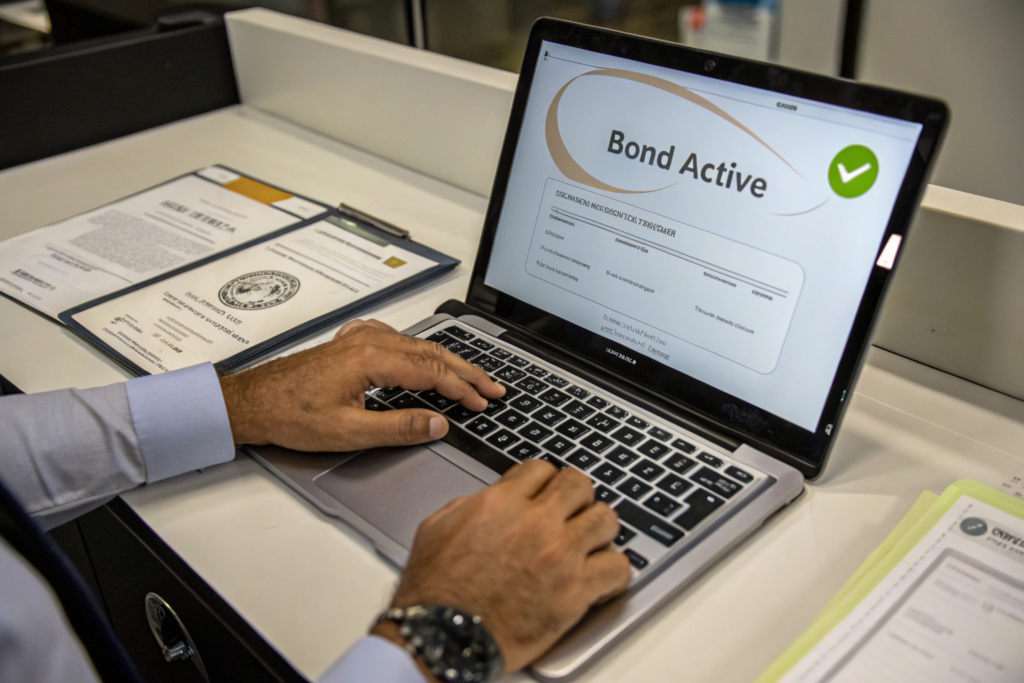
Our process starts with an assessment. We look at your projected import volume, your product categories, and your estimated duty exposure. We recommend either a single-entry or continuous bond and, if continuous, the appropriate bond amount. We then provide you with the surety company’s application form. For a continuous bond, the surety will typically request business financial statements, a credit report authorization, and basic corporate information. For a single-entry bond, the process is lighter, often requiring only a completed application and payment of the premium. We collect the completed application and documents from you, review them for completeness, and submit them to the surety. We act as the intermediary, chasing the surety for approval, answering any underwriting questions, and communicating the decision back to you. Once approved, the bond is issued. We receive the electronic bond rider and file it in ACE, linking it to your importer of record number. From that moment, your bond is active. You can start shipping.
What documents do you need to apply for a continuous customs bond?
The surety company needs to assess your financial stability and your identity as a legal entity. The exact document list varies by surety, but a core set is standard.
For a U.S. corporation or LLC, you typically need the articles of incorporation or organization, an IRS Employer Identification Number confirmation letter, and recent financial statements. For a newer business without a long financial history, the surety may request personal financial statements from the owners and personal credit reports. This is normal. The surety is underwriting the risk that your business will be able to pay its duty bills. If your business is new, they look to the owners’ personal financial strength as a proxy. For a foreign company acting as the importer of record, the requirements are more stringent and often include a larger collateral deposit or a higher premium. We advise our clients on how to present their financial information clearly and completely to maximize the chance of approval and minimize the premium rate. A well-organized, professionally presented application often results in a lower premium quote from the surety.
How does GeeseCargo monitor your bond status to prevent lapses?
A continuous bond has an annual term. It renews automatically if the surety agrees, but it can also be cancelled by the surety with notice. If a bond lapses or is cancelled, every open entry is suddenly un-bonded, and future entries are blocked until a new bond is in place.
We maintain a bond management calendar for our clients. We track the bond term, the renewal date, and the current bond amount. We alert the client well in advance of the renewal date to confirm the bond should be renewed and to update any financial information the surety may require. We also monitor the client’s import activity relative to the bond amount. If the client’s duty payments are increasing and the bond is approaching insufficiency, we flag it early and arrange an increase rider from the surety. An increase rider adjusts the bond amount upward without rewriting the entire bond. It is a simple, fast process if done proactively. If done reactively after an entry rejection, it is a crisis. We prevent the crisis by doing the monitoring.
Conclusion
David, the first-time importer whose pallet of gift items sat stuck at the Port of Oakland for six days, eventually got his bond, paid his storage fees, and received his goods. He also called me and moved his business to GeeseCargo. The next shipment, we had his continuous bond in place before the factory even finished production. The entry was filed, accepted, and released on the day of arrival. He called me again, but this time his voice was calm. He said, "I didn’t realize importing could feel this easy." That is the difference a properly managed bond makes.
An import bond is not a complex mystery. It is a financial prerequisite for importing legally and efficiently into the United States. If you import more than twice a year, get a continuous bond. If you import high-value goods or large volumes, make sure your bond amount is sufficient. If you are not sure, ask us. We will assess your situation and give you a straight answer with no upselling and no jargon. At GeeseCargo, we handle the bond process from application to filing to ongoing monitoring as part of our complete customs clearance service. You focus on your products and your customers. We make sure the financial guarantee to the government is always in place so your cargo never sits waiting for a bond.
If you are planning your first import from China, or if you are a regular importer who has never really understood your bond arrangement, reach out to me. I will personally review your import activity and tell you exactly what bond you need and why. We can have a continuous bond in place within a few business days. Let us handle this fundamental piece of your supply chain so you can operate with confidence and never fear the bond-related port hold that cost David his first shipment’s profit.