Accelerating customs clearance for perishable goods represents one of the most critical challenges in international food, floral, and pharmaceutical logistics. As a freight forwarder specializing in temperature-controlled shipments, I’ve helped numerous clients transform their perishable supply chains from constant race-against-time emergencies to streamlined, predictable operations. The difference between rapid clearance and extended delays often determines whether products reach consumers at peak quality or become costly waste.
You can speed up customs clearance for perishable goods by implementing FDA Prior Notice submissions, ensuring perfect documentation accuracy, utilizing specialized perishable brokers, leveraging FAST (Free and Secure Trade) programs, and establishing pre-clearance arrangements with customs authorities. Companies mastering these techniques typically reduce customs processing from days to hours while maintaining compliance and product integrity.
Perishable goods clearance requires a proactive, multi-layered approach that begins long before goods arrive at port. Let’s examine the specific strategies that deliver measurable time savings while protecting your valuable temperature-sensitive cargo.
What Pre-Arrival Documentation Strategies Save Critical Time?
Advance preparation is the single most effective strategy for accelerating perishable goods clearance.

How Can FDA Prior Notice Submission Accelerate Clearance?
Mandatory 2-hour to 5-day advance notice depending on transport mode. For FDA-regulated perishables (most food, seafood, produce, dairy), electronic Prior Notice must be submitted and confirmed before arrival: at least 2 hours for truck/rail, 4 hours for air, and 8 hours for ocean shipments.
FDA PN confirmation system integration provides immediate validation. Integrate with FDA’s Prior Notice System Interface (PNSI) to receive immediate confirmation of submission acceptance, preventing arrival with unconfirmed or rejected notices that trigger automatic holds.
What Documentation Perfection Strategies Prevent Delays?
Commercial invoice precision is non-negotiable for perishables. Ensure exact product descriptions, scientific names for seafood and produce, detailed origin information, and accurate quantity declarations that match physical shipments to prevent examination requests.
Temperature documentation supports specialized handling requests. Include temperature logs, packing protocols, and cold chain validation data with your submission to demonstrate proper handling and justify priority processing.
What Specialized Brokerage Services Expedite Perishable Clearance?
Using brokers with specific perishable expertise dramatically reduces clearance times.

How Do Perishable-Specialized Brokers Differ?
Dedicated agricultural specialists understand nuanced requirements. Brokers focusing on perishables maintain specific knowledge of FDA, USDA, and other agency requirements for different commodity types, preventing errors that standard brokers might make.
24/7 monitoring and response capabilities match perishable realities. Unlike standard brokers with business-hour operations, perishable specialists provide continuous monitoring and can respond immediately when shipments arrive outside normal hours.
What Technology Capabilities Should You Seek?
Real-time tracking integration with customs systems. Advanced brokers use systems that provide real-time visibility into customs status, examination queues, and hold reasons, enabling immediate intervention when issues arise.
Automated document processing reduces human error. Look for brokers using AI-assisted document verification that catches errors before submission, particularly valuable for complex perishable shipments with multiple product types and origins.
What Regulatory Program Participation Accelerates Processing?
Government programs specifically designed for low-risk, compliant importers provide expedited processing lanes.

How Does C-TPAT Participation Benefit Perishable Importers?
Reduced examination rates for validated members. Customs Trade Partnership Against Terrorism (C-TPAT) members typically experience 4-6 times fewer examinations than non-members, crucial for perishables where examinations can compromise temperature integrity.
Dedicated FAST lanes at land borders. For truck shipments from Canada and Mexico, Free and Secure Trade (FAST) lanes provide dedicated processing that bypasses regular queues, particularly valuable for highly perishable items with limited shelf life.
What About FDA’s Voluntary Qualified Importer Program?
Expedited review for food safety shipments under VQIP. FDA’s Voluntary Qualified Importer Program provides priority review for participating importers with demonstrated strong food safety systems, significantly reducing review times for eligible perishable food shipments.
Predictable processing timelines through pre-approval. VQIP participants receive more predictable processing times, enabling better planning for labor, transportation, and distribution upon release.
What Operational Strategies Minimize Port Delays?
Tactical decisions at the port level can significantly impact perishable clearance speed.
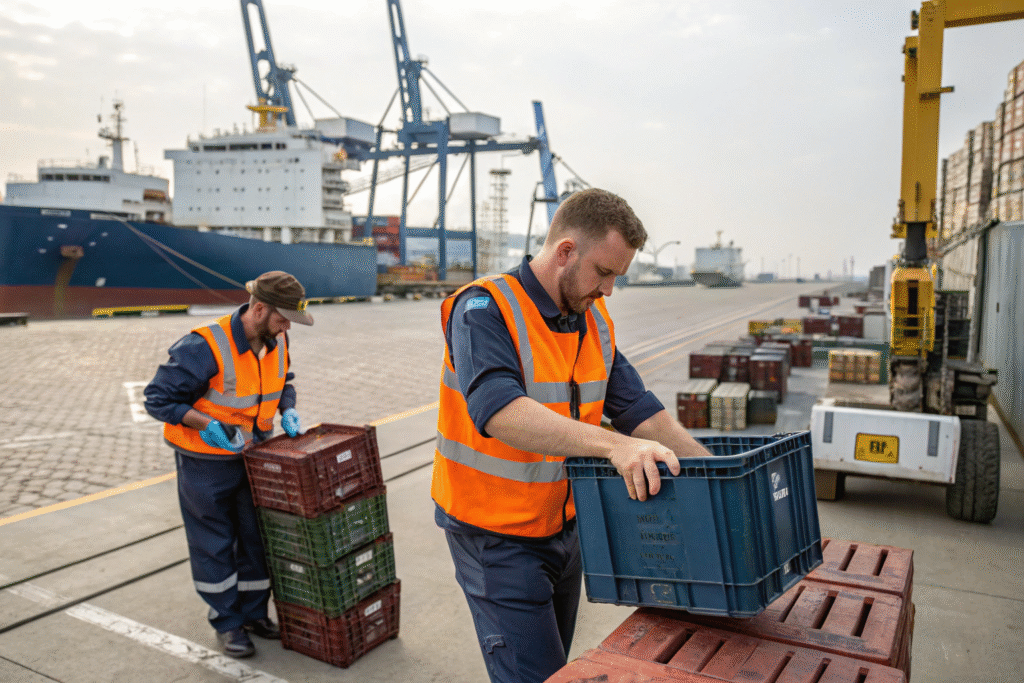
How Does Port Selection Impact Clearance Speed?
Specialized perishable facilities at certain ports. Ports like Miami (for Latin American perishables), Los Angeles (for Asian seafood and produce), and JFK (for European specialty items) have dedicated perishable handling facilities and inspectors with specific commodity expertise.
Off-peak arrival scheduling reduces congestion delays. Schedule arrivals during less congested periods (typically mid-week, avoiding Monday mornings and Friday afternoons) when inspection resources are more readily available.
What Inspection Coordination Strategies Work Best?
Pre-arranged inspection appointments prevent queuing delays. Work with brokers to schedule USDA or FDA inspections in advance when possible, rather than arriving and joining general inspection queues.
Consolidated inspections for multi-product shipments. When shipping multiple perishable items, consolidate them for single comprehensive inspection rather than separate examinations that multiply delays.
What Technology Solutions Provide Real-Time Advantage?
Modern technology creates visibility and control that directly translates to faster clearance.

How Can Advanced Tracking Systems Accelerate Clearance?
Real-time temperature and location monitoring provides proactive intervention capability. Systems that alert you to temperature excursions or unexpected delays enable early communication with customs about potential quality issues before they become clearance problems.
Automated document generation ensures submission readiness. Platforms that automatically generate customs documents from your purchase orders and commercial data eliminate last-minute preparation delays.
What About Data Analytics for Predictive Clearance?
Historical clearance pattern analysis predicts likely processing times. Advanced systems analyze your historical clearance data by product type, origin, port, and season to predict likely processing times and identify optimization opportunities.
Risk assessment algorithms flag potential issues early. AI systems can analyze your shipment data against regulatory databases to identify potential compliance issues before submission, allowing correction before they cause delays.
Conclusion
Speeding up customs clearance for perishable goods requires a comprehensive strategy combining perfect pre-arrival documentation, specialized brokerage services, trusted trader program participation, strategic port operations, and advanced technology integration. The most successful importers treat perishable clearance as a specialized discipline requiring dedicated resources and continuous optimization rather than a standard logistics function.
At GeeseCargo, we’ve helped clients implement perishable clearance strategies that typically reduce customs processing time by 60-80% while maintaining 99%+ compliance rates. Our experience shows that companies investing in specialized perishable clearance capabilities typically achieve 20-40% longer shelf life for their products and significantly reduced spoilage rates compared to those using generic clearance approaches. Remember that with perishable goods, time saved at customs directly translates to extended shelf life, reduced waste, and improved profitability—making clearance optimization not just an operational improvement but a significant competitive advantage.