
When one of our e-commerce clients automated their shipping process, they reduced order processing time from 3 hours daily to just 20 minutes while cutting shipping errors by 92%. As founder of GeeseCargo with extensive experience in logistics automation, I’ve witnessed how strategic automation transforms shipping from a time-consuming operational burden to a competitive advantage. The question isn’t whether you can automate—it’s where to start and how much time you’ll save.
Yes, most businesses can automate 60-85% of their shipping processes, typically saving 5-20 hours per week while reducing errors by 70-90%. Key automation opportunities include order import, label generation, customs documentation, carrier selection, and tracking communications. The average ROI for shipping automation is 3-6 months, with ongoing time savings compounding as volume grows.
Shipping automation isn’t about replacing human oversight but eliminating repetitive tasks that consume disproportionate time while introducing error risk. The most successful implementations balance automation with strategic human intervention where judgment and relationship management matter most.
What Shipping Processes Can You Realistically Automate?
Understanding which aspects of shipping lend themselves to automation helps prioritize implementation for maximum time savings.

Which Repetitive Tasks Are Prime Automation Candidates?
Order import and processing automation saves the most time for e-commerce businesses. Connecting your shopping cart, marketplace, or ERP system directly to your shipping platform eliminates manual order entry, typically saving 2-3 minutes per order.
Shipping label and documentation generation happens instantly with automation. Instead of manually entering addresses, package dimensions, and service selection, automated systems pull this information and generate compliant labels and documents in seconds.
Carrier and service selection can be rules-based automated decisions. By establishing business rules (like "express for orders over $200," "ground for under 5 lbs"), the system automatically selects optimal shipping methods without manual intervention.
How Much Time Can Documentation Automation Save?
Commercial invoice and customs documentation automation saves 5-15 minutes per international shipment. Automated systems pull product information, harmonized codes, and values from your database to generate accurate customs documents instantly.
Shipping manifest generation and submission happens automatically with integrated systems. Instead of manually compiling daily manifests, automated systems create and submit required manifests to carriers at predefined intervals.
Certificate of origin and other trade documents can be templated and auto-populated. For businesses with repetitive shipments, document templates with auto-populated fields save significant research and preparation time.
What Technology Solutions Enable Shipping Automation?
The right technology stack transforms manual shipping processes into automated workflows with minimal human intervention.

What Types of Shipping Software Provide Automation?
Shipping management platforms like ShipStation, Shippo, and Easyship offer comprehensive automation. These platforms connect multiple sales channels to multiple carriers, with rules-based automation for label generation, tracking, and documentation.
Enterprise resource planning (ERP) systems with shipping modules automate business processes. Systems like NetSuite, SAP, and Oracle include shipping automation that integrates with inventory, accounting, and customer management.
Custom-built solutions using carrier APIs provide tailored automation. For unique business needs, developing custom integrations using FedEx, UPS, and USPS APIs creates perfectly tailored automation.
How Do Integration Capabilities Affect Automation Potential?
API connections enable real-time data exchange between systems. Modern shipping platforms offer robust APIs that connect to e-commerce platforms, marketplaces, and enterprise systems for seamless automation.
Webhook support triggers actions based on events in other systems. When an order is placed, webhooks can automatically trigger shipping process initiation without polling or manual intervention.
EDI (Electronic Data Interchange) facilitates automation with enterprise partners. For businesses shipping to large retailers or distributors, EDI enables automated advanced shipping notices and documentation.
How Can You Implement Automation Gradually?
A phased automation approach minimizes disruption while delivering quick wins that build momentum for broader implementation.
Where Should You Start with Shipping Automation?
Begin with the most time-consuming repetitive tasks. For most businesses, this means automating order import from their primary sales channel and basic label generation.
Address validation and correction automation provides immediate time savings and error reduction. Implementing real-time address validation during order entry prevents shipping delays and failed deliveries.
Carrier rate shopping automation optimizes costs from day one. Systems that automatically compare carrier rates for each shipment ensure optimal pricing without manual research.
How Can You Expand Automation Over Time?
Add rules-based shipping method selection after basic automation is stable. Once label generation is automated, implement business rules that automatically select optimal shipping methods based on order characteristics.
Integrate inventory management to automate stock allocation and updates. Connecting shipping automation to inventory systems ensures accurate stock levels and prevents overselling.
Implement automated tracking and customer communications. Once shipments are processing automatically, add systems that automatically send tracking information and delivery updates to customers.
What Are the Real Time Savings from Shipping Automation?
Quantifying time savings helps justify automation investments and set realistic expectations.
How Much Time Does Order Processing Automation Save?
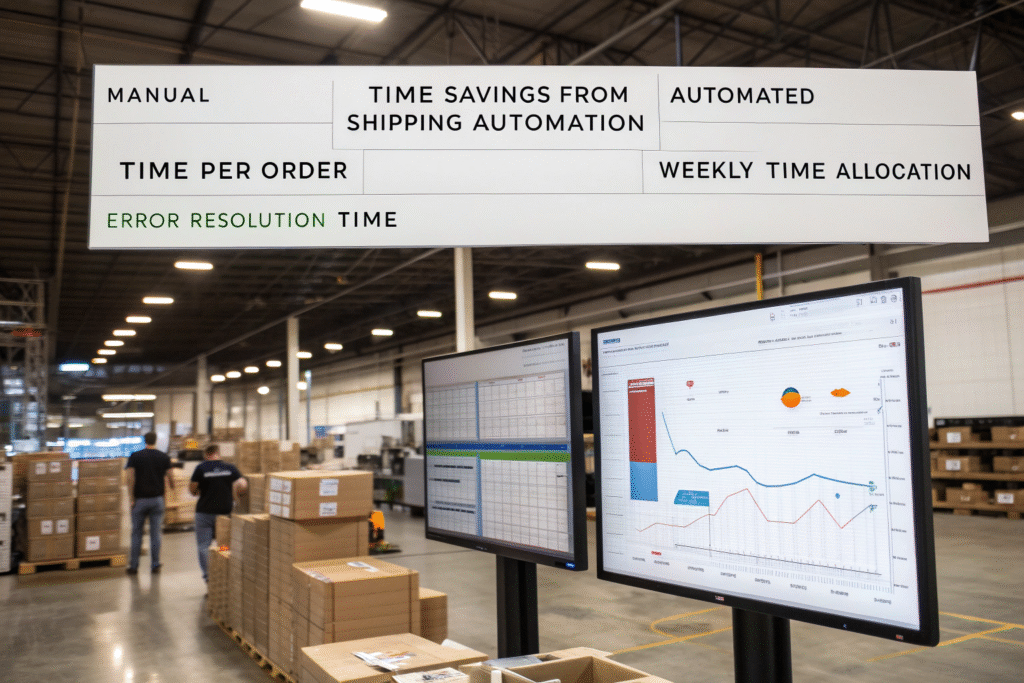
Manual order processing typically takes 2-5 minutes per order depending on complexity. This includes order review, address verification, carrier selection, and label generation.
Automated order processing reduces this to 15-30 seconds per order. The system handles data transfer, address validation, and document generation automatically, requiring only final review or exception handling.
Volume magnification means time savings compound significantly. At 50 orders daily, automation saves approximately 4-6 hours daily—20-30 hours weekly—just in order processing time.
What Time Savings Come from Documentation Automation?
International shipping documentation takes 8-20 minutes per shipment manually. Researching harmonized codes, calculating values, and preparing customs forms consumes significant time.
Automated documentation generation reduces this to 1-2 minutes. Systems with product databases auto-populate customs forms, commercial invoices, and certificates of origin using predefined product information.
Error reduction saves additional correction time. Automated systems significantly reduce documentation errors that typically require 15-45 minutes to identify and correct.
What Human Oversight Remains Essential After Automation?
Strategic automation eliminates repetitive tasks while preserving human judgment where it adds value.

What Decisions Still Require Human Judgment?
Exception handling for address corrections and special instructions. While automation handles standard scenarios, unusual addresses, special delivery instructions, and exception cases benefit from human review.
Strategic carrier relationship management maintains service quality. While automation selects carriers based on rules, human management of carrier relationships ensures service quality and negotiates rates.
Complex international shipments may require specialized knowledge. Unusual destinations, high-value shipments, or restricted commodities often benefit from experienced human oversight despite automation of routine elements.
How Can Automation Enhance Rather Than Replace Human Effectiveness?
Automation frees staff for customer service and problem resolution. By eliminating repetitive tasks, automation enables staff to focus on customer communication, issue resolution, and service improvement.
Data from automated systems informs better decision-making. Automation generates valuable data about shipping performance, costs, and carrier reliability that humans can use for strategic improvements.
Human oversight focuses on continuous improvement of automated systems. Instead of performing repetitive tasks, staff can monitor automation performance and refine rules for better outcomes.
What Are Common Automation Mistakes and How to Avoid Them?
Understanding potential pitfalls helps implement automation successfully while avoiding disruptive errors.

What Implementation Errors Undermine Automation Benefits?
Over-automation without human oversight points creates fragile systems. Automating processes that require judgment or exception handling leads to errors that require more time to fix than the automation saves.
Inadequate testing before full implementation causes operational disruptions. Implementing automation without thorough testing across different order types, destinations, and scenarios creates errors that impact customers.
Poor change management and staff training creates resistance and errors. Failing to properly train staff on new processes and their changed responsibilities undermines automation benefits.
How Can You Ensure Smooth Automation Transitions?
Start with pilot programs before full implementation. Automating a subset of orders or specific product lines first allows refinement before scaling to entire operations.
Maintain manual parallel processing during transition. Running automated and manual processes simultaneously during initial implementation provides fallback while verifying automation accuracy.
Implement gradual automation with clear metrics. Rather than automating everything at once, phase implementation while tracking time savings, error rates, and customer satisfaction.
Conclusion
Shipping automation represents one of the highest-return investments most businesses can make, typically saving significant time while reducing errors and improving customer satisfaction. The most successful implementations balance technological capability with human oversight, creating systems that handle routine tasks efficiently while preserving judgment where it matters most.
At GeeseCargo, we’ve helped clients automate shipping processes that saved an average of 18 hours weekly while reducing shipping errors by 76%. The most successful approaches begin with thorough process analysis to identify the highest-ROI automation opportunities, then implement solutions progressively while maintaining quality control.
Begin your automation journey by documenting your current shipping processes and time allocation, then prioritize automation opportunities based on time consumption and error frequency. Remember that effective automation isn’t about eliminating human involvement—it’s about empowering your team to focus on value-added activities while systems handle repetitive tasks.